Key takeaways
- Extreme Programming (XP) is a software development framework that intensifies Agile practices, including constant testing, frequent integration, and continuous refactoring. It prioritizes collaboration and continuous improvement.
-
The success of Extreme Programming is dependent on adherence to its five key values: simplicity, communication, feedback, respect, and courage.
-
XP offers structured rules for planning, designing, coding, and testing to ensure a healthy product release as well as improved productivity for development teams.
In the 1990s, the rise of the internet necessitated a shift in software development. If a company’s success depended on the speed at which it could grow and bring products to market, businesses needed to reduce the software development life cycle dramatically.
It was in this environment that Kent Beck created Extreme Programming (commonly referred to as XP) while working on a project for Chrysler in 1996.
In this article, we’ll discuss the XP methodology and its relationship to Agile software development.
What is Extreme Programming?
Extreme Programming is a software development framework focused on creating high-quality software quickly, directly tailored to customer requirements. The XP methodology supports frequent releases of usable software in short development cycles.
Developing, testing, and releasing software in small, frequent increments creates checkpoints in the development process. These checkpoints make it easier for developers to evaluate their work and incorporate new customer requirements for subsequent releases.
Teams that need to release software and respond to ever-changing customer needs quickly should take a look at XP to see if it’s a good fit for their software development projects.
Extreme Programming vs Agile
XP is one of the many methods under the umbrella of Agile principles that is used to develop software in short, incremental cycles. All of the Agile frameworks include practices and values that aim to improve software quality, release products quickly to market, and promote flexibility and responsiveness to customer demands.
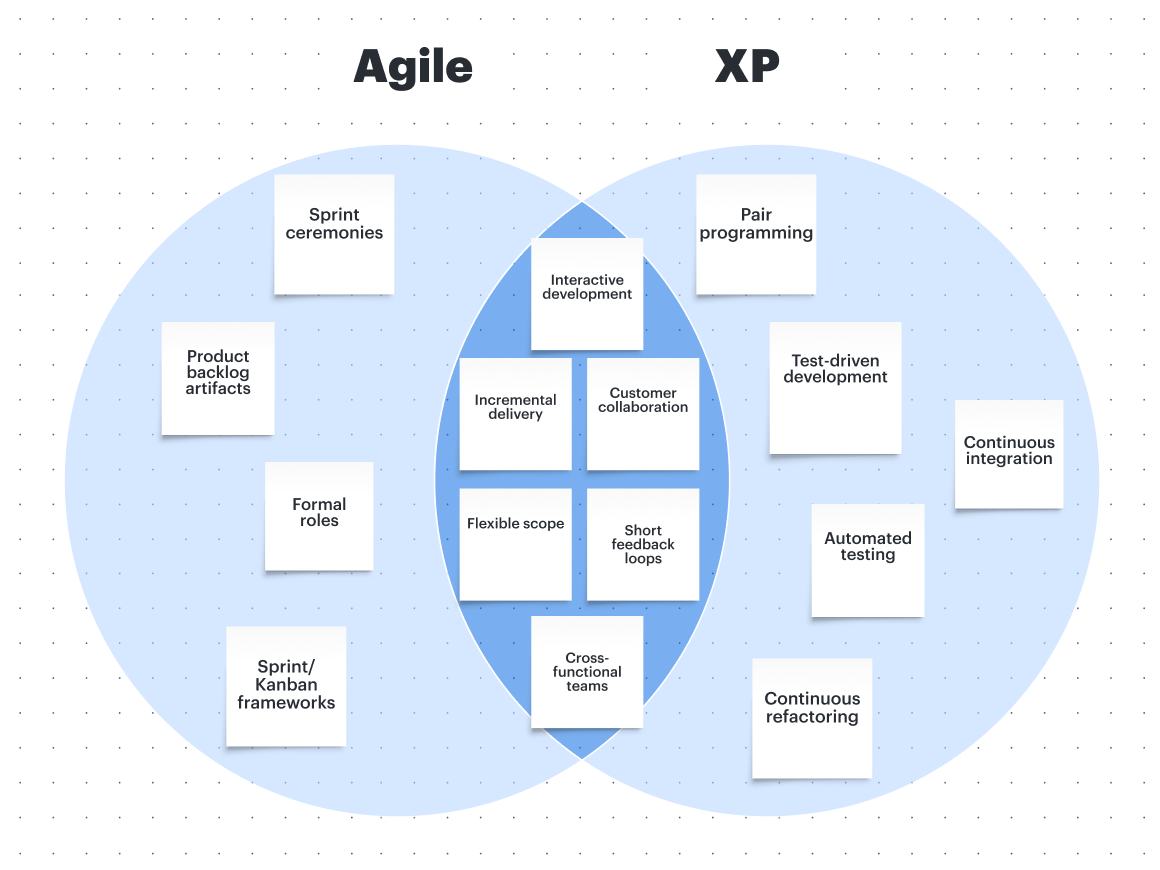
But XP takes these practices and ramps them up to “extreme” levels. Here are some of the ways that Extreme Programming differs from other Agile frameworks:
-
Code reviews are performed at every step, ensuring code is clean and effective.
-
Continuous regression testing ensures features and processes work correctly after changes are made to the code.
-
Everybody does code refactoring every day to improve software design.
-
Integration testing is performed multiple times a day to ensure that software modules work together effectively as a group.
-
Most testing is automated, allowing XP projects to be run and completed at top speed.
-
Multiple short iterations make delivery more effective and provide opportunities to incorporate new requirements.
-
There aren’t any intermediaries between customers and the team.
When to use Extreme Programming
Extreme Programming in Agile is designed to enhance productivity by making teams more adaptable, incorporating customer feedback, identifying and eliminating errors early, and promoting collaborative coding.
Extreme Programming methodology might work well for teams that:
-
Expect frequent functionality changes to systems and applications.
-
Include only two to twelve software programmers.
-
Want to reduce project risk.
-
Can work directly with customers without an intermediary.
-
Have customers who constantly change requirements or who don’t really know what they want yet.
-
Can create automated unit and functional tests.
Values of Extreme Programming
XP Agile methodology is more than just a series of steps to manage projects—it follows a set of values that will help your team work faster and collaborate more effectively.
Simplicity
Teams accomplish what has been asked for and nothing more. XP breaks down each step of a significant process into smaller, achievable goals for team members.
Streamlined communication
Teams work together on every part of the project, from gathering requirements to implementing code and participating in daily standup meetings to keep all team members updated. Any concerns or problems are addressed immediately.
Consistent, constructive feedback
In XP, teams adapt their process to the project and customer needs, not the other way around. The team should demonstrate their software early and often so they can gather feedback from the customer and make the necessary changes.
Respect
Extreme Programming encourages an “all for one and one for all” mentality. Each person on the team, regardless of hierarchy, is respected for their contributions. The team respects customers' opinions, and vice versa.
Courage
Team members adapt to changes as they arise and take responsibility for their work. They tell the truth about their progress—there are no excuses for failure to make people feel better. They value teamwork over ego and are always looking out for what’s best for the team.
Rules of Extreme Programming
We all need rules to function in society, and the same is true for Extreme Programming methodology. The following rules remind the team about what and how things need to be done.
Planning
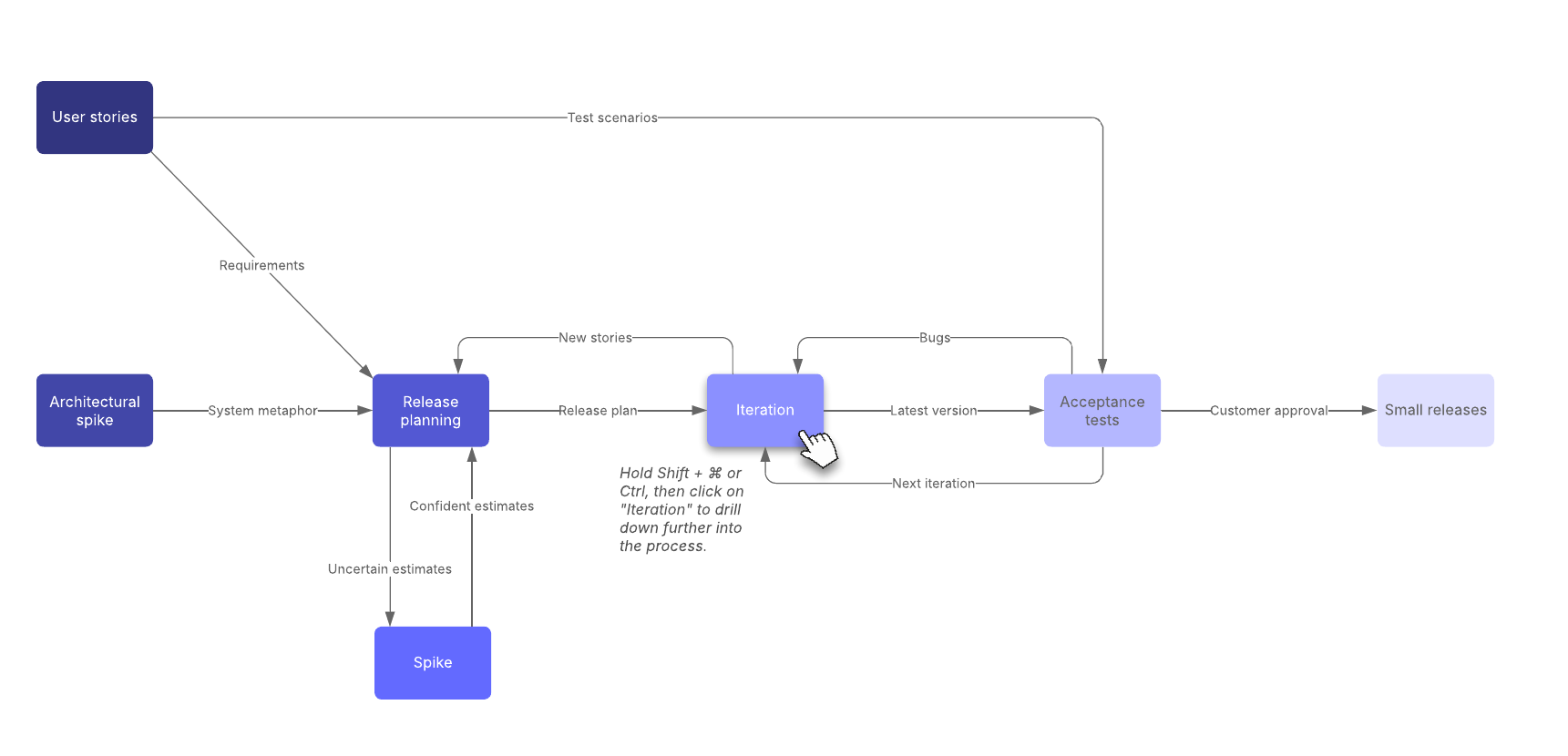
User stories are written to define the functionality the customer requires, the anticipated business value, and the priority of the feature. These stories provide just enough detail to help teams estimate the time required to implement the features. This information helps the team create a realistic project timeline with iterations.
Managing
Successful management of XP projects requires:
-
Creating an open workspace for your team
-
Setting a sustainable pace (i.e., determining the right length for iterations)
-
Scheduling a daily standup meeting
-
Measuring project velocity (the amount of work getting done on your project)
-
Reassigning work to avoid bottlenecks or knowledge loss
-
Changing the rules if XP isn’t working perfectly for the team
Designing
Extreme Programming is based on the idea that you start with the simplest design that can possibly work. Then, only add complexity when it’s required. Refactor the code often to keep the design simple and the code clean.
Coding
Now your team can start coding the project. To be successful, the team should:
-
Choose a system metaphor (standardized naming scheme).
-
Practice pair programming, where team members work in pairs at a single computer and only one pair integrates code at a time.
-
Integrate and commit code into the repository every few hours.
The customer should be available throughout this entire process to answer questions and establish requirements.
Testing
The team performs unit tests on all code and creates new tests when defects are found. The team also conducts frequent acceptance tests to ensure that all bugs are fixed before the software is released.
Lucid for Extreme Programming in Agile
Implementing Extreme Programming? Lucid can help Agile and XP teams move fast without losing clarity.
Effortlessly create flowcharts to capture and share desired functionality, providing teams with a shared understanding from the start. From there, teams can strategically plan releases, break work into short iterations, and visualize schedules with timelines or Gantt charts, helping everyone stay aligned while moving quickly through XP development cycles.
Lucid can also scale XP practices by helping teams conduct capacity planning, gain qualitative insights on team health, and future-proof their plans.
If collaboration and continuous development are priorities for your team, XP might be worth a try. Because this highly adaptable model requires ongoing feedback from customers, anticipates errors along the way, and requires developers to work together, Extreme Programming ensures a healthy product release, as well as improved productivity for development teams.

The comprehensive guide to Agile frameworks
Read our guide on different Agile frameworks (including Extreme Programming) to determine which approach is best for your team.
Read now