Key takeaways
Agile is a collaborative mindset and approach where teams adapt to change, deliver continuous customer value, and build in small increments.
Organizations across technical and non-technical departments use Agile practices to foster resiliency, iterate quickly, and stay competitive in the modern workforce.
Created in 2001, the Agile Manifesto outlines four core values and 12 principles that prioritize people, working solutions, and adaptability.
Implementing Agile offers major benefits, including increased employee and customer satisfaction, improved risk management, higher product quality, and predictable scheduling.
Overcoming common misconceptions about Agile helps teams avoid sidetracks, maintain appropriate structure, and maximize long-term organizational value.
Chances are, you've heard about Agile—it's been a big buzzword within tech companies and has been widely adopted by businesses in general. The 17th State of Agile Report reveals that 71% of companies already use Agile.
No doubt you know the definition of agility in the context of moving fast and nimble, but what does it mean to be Agile in the context of business?
Agile is all about adapting to change and providing customer value through incremental work. Teams that practice Agile constantly incorporate customer feedback and focus on continuous improvement to stay ready for whatever change may bring.
In this guide, you'll learn all about Agile, including the definition of Agile, its origins, and the modern-day benefits of implementing Agile in your organization.
This video sets up the definition of Agile.
What is Agile methodology?
For starters, Agile is not a methodology. Agile is both a movement and a mindset that has fundamentally revolutionized how many people work together. Through collaboration and continuous improvement, teams respond to change, learn from feedback, and make progress step by step. Agile has enabled teams to discover better ways of working, transforming how they create, adapt, and deliver value to customers. This mindset marks a dramatic shift away from top-down control.
Teams now work together across different skills and specialties, making their own informed decisions. When people are trusted to manage their work, own their outcomes, and solve problems together, something remarkable happens. People feel empowered to be transparent, brave enough to experiment, and excited to grow—all while delivering better results. This incremental approach allows teams to better react to changes, such as a shift in customer needs or a technological improvement.
Agile also aims to bring more humanity into the workplace. Agile teams:
Operate at a more sustainable pace, preventing overwork and burnout. Teams are also transparent about their goals and ensure each team member understands how their individual role supports those goals.
Focus on high-value collaboration where everyone is given an equal chance to contribute.
Encourage risk-taking and autonomy, as team members are empowered to own their work and bring diverse perspectives to the table.
Are adaptable and open to feedback, whether from customers or each other. The values of transparency and listening are especially embodied by team leaders.
In practice, this mindset often shows up as a preference for building in small increments, validating assumptions early, and using real user input to steer what gets built next.
How Agile applies to the modern-day workforce
In many ways, it's more important than ever for companies to implement Agile. While Agile originated in the software industry, every company can incorporate Agile practices and benefit from them. The COVID-19 pandemic showed how important it is for companies to value resiliency and have change management practices in place—and cultivating an Agile mindset helps your teams adapt well to change.
This new generation of work, where nearly every company is digital, has called for a new way of working. Since technology is constantly changing and improving, iteration has become an essential aspect of staying competitive. Today, companies need to constantly release new updates to their products, improve their services, and incorporate customer feedback.
That's where Agile comes in with its key principles of adaptability, customer collaboration, and responsiveness to change. Agile teams deliver work incrementally to ensure that they understand what customers need and work on the items that will provide the most value.
Agile isn't just for software or other technical teams. It can be used by anyone. If you work in non-tech teams such as marketing, HR, customer service, or sales, you can adopt an Agile mindset to focus on continuous improvement and high-value communication.
This video describes the origins, values, and principles of the Agile Manifesto.
The history of Agile
The fundamentals of the Agile mindset—adaptability, continuous improvement, and innovation—emerged in the 1990s. The development of technology changed our world so rapidly that, by the late 20th century, people realized the way we worked needed to change with it. Practices that emerged from this period of time included close collaboration between stakeholders and development teams, self-organizing teams, and frequent delivery of business value.
These ideas were solidified in Snowbird, Utah, in 2001 when 17 software practitioners gathered, officially coined the term "Agile software development," and formed what is known as the Agile Manifesto.
What is the Agile Manifesto?
The Manifesto for Agile Software Development—or the Agile Manifesto—is a declaration written by those 17 software practitioners that became the foundation for the Agile mindset. When this group gathered in Utah, they agreed on four value statements that define Agile. Afterward, they expanded on their ideas to establish the 12 principles behind the Agile Manifesto.
Remember, the Agile Manifesto is meant to guide decision-making and planning, but it isn't a rigid methodology.
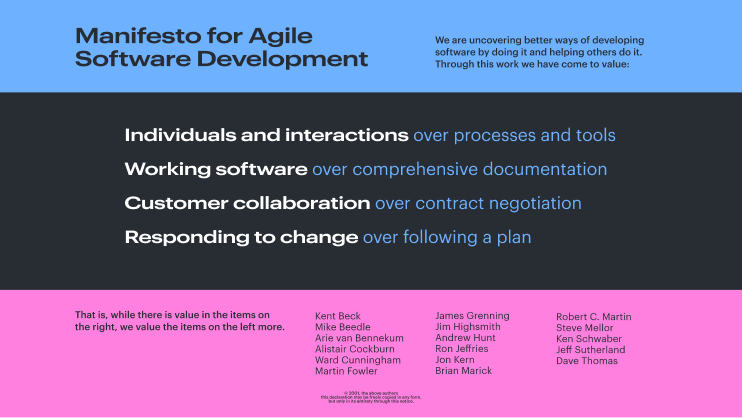
4 Agile Manifesto values
These are the four values in the Agile Manifesto:
Individuals and interactions over processes and tools
Working software over comprehensive documentation
Customer collaboration over contract negotiation
Responding to change over following a plan
Agile practitioners acknowledge that all parts of the statements hold value, with a bias to those on the left. For example, Agile teams will still use tools to help them complete their work, but they will prioritize tools that enhance their collaboration with team members.
12 Agile Manifesto principles
The 12 principles behind the Agile Manifesto guide teams in implementing Agile practices.
Our highest priority is to satisfy the customer through the early and continuous delivery of valuable software.
Welcome changing requirements, even late in development. Agile processes harness change for the customer's competitive advantage.
Deliver working software frequently, from a couple of weeks to a couple of months, with a preference to the shorter timescale.
Business people and developers must work together daily throughout the project.
Build projects around motivated individuals. Give them the environment and support they need, and trust them to get the job done.
The most efficient and effective method of conveying information to and within a development team is face-to-face conversation.
Working software is the primary measure of progress.
Agile processes promote sustainable development. The sponsors, developers, and users should be able to maintain a constant pace indefinitely.
Continuous attention to technical excellence and good design enhances agility.
Simplicity—the art of maximizing the amount of work not done—is essential.
The best architectures, requirements, and designs emerge from self-organizing teams.
At regular intervals, the team reflects on how to become more effective, then tunes and adjusts its behavior accordingly.
Throughout our guides, you'll discover different ways to apply these principles and live the Agile Manifesto values in your workplace.
Agile methodology steps
While Agile itself is a mindset rather than a methodology, the frameworks teams use to apply this mindset share a common workflow. Instead of following one long, linear plan, Agile teams work in short, repeating cycles, often called sprints or iterations. Each cycle delivers something of value and uses feedback to shape the next one.
Here are the basic steps of the Agile lifecycle:
Set the vision. Your team and stakeholders agree on the problem you’re solving, who you’re solving it for, and what success looks like. This step sets a clear direction without locking in every detail upfront.
Build and prioritize the backlog. Break the work into a prioritized list of smaller items, often written as user stories that describe what the customer needs. The most valuable items go to the top, and the backlog keeps changing as you learn more.
Plan the iteration. Your team chooses a manageable set of high-priority items to complete in a short, time-boxed cycle, usually one to four weeks. Teams that use a flow-based approach like Kanban skip fixed cycles and pull in new work as capacity opens up.
Build and test incrementally. Your team works through the selected items together and meets in brief daily check-ins to share progress and remove blockers. Testing happens throughout the cycle, not at the end, so issues surface early.
Review and release. Show the completed work to stakeholders and gather their feedback. Work that meets your team’s definition of done can go to customers, which keeps value flowing in small increments.
Reflect and adjust. In a retrospective, your team discusses what worked, what didn’t, and what to try next time. You then reprioritize the backlog based on what you learned, and the cycle starts again.
Because steps three through six repeat, your team gets regular chances to change course, whether that’s a shift in customer needs, new market information, or a better way of working together.
Agile methodology examples
As mentioned earlier, Agile isn’t rigid. Many teams adopt an Agile framework to add just enough structure while staying true to the Agile Manifesto. Here are some of the most widely used examples:
Scrum. The most popular Agile framework. Scrum organizes work into fixed-length sprints and uses defined roles (product owner, Scrum master, and developers) and regular events (sprint planning, daily scrums, sprint reviews, and retrospectives). It works well for complex projects where requirements are likely to change.
Kanban. A visual approach that focuses on continuous flow rather than fixed sprints. Work items move across a board based on their stages (for example, to do, in progress, and done), and limits on work in progress help teams spot bottlenecks. Kanban is a great fit for teams with a steady stream of incoming requests, such as support, operations, or marketing.
Extreme Programming (XP). A software-focused framework built around engineering practices like pair programming, test-driven development, continuous integration, and frequent small releases. XP helps teams maintain high technical quality while responding quickly to change.
Lean. Rooted in manufacturing, Lean focuses on maximizing customer value by eliminating waste, such as unnecessary features, delays, and handoffs. Many Agile practices, including Kanban, grew out of Lean thinking.
Scaled frameworks. Frameworks like the Scaled Agile Framework (SAFe) and Large-Scale Scrum (LeSS) extend Agile practices across multiple teams working toward shared goals. They add coordination through shared planning events and aligned cadences.
Learn more in our guide to Agile frameworks.
This video reviews some advantages of applying the Agile mindset.
Benefits of Agile
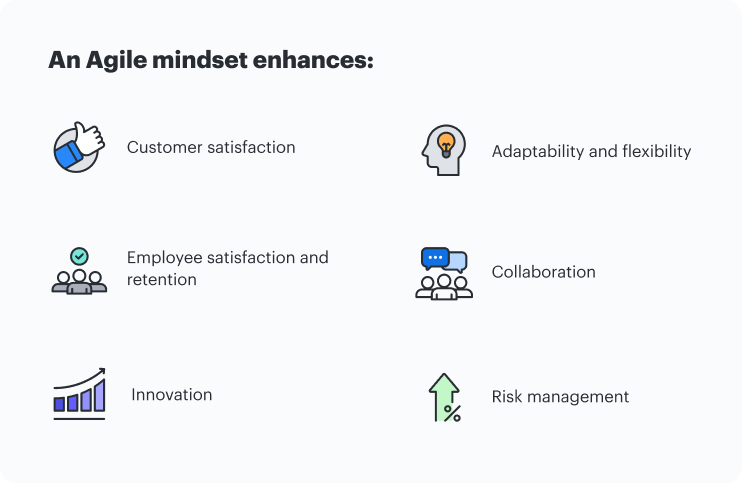
Why should organizations embrace the Agile movement? There are many reasons to develop an Agile approach within your business. Some of the top advantages include:
Increased employee satisfaction and engagement, which leads to increased productivity and retention.
Enhanced customer satisfaction due to a greater focus on delivering value.
Continuous improvement and enhanced innovation.
Better risk management, as well as improved adaptability and flexibility.
Increased prioritization and problem-solving skills.
Improved collaboration and communication with greater transparency.
Faster time to market, as well as greater cost control and predictability.
Common misconceptions about Agile
While there are many benefits to having an Agile mindset and Agile has helped businesses for decades, there are still a lot of misconceptions surrounding Agile. Many misunderstand what Agile is and how it enables teams to embrace and adapt to change.
This video reviews common misconceptions about the Agile mindset.
Here are some common misconceptions:
Agile is a quick fix. Don't expect to start experiencing benefits the moment you introduce the Agile Manifesto to your team. Agile is a transformation that begins on an individual level, and it takes time for a whole company to adopt the Agile mindset.
Agile is only for technical teams. Agile fundamentals can be used by anyone, in a variety of departments and in any company. You can even use Agile in your personal life!
Agile is rigid. Agile is a mindset, not a rigid methodology. If you need some guidance, there are Agile frameworks and methods, such as Scrum and Kanban, which will be covered later in this series. These approaches can help you determine how best to apply Agile principles.
Agile is all or nothing. Agile adoption is a journey, not a destination. Organizations typically start small and incrementally improve along the way.
Agile eliminates project management. Agile doesn't eliminate project management but disperses it across different roles with a focus on supporting and enabling the team rather than directing it. In some organizations, project managers transition to these new roles, while others move into strategic positions, such as portfolio or program management.
Scrum masters are glorified administrators. Often miscast as administrators due to their visible work with meetings and documentation, Scrum masters are actually leaders who serve. They coach on Agile theory and practice, remove obstacles, and foster team self-organization to maximize value delivery and continuous improvement.
Agile means more meetings, less work. Agile meetings are focused, collaborative events that are part of the work, ensuring that team members are given the opportunity to address blockers and communicate about the status of projects. Time-boxing is a common practice to increase productivity in meetings.
Agile solves all problems. As mentioned previously, Agile isn't a quick fix. Implementing Agile helps to highlight issues, but it isn't a silver bullet for all organizational challenges.
Agile is best for co-located teams. Again, Agile's for everyone! Agile can be effectively implemented in distributed teams, using the right tools and practices.
Change management is a waste of money. While there might be some upfront costs with training and implementation, investing in structured change management during an Agile transformation pays dividends through improved delivery speed, higher-quality outcomes, and sustained organizational agility.
Disadvantages of Agile (and how to address them)
Like any approach, Agile comes with trade-offs. Knowing them up front helps your team plan for them and get the most out of an Agile mindset.
Flexibility can lead to scope creep. Agile’s adapt-as-you-go nature is a strength, but without a clear vision, teams can drift off course. Keep a shared vision, a well-prioritized backlog, and lightweight documentation, so you stay flexible without losing focus.
Long-range forecasting is harder. Agile teams don’t assume they know the final result at the start, so predicting exact timelines and resources for long projects can be difficult, especially if the organization expects certainty too early. Agile makes delivery predictable in the short term through a regular cadence. Teams can then use data from past iterations, such as velocity, to forecast further ahead, and many fix time and budget while letting scope flex.
Collaboration requires real commitment. Frequent check-ins, reviews, and retrospectives take time and energy, and they can be hard to sustain without strong habits. Keep meetings focused and time-boxed, and make sure leadership actively supports the time teams spend collaborating.
Not every project is a natural fit. Work with fixed requirements, strict regulatory approvals, or little room for change may benefit from a more traditional or hybrid approach. Apply Agile practices where they add the most value, and adopt them gradually rather than all at once.
Understanding Agile’s trade-offs and common misconceptions helps teams avoid sidetracks, maintain appropriate structure, and maximize long-term value.
Remember—Agile is a mindset, a transformation, and a journey. It takes time and commitment to fully adopt Agile. But in the long run, Agile can help your company for the better at the organizational, team, and individual levels.