Key takeaways
-
The Manifesto for Enterprise Agility, by the PMI Agile Alliance, provides a set of values and principles to help organizations enhance resilience and adaptability at scale.
-
The Enterprise Agility Manifesto shifts from team-level delivery to organizational leadership behavior, asking leaders to think about creating conditions for agility rather than directing how work is accomplished.
-
A visual collaboration solution like Lucid provides a central space for companies to plan for adaptability, track progress, and connect strategy to execution with capabilities that enable teams to sense shifts early and respond quickly.
Companies are navigating the most disruptive inflection point the modern workplace has ever seen. Driven by AI, the market is changing so fast that executives estimate 40% of their workforce will need to reskill over the next three years just to keep up.
In an environment that’s changing this quickly, agility is no longer a competitive advantage; it’s a matter of survival. Yet many organizations are stuck as they try to address enterprise-level volatility with team-level agility. You can have highly adaptive engineering or product teams, but that agility cannot propagate upward through rigid annual funding cycles or governance structures.
Companies need strategies to help them adapt at the organizational level, reshaping how the entire organization operates, funds, and directs itself. That’s why the Project Management Institute (PMI) Agile Alliance created the Manifesto for Enterprise Agility, providing a blueprint for enterprises to be better prepared for change. Our seasoned agility experts at Lucid share what this shift indicates and offer tips on putting enterprise agility into practice.
What is the Manifesto for Enterprise Agility?
The Manifesto for Enterprise Agility is intended to guide organizations on scaling agility and acting with responsiveness at the enterprise level, particularly by changing associated leadership behaviors. PMI Agile Alliance defines enterprise agility, opens in a new tab as “the capacity to adapt at scale without losing coherence—to decide quickly, redirect resources deliberately, and keep strategy actionable under real-world pressure.”
The Manifesto provides principles and values that leaders can follow to help their organizations adapt better to changing environments over time. There are four values clearly defined in the Manifesto:
-
Clear purpose realized through adaptive change
-
Shared enterprise outcomes over functional optimization
-
Continuous reinvention over preservation
-
Human centricity amidst change
The Manifesto was developed based on real-world experience and insights from seasoned transformation leaders and agile practitioners. PMI Agile Alliance conducted more than 70 surveys with leaders and interviewed over 30 C-suite executives, including Lucid’s CEO, Dave Grow.
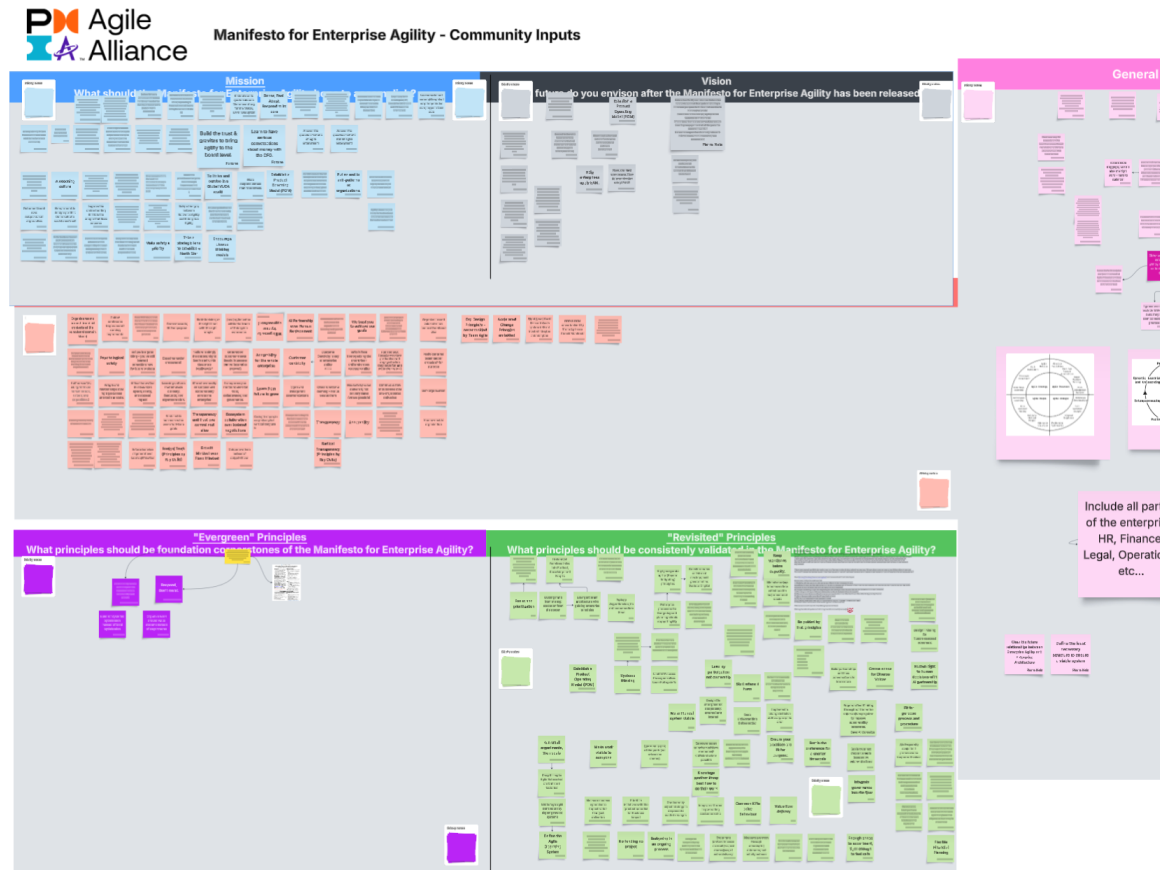
PMI Agile Alliance even used a Lucid board for public feedback as they collected ideas on the mission, values, and principles of the Manifesto. Using Lucid enabled public input and contributions from dozens of project professionals, leaders, and practitioners.
The Manifesto for Enterprise Agility was created in response to global shifts, such as remote work, AI, and a new generation of digital-native talent, that have made “business as usual” impossible. According to the Manifesto, achieving true enterprise agility is about more than simply scaling Agile frameworks or practicing SAFe.
As Janie Leddy-Jones, Director of Program Management at Lucid, explains:
“For the PMI Agile Alliance, releasing this Manifesto now signals a major pivot in the industry, moving away from rigid processes and control toward a human-centric model of shared agency. It’s a recognition that in a world of constant change, the only way to survive is to stop controlling the future and instead build an organization that is designed to learn and pivot in real time.”
Differences between the Manifesto for Enterprise Agility and the Agile Manifesto
Many companies that have looked into enhancing agility are familiar with the Agile Manifesto, which was written in 2001. The original Manifesto contains four values and 12 principles that became the foundation for the Agile movement as teams focused on achieving incremental progress, delivering value more frequently, and enhancing collaboration as they responded to change.
So what are the differences between the Agile Manifesto and the Manifesto for Enterprise Agility? The Agile Manifesto focused on agility at the team level, specifically with delivery teams. The Manifesto for Enterprise Agility moves beyond delivery teams to focus on agility at the enterprise level, taking a top-down approach with a focus on leadership behavior.
“An organization is not just made up of delivery teams,” Jeff Rosenbaugh, Senior Director of Professional Services at Lucid, says. “All the pieces need to move in concert, and it starts at the top. Your job as a leader now is to create conditions for agility, rather than direct the work.”
PMI Agile Alliance’s Manifesto scales team collaboration and delivery to the macro level, emphasizing executive trust, employee autonomy, and cultural resistance across an organization’s structure. The new Manifesto also addresses the gap where agile transformations often fell short as tech teams moved fast, while departments such as HR and finance remained siloed. With enterprise agility, companies prioritize cross-functional coordination and operate with coherence so everyone follows the same fixed purpose.
“We often think about agility in terms of building products. But, really, it’s a whole business philosophy. It’s not just about moving fast. It’s about constantly evolving.”
—Dave Grow, Chief Executive Officer, Lucid
PMI Agile Alliance’s own research shows that reinvention is the norm: 93% of CEOs say they must challenge assumptions of their operating models at least every five years. As global changes create a new operating reality, CEOs need to rethink how they lead and no longer ask, “What is our plan?” but instead ask, “Are we built for change?”
How to put the Enterprise Agility Manifesto’s principles into action
Enterprise agility is all about an organization’s ability to see, decide, and act at speed. How can you actually put enterprise agility into practice?
The Manifesto for Enterprise Agility has nine principles that act as starting points for implementing agility, organized into three distinct sections: leadership behavior, organization design, and execution. Here are some tips for putting the Manifesto’s principles into action and scaling agility at your organization.
Leadership behavior
The three principles of leadership behavior in the Manifesto for Enterprise Agility are:
-
Create clarity of purpose and align on enterprise outcomes.
-
Expand agility across partners and ecosystems.
-
Embrace technology and distributed talent.
The Manifesto suggests that leaders should link individual goals and incentives to overall business goals while anchoring agility in long-term purpose. It’s also important to make any changes to leadership behavior clear to all employees. When people see that the organization is serious about adopting change, and they know where they’re going and why, they respond more quickly.
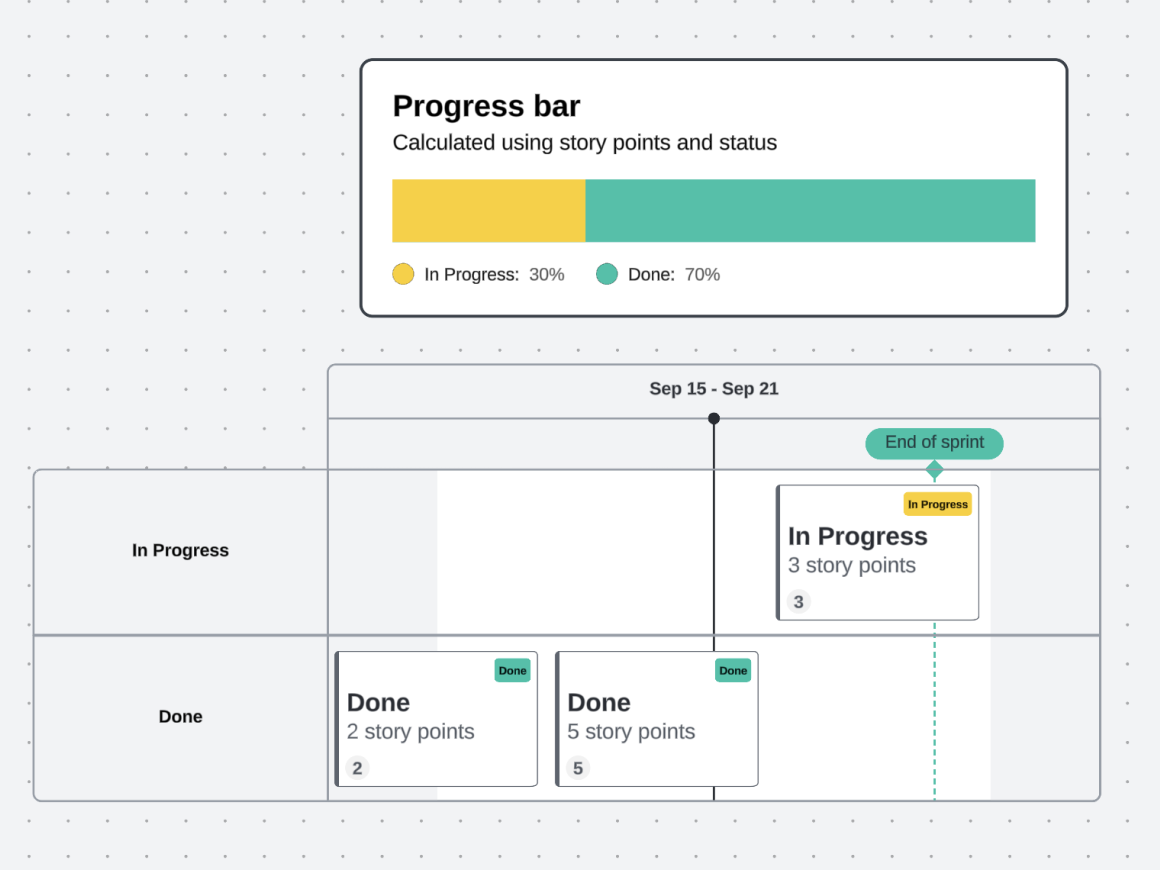
You can enhance clarity and alignment by making goals, behaviors, or objectives visible and establishing a clear way to track progress. For example, with a visual collaboration solution like Lucid, you can keep resources (such as OKRs) in one place that’s easily accessible to everyone. You can also use reporting shapes, such as progress bars, so people can understand how their work connects to business goals at a glance.
Agility should expand beyond your organization to include customers, suppliers, partners, and regulators, as a business’s ecosystem shapes relationships that foster adaptability and speed. AI and other technologies, as well as the rise of distributed teams, have changed the way companies operate, so leaders should leverage technological capabilities and use data to drive decision-making.
Organization design
The three principles of organization design behavior in the Manifesto are:
-
Govern with clear guardrails, not gatekeepers.
-
Fund purpose and intent, not execution activity.
-
Design for adaptability, not just efficiency.
The Manifesto suggests allowing people to pivot when things don’t go according to plan and implement agile operating models for flexibility and empowered teams. By governing with guardrails, not gatekeepers, businesses provide behavior norms that give teams the direction they need, while clear principles and boundaries are defined to guide judgment. With trust and shared accountability, people make faster decisions and can pivot more quickly.
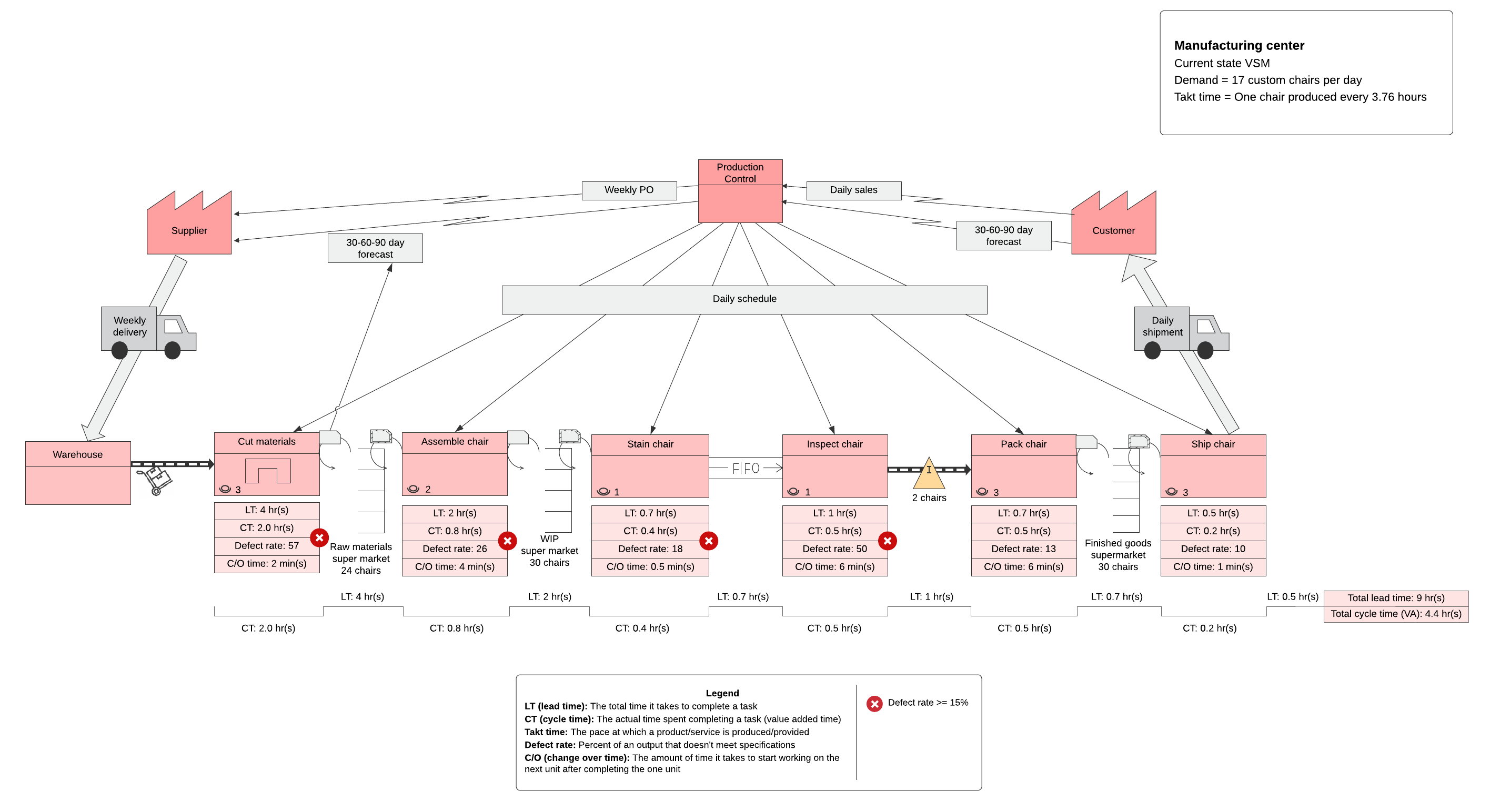
Practices such as value stream mapping can help you visualize your steps to value delivery and other processes. Value streams increase an organization’s agility by making unknown impediments or waste visible and involving cross-functional teams. Not only does value stream management enable rapid reconfiguration, but it can also help you align funding models to agile execution.
The Manifesto suggests that companies should devote resources toward the most promising ideas, with dynamic funding decisions occurring more than once a year. True agility enables faster decision cycles, leading to greater responsiveness, and requires the ability to move people and capital quickly toward what really matters.
Execution
The three principles of execution in the Manifesto are:
-
Move authority and decision-making to where value is created.
-
Deliver value frequently and make work visible.
-
Sense early, learn quickly, act with confidence.
The Manifesto suggests sensing shifts early, learning quickly, and acting with confidence. Enable teams to make decisions and ensure that the decision-making criteria are clear to support ongoing, aligned choices. Feedback loops help deliver value frequently as teams learn what works and what doesn’t.
According to the Manifesto, making risk and dependencies visible to teams helps shorten the distance between sensing a shift and executing a response. With dependency mapping, teams can visualize the relationships between tasks and mitigate or eliminate potential dependencies. By factoring in dependencies and risks into planning, you can better connect strategy to execution and provide insight into how teams are delivering value.
An example of mapping dependencies in Lucid.
Accelerate responsiveness and embrace change with Lucid
Enterprise agility is all about responding to change, and quickly. With its top-down approach, the Manifesto for Enterprise Agility helps businesses understand the practices they need to put in place to elevate agility beyond individual teams and ensure the whole organization responds in tandem.
Following the Manifesto is one thing; having the tools you need to put it into practice is another. Lucid has worked for years to develop capabilities that enhance agility and improve responsiveness. Use Lucid as your single source of truth and transform your plans into action with a data-backed solution that supports your journey toward enterprise agility.
“Lucid is the modern solution for making the invisible visible,” Christopher Bailey, Director of Consulting Services at Lucid, says. “Whether that’s visualizing work management, processes, people, or technology, Lucid provides the visuals needed to enable enterprise agility.”
Learn more about enterprise agility and see how your company can improve its response to change.

A how-to guide on enterprise agility
Get tips and best practices for successfully scaling agility across your enterprise with this in-depth guide.
Check it out