
Before launching into a new initiative or project, it’s important to come up with a plan. And part of that plan—the first part, in fact—should be conducting a situation analysis. At its core, situation analysis is a way to see how your business stacks up against competitors. It includes looking at several aspects of your business to help you make informed decisions as you grow your business.
So why is situation analysis so important to project planning and marketing strategies? Think of it this way: companies typically launch new projects or initiatives to build a new product, improve an existing one, or help connect their products to new and existing customers. But what happens if you do connect with customers and they don’t want or need your product? That’s months (maybe years) of work down the drain.
That's where a situation analysis can help.
While there’s no way to ensure the success of a product, situation analysis gives you the information you need to guide your business in the right direction. In this post we’ll cover the basic information you need to perform your own situation analysis.
What is a situation analysis?
Before getting into anything else, let’s address the question on everyone’s mind: What is situation analysis? We gave a brief answer in the intro, sure, but let’s really get into it.
Situation analysis is basically a methodical look at the internal and external factors influencing your business at any given moment. These factors might include customers, competitors, the market environment, and your business’s capabilities. By examining these elements of your business and its environment, you can identify strengths and weaknesses as well as potential areas of growth.
If this definition seems a little broad, that’s because it is: situation analysis is a broad term that encompasses several smaller activities. These activities include SWOT analysis, PESTEL analysis, Porter’s Five Forces, 5C analysis, and VRIO analysis (but more on those later). In other words, situation analysis is a phase of strategic planning, and during that phase, you might use several analytical tools.
Importance of situation analysis
We said it before and we’ll say it again, you should conduct a situation analysis before coming up with any concrete project plan or marketing strategy. But don’t worry, you don’t have to take us at our word—let’s break down exactly why situation analysis is so important in the early stages of planning.
Before anything else, situation analysis gives you a view of your business as it stands. No frills, no exaggeration, just an honest look at where you’re at. What are your strengths? Weaknesses? How do you compare to competitors? By performing a situation analysis, you’ll get a comprehensive view of your organization and its current state.
This can help shed light on other areas of your business. What problems are you facing? What strategies are you currently using to combat those problems?
With a well-rounded view of where your business is, you can get a better idea of where you want it to be. After performing situation analysis, you should be able to clearly identify your business’s current and desired states. From there, you can establish goals and take action to make your dream a reality.
Considerations within a situation analysis
To be effective, situation analysis needs to be thorough. A half-baked job simply won’t cut it. So what does a thorough situation analysis look like? For starters, it should look at your business from a variety of perspectives. But that’s the short answer. Let’s take a look at some of the key perspectives that go into situation analysis. As you perform situation analysis, you should consider:
- Product situation: This one’s pretty straightforward: what is your current product? In this instance it might be helpful to define “product” as all the ways you meet your customers’ needs. As you evaluate your current product, remember to also include any additional services you provide customers. Is your customer service top-notch? Because that certainly influences your product’s situation.
- Competitive situation: Situation analysis wouldn’t be complete without performing some form of competitor analysis. Your marketing strategy and business plan should always take competitors into consideration, and to do that, you’ll have to analyze where your competitors stand. (VRIO analysis can be a great tool for identifying long-term competitive advantage.)
- Distribution situation: How do you get your product to customers? This could be the app store, physical stores, etc. That’s your distribution situation. Your distribution mechanism can make or break your business—it is, after all, where you actually reach customers. Including it in your situation analysis can help you identify ways to better reach, engage, and retain customers.
- Environmental factors: You might not expect it, but environmental factors can be both internal and external. Internal environmental factors might include poor inter-company communication or changes in leadership and structure. External environmental factors are often wide-reaching: economic recessions, legal restrictions, etc. Stimulus checks are a timely example of an external environment factor.
- Opportunity and issue analysis: As you consider each of the previous situations, you’ll likely begin to identify your business’s strengths and weaknesses, and with those, opportunities and threats. To formalize and document this process, you should conduct SWOT analysis with your team.
Methods and diagrams for situation analysis
Remember how we said that situation analysis is a broad term that includes several smaller, more specific activities? It’s time to take a look at those smaller pieces that make up situation analysis.
There are five types of analysis typically used for situation analysis: SWOT analysis, PESTEL analysis, Porter’s Five Forces, 5C analysis, and VRIO analysis. Let’s take a closer look at each.
SWOT analysis
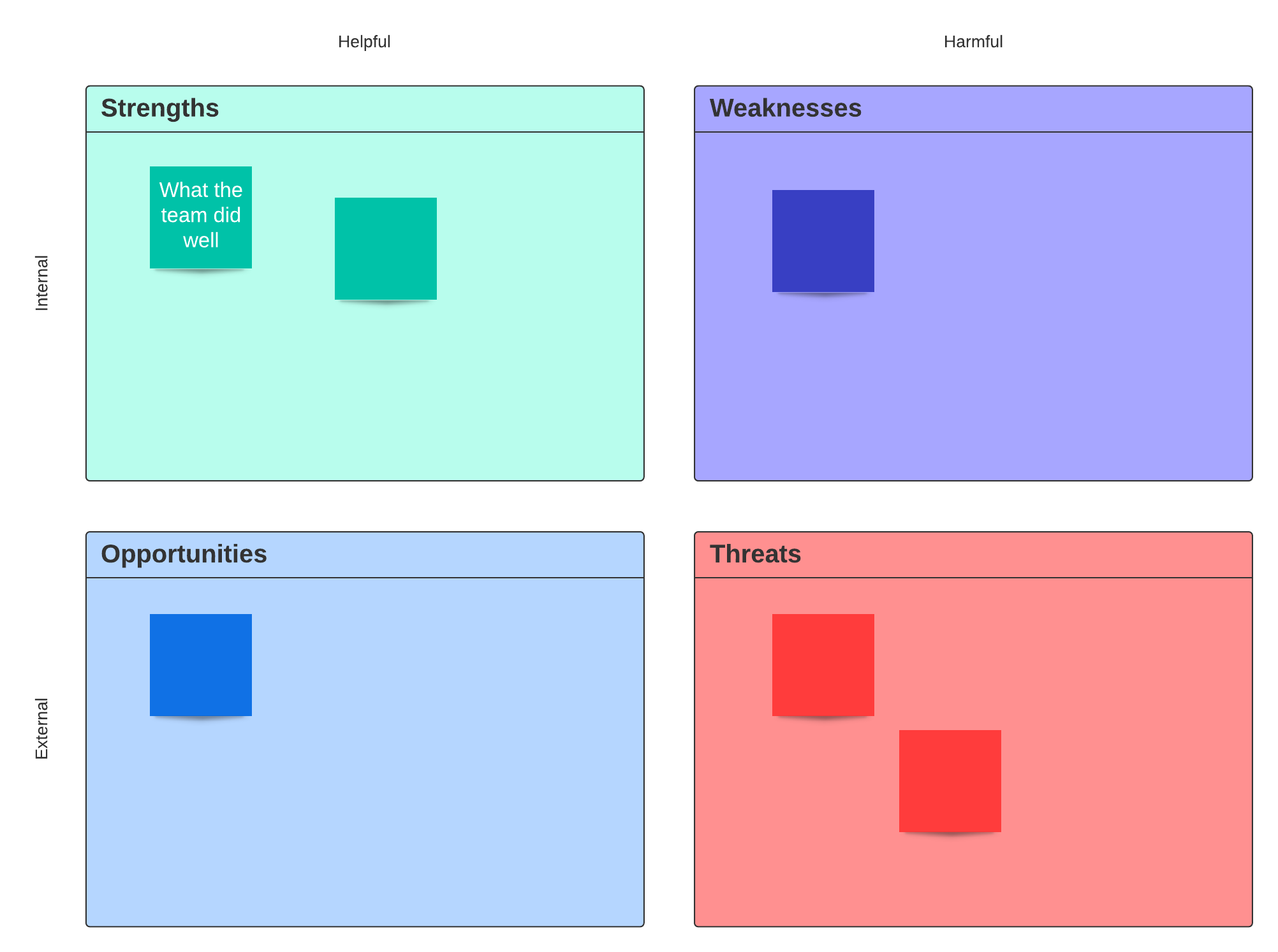
When it comes to strategic analysis, SWOT charts should be your bread and butter. SWOT is an acronym that stands for strengths, weaknesses, opportunities, and threats. As you perform SWOT analysis, you’ll think about your business from each of those standpoints and document your findings on a SWOT chart—four quadrants corresponding to each part of the acronym.
SWOT analysis is best done as a team. You’ll need a variety of perspectives to get a well-rounded view of your business. Like most team activities, SWOT analysis requires collaboration and communication. Enter Lucidspark. If you create your SWOT chart using Lucidspark, team members can participate in the meeting no matter where they’re based. Edit in real time as you brainstorm with your team. If you’ve shared the chart with your team, each team member will have access to the current version at all times.
PESTEL analysis
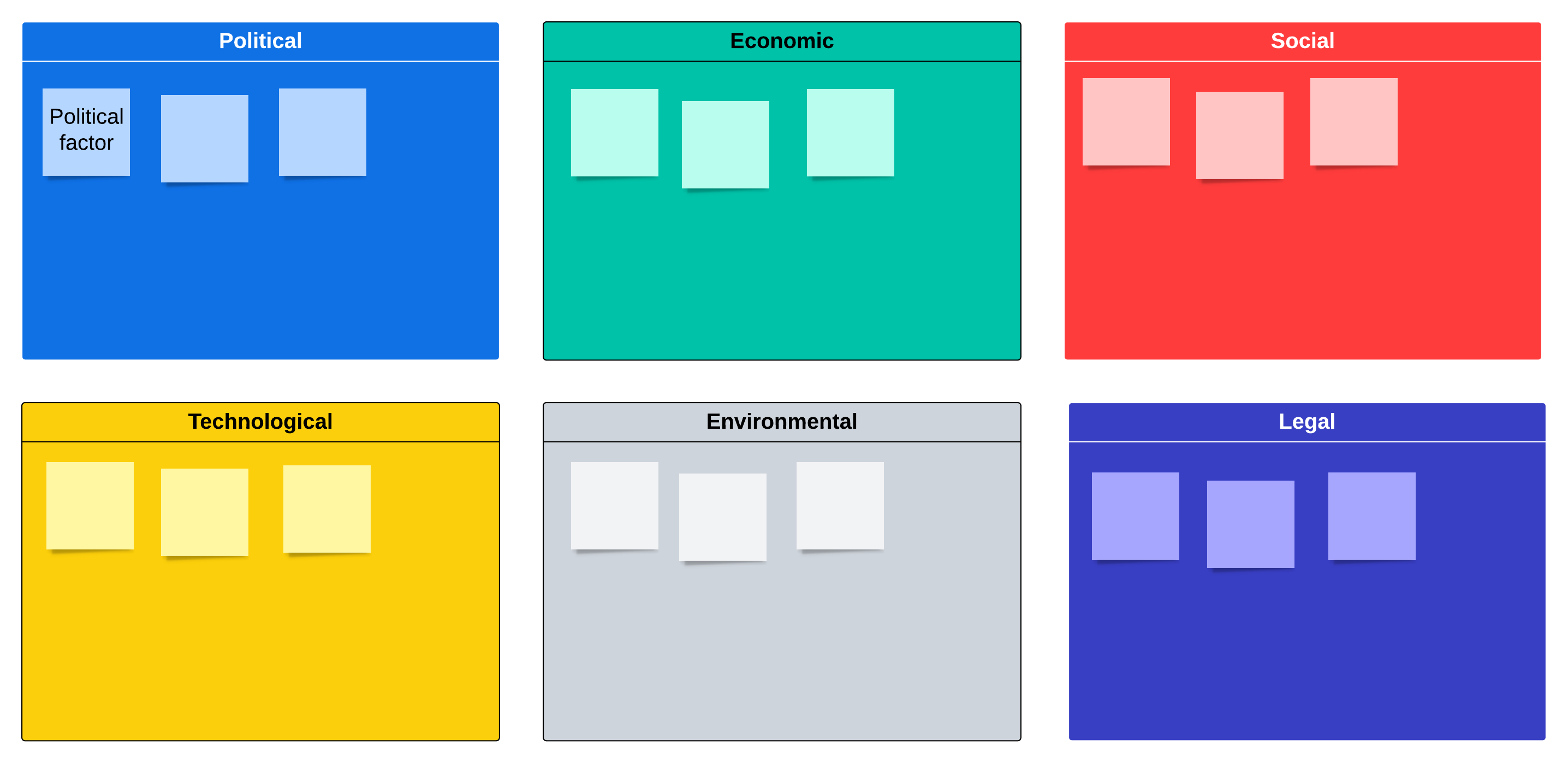
Just like SWOT, PESTEL is an acronym. Each letter corresponds to a category of external factors that might influence your business: political, economic, social, technological, environmental, and legal factors. If you’re unsure what falls under each category, ask yourself the questions below as you move from category to category:
- Political factors: Are there government policies or trading restrictions that will impact your business?
- Economic factors: Is there an economic recession or boom? Did people get stimulus checks recently?
- Social factors: What lifestyle trends impact your business? What demographic are you trying to reach?
- Technological factors: Have there been any big tech advances in your industry? Any new legislation regarding your technology?
- Environmental factors: Are there environmental regulations that impact your industry? These could be emissions standards or something similar. (This one may or may not be relevant, depending on your industry.)
- Legal factors: What health regulations impact the way you conduct business? Safety regulations? If there’s legislation that impacts your business, that’s a legal factor.
In PESTEL analysis, you consider how your business is impacted by each category of factors in turn. Record your findings on a PESTEL chart.
Porter’s Five Forces
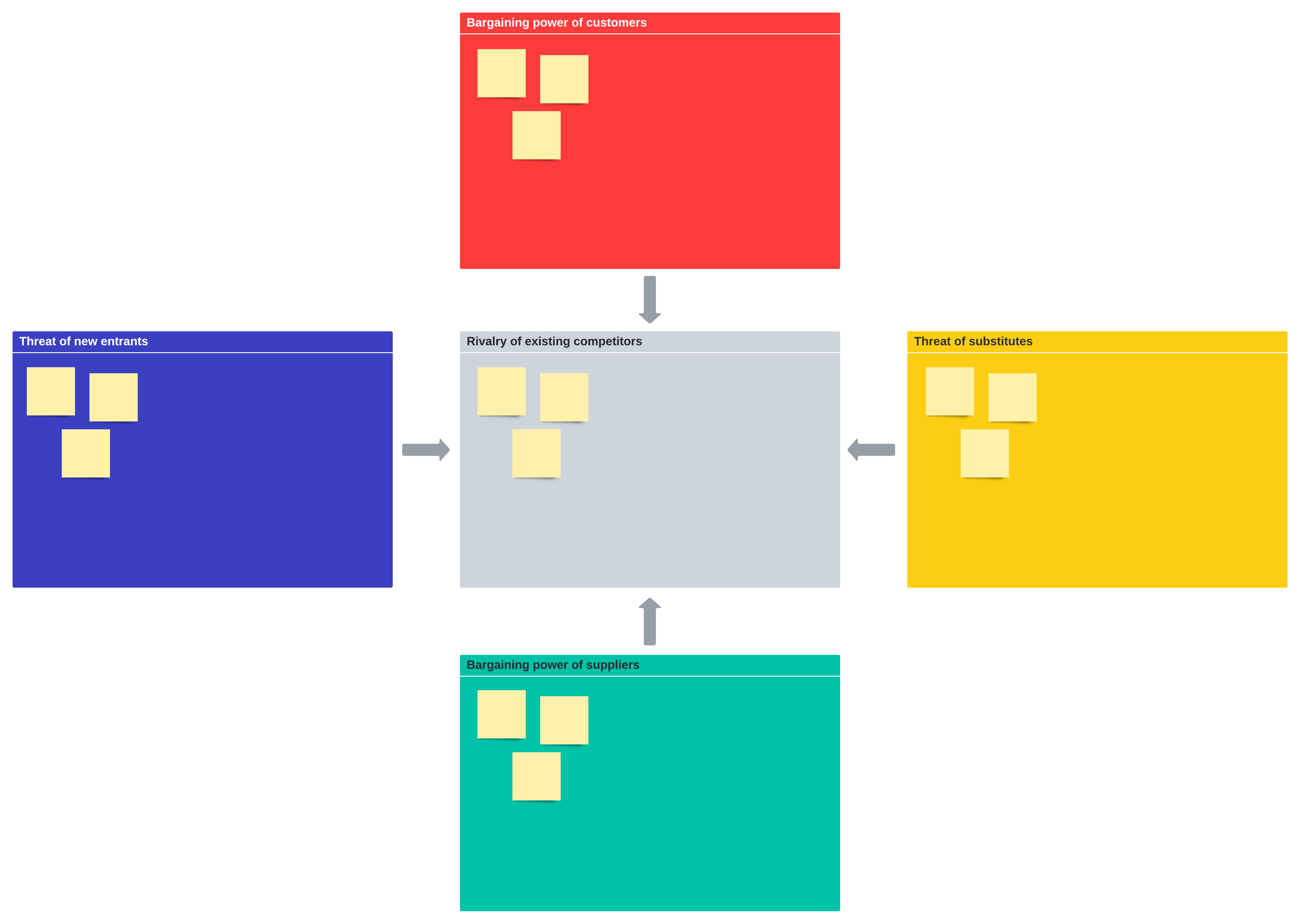
First introduced by Harvard professor Michael E. Porter in the late 1970s, Porter’s Five Forces is an analytical method that helps you analyze your competition. The goal is to identify and eliminate (or avoid) competitive threats. According to Porter’s method, there are five forces that make up your competitive environment:
- Threat of substitute: Can a new product or service replace your product or service? If so, customers will have more options, and more options means you’ll have to have a competitive edge.
- Threat of new competitors: If new competitors enter the game, there’s a chance you’ll lose customers because they’ll have more options to choose from.
- Threat of established competitors: No matter how you cut it, rival businesses will always threaten your business. They are also vying to dominate the market, so you have to be better.
- Bargaining power of suppliers: If you’re dependent on a supplier, they have a lot of leverage over you. If they choose to raise prices, you don’t have any choice but to accept it or find a new supplier.
- Bargaining power of customers: How much does the customer depend on your product? If they don’t depend on it, what’s keeping them around?
5C analysis
In 5C analysis, you and your team will consider five factors impacting your business: the company, your competitors, your customers, your collaborators, and the climate. Let’s take a look at what each means:
- Company: Look at the internal aspects of your business. What are your goals and objectives? What are your products? Who is on your team?
- Competitors: Look at the other businesses in your industry. What are they doing to capture a share of the market? What are they doing differently than you?
- Customers: What are the demographics of your customers? Can you expand them?
- Collaborators: What suppliers and distributors do you depend on? Are there alternative options?
- Climate: What political, legal, and economic factors are influencing your industry and market?
VRIO analysis
If you’re trying to identify competitive advantages, VRIO analysis is the tool for the job. VRIO analysis is a method for evaluating your resources and the competitive advantages (or disadvantages) they give you. In VRIO analysis, you consider a resource from four perspectives:
- Is it valuable?
- Is it rare?
- Is it imitable?
- Are you organized to use it?
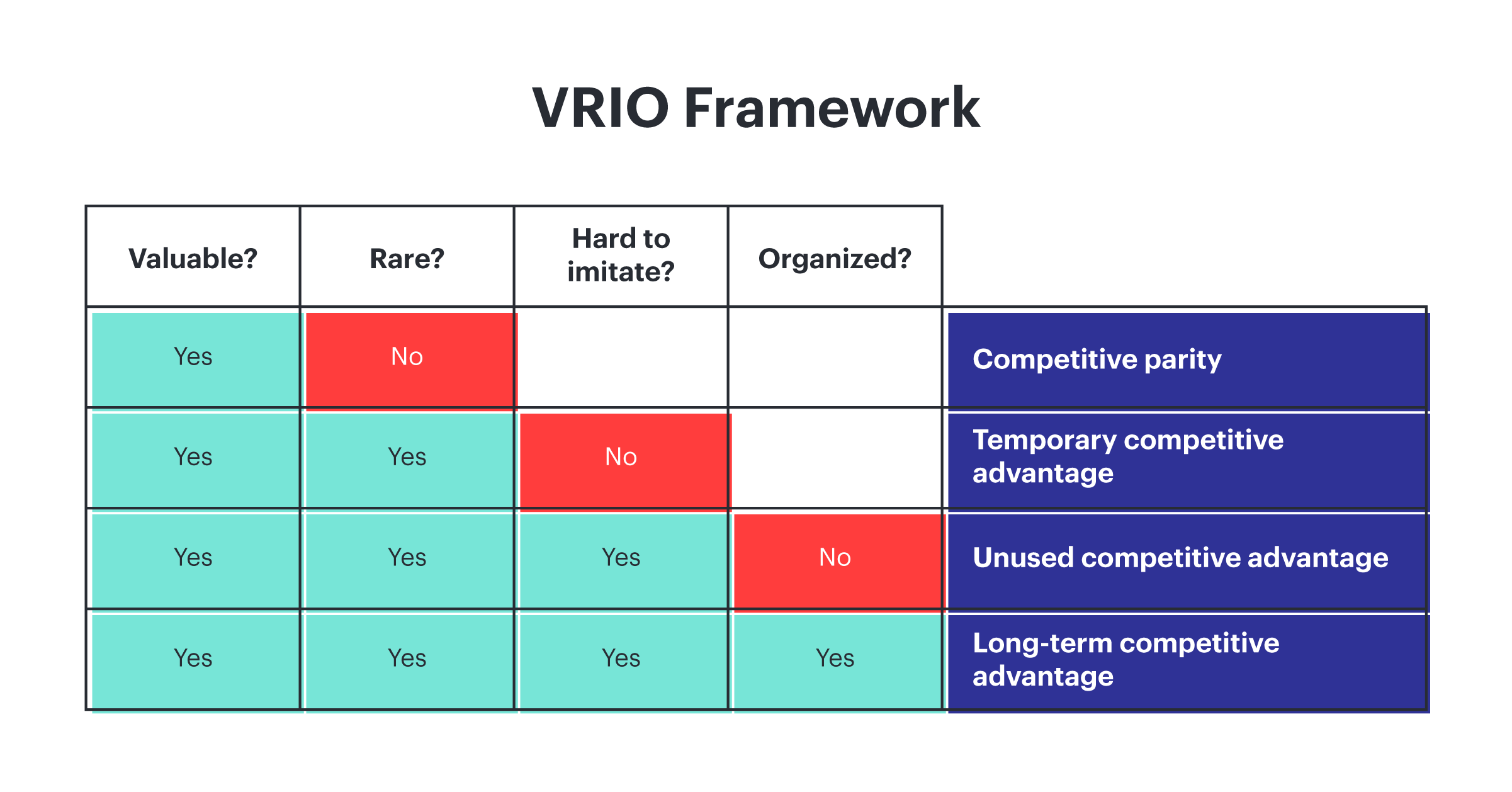
As you answer these questions, you’ll be able to determine if that resource gives you a competitive disadvantage, competitive parity, a temporary competitive advantage, an unused competitive advantage, or a long-term competitive advantage.
You may have noticed a common theme linking the five methods listed above: visuals. Like most analytical processes and methods, situation analysis is a whole lot easier when you visualize your information. Whether it’s through a SWOT chart, VRIO diagram, or simply a brainstorming board, Lucidspark can help your team stay organized and creative as you perform situation analysis.

Perform your own situation analysis in Lucidchart to propel your business forward.
Try for free today!