
Key takeaways
-
Story points are a unit of estimation that helps teams determine the amount of effort and complexity required for individual work items.
-
By assigning story points to work tasks, teams gain a better understanding of when a task may be completed.
-
To conduct story point estimation, teams should establish a baseline for work items that have the least amount of risk and complexity, use exponential numbers from the Fibonacci scale, and gain consensus on the number of story points that are assigned to each work item.
If you’ve ever experienced traffic in Los Angeles, you know that the amount of time it should take you to get from Arcadia to Santa Monica is subject to a number of factors, including traffic, weather, construction, time of day, and the whims of other drivers. It’s a 32-mile distance that could take 41 minutes or four hours.
The items in your Scrum product backlog are subject to a similar number of variables, including complexity and risk. This complication often makes Agile planning as frustrating as sitting in Southern California traffic.
Inaccurate planning can become a massive problem down the line. Failing to accurately and consistently estimate how long it will take to complete tasks can lead to missed deadlines, bottlenecks, roadblocks, and scope creep.
The good news is, there’s an accurate way for your team to estimate the time and effort it’ll take to complete tasks in your backlog: story point estimation.
What are story points?
Story points are a unit of estimation that allows teams to consider the effort and complexity it will take to complete each item in a product backlog. Story points are much more comprehensive than looking at just one factor (like time, for example) to estimate during sprint planning, which gives teams a more accurate calculation of how long user stories will take to complete.
Story point estimation in Agile includes four main components:
-
Risk: The risk of a particular project or item includes cross-team dependencies, unclear direction, or potential changes mid-task.
-
Complexity: This component is determined by how difficult the item is to see to completion.
-
Familiarity: This component is determined by how familiar a team member is with the task and how monotonous certain tasks are within development.
-
Relative effort: This component is determined by the amount of effort required for the task relative to the effort required for other work items.
Many teams wonder how to estimate effort in Agile. By accounting for the four components above, your team can more accurately calculate sprint velocity, include some wiggle room for uncertainty, and avoid leaning too heavily on time commitments. Story points allow for consistency not just in teams, but across departments.
3 steps to Agile story point estimation
Story point estimation should be done during sprint planning as your team defines the sprint goal and creates a plan for what the team will accomplish. Follow this process to more accurately plan out your sprints, align expectations, and complete projects on time.
1. Determine a baseline
Before you begin to assign story points to work items, you need to create a baseline for what exactly those numbers mean. Your baseline, which is often 1 or 0.5 for Agile teams, sets the standard for a work item that has the least amount of risk, complexity, and repetition. The higher the number of points, the higher the assumed amount of risk, complexity, and repetition.
You might choose to assign one story point to an item that a team member is very familiar with and can take care of without any dependencies on other teams. For example:
-
1 story point = Adding a new product to a dropdown menu on the website
-
3 story points = Adding a ratings system to the website
-
8 story points = Adding GDPR and CPA compliance across the website
Remember, your baseline for estimating work items isn’t based solely on length of time but takes other factors, such as complexity and effort, into consideration.
2. Use Fibonacci sequence numbers
It’s tempting to assign work items with numbers on a linear scale, but those numbers aren’t differentiated enough to clearly define an estimate. For example, if you assign an item four story points, how is four story points different from five in terms of complexity, risk, and repetition?
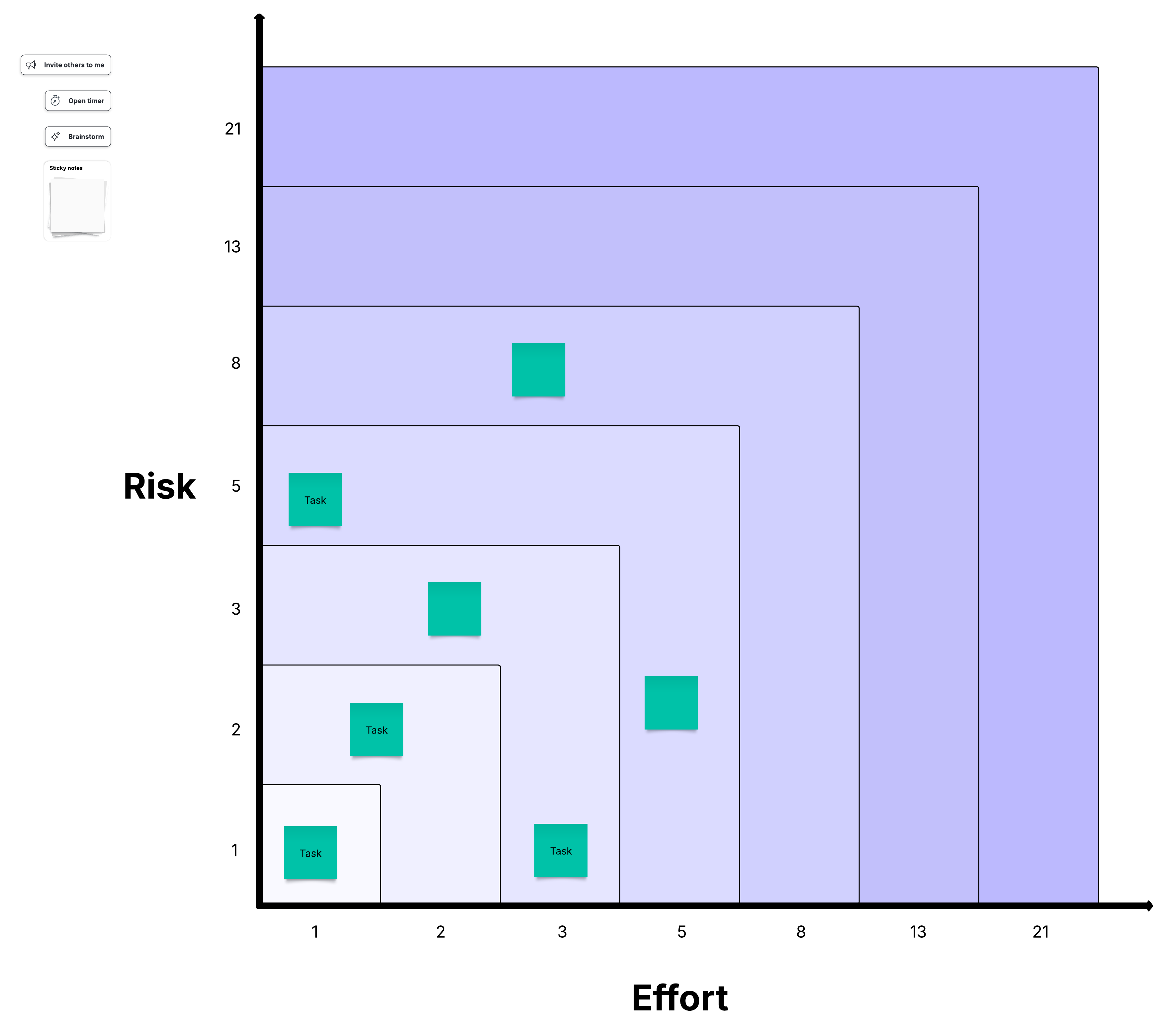
Using exponential numbers from the Fibonacci scale helps people more easily define the differences between tasks. The Fibonacci sequence is a series of numbers where each number is the sum of the two previous: 0, 1, 1, 2, 3, 5, 8, etc. For Agile teams, the sequence is typically modified to 0.5, 1, 2, 3, 5, 8, etc. With these numbers, it’s easier to decide if a work item is two story points or five story points.
To keep track of what number of story points you’ve assigned to work items, you can use a Fibonacci scale template. Estimate the work to be done by assigning items a number from the scale, and make a copy of your template for each sprint so you can create a historical record and improve your estimation over time.
3. Facilitate a story point estimation session with your team
Estimating story points should be done with the entire team, so you gain consensus on the approximate amount of story points for each work item. Facilitating estimation sessions increases alignment and transparency.
To organize an estimation session with your team, you have a few options. Some common Agile estimation techniques include planning poker, affinity estimation, the three-point system, and the bucket system. These activities help teams gauge factors that will affect the completion of work, and they can be done in person or online.
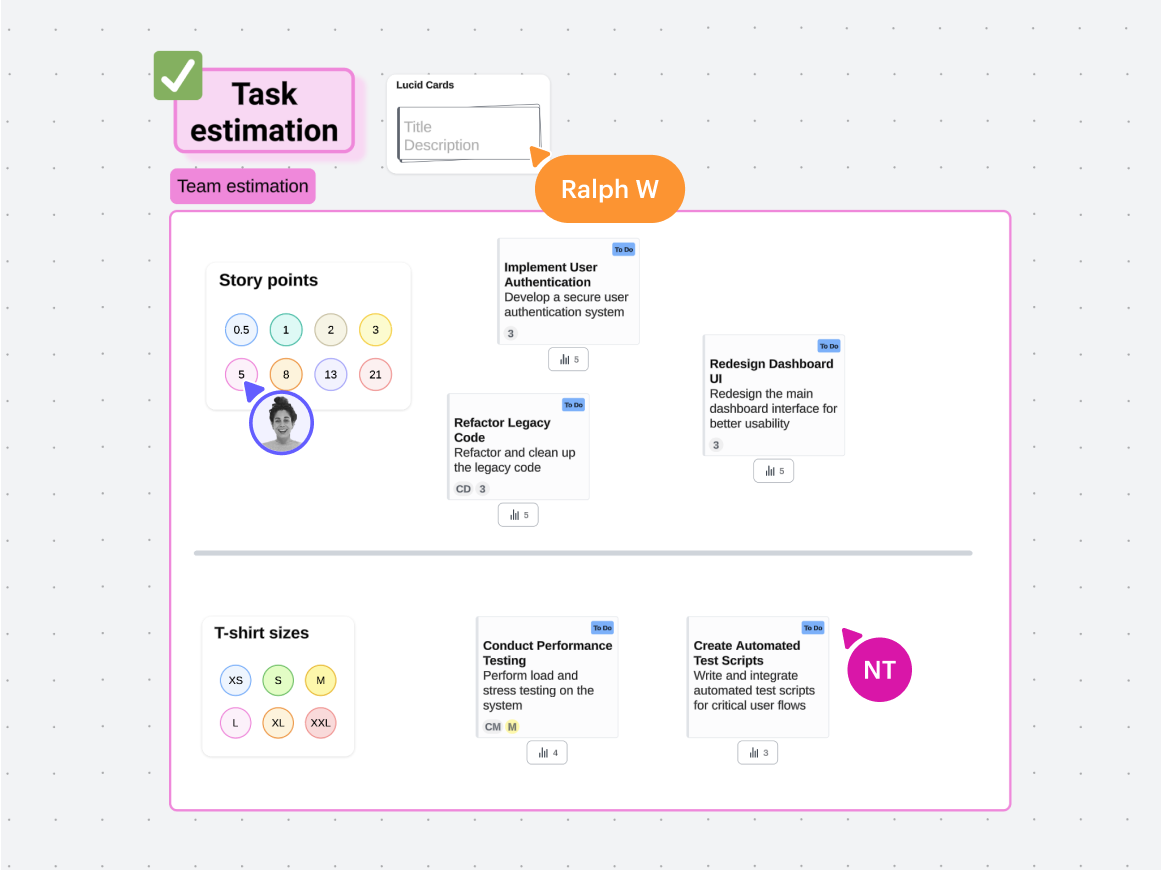
If you have a distributed team, you can host virtual team estimation activities with a visual collaboration solution like Lucid. Lucid’s task estimation feature allows teams to individually estimate the effort required for a task, view estimation results, and apply a final consensus-based estimation to work items. It’s easy to add an estimation shape bank to your Lucid canvas and participate in an estimation activity with your entire team.
Once you have reached a consensus on story points for each work item, the items in your product backlog can be prioritized and divided amongst the team based on workload capacity.
Continue to improve Agile story points estimation
Your first sprint after implementing the story point technique isn’t likely to go perfectly, and that’s completely normal. It will take some time to improve your estimation skills as a team to accurately apply estimates and come to a consensus for common work items.
Use your sprint retrospectives to ask your team what went right, what went wrong, and what can be done to improve estimation. You might need to adjust your initial baseline or practice a few times to ensure everyone’s comfortable with estimating each task's effort. Since Agile development is a team effort, it’s important to lean heavily on the team’s feedback to determine improvement.
While Agile story points estimation may not feel as intuitive as simply assigning estimates of time to each task, you’ll find that, by estimating other factors such as complexity and effort, you’ll have a calmer sprint and a more organized and prepared team. Further, you’ll be able to discuss expectations with stakeholders and set more reasonable delivery dates moving forward, which improves efficiency and ultimately improves your product.

Learn more about improving Agile estimation
Ready to take estimation to the next level? Learn all about Agile estimation techniques in our in-depth guide.
Read more