
Are your employee training programs effective? How can you even tell?
The first step is measurement. You need to understand what is working (and what isn’t) so you can design and develop programs that meet the needs of your employees and the business.
The Kirkpatrick Evaluation Model helps businesses do just that.
Through this simple four-step process, you can measure training effectiveness and improve your instructional design for future initiatives.
What is the Kirkpatrick Model?
The Kirkpatrick Evaluation Model was first introduced in 1959 by Donald Kirkpatrick, a professor emeritus at the University of Wisconsin. It has since undergone several iterations over the years by Kirkpatrick and, after his death, his family—the most recent update, called the New World Kirkpatrick Model, was released in 2016.
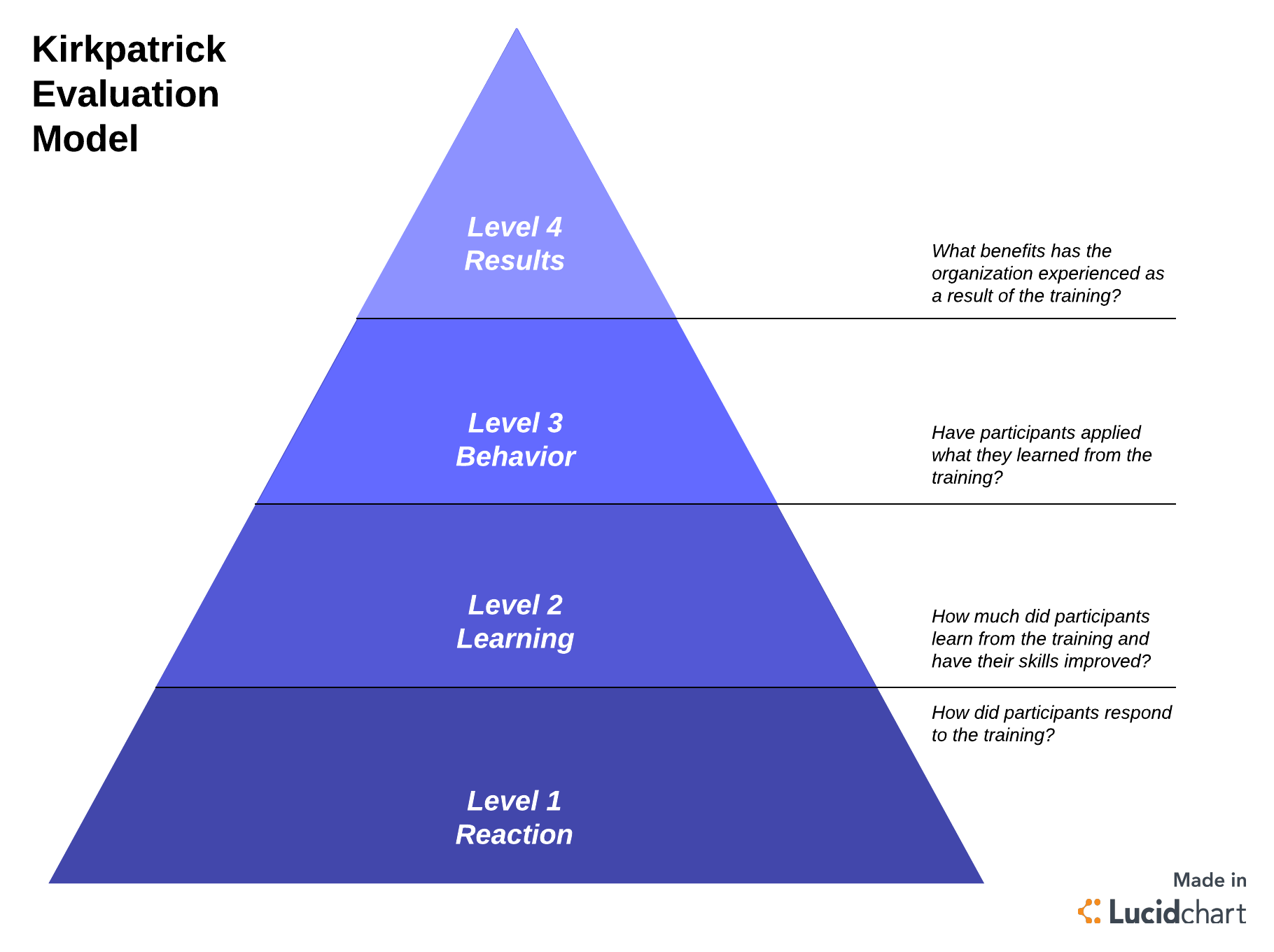
The model outlines four levels of training evaluation:
- Reaction
- Learning
- Behavior
- Results
The Kirkpatrick Model remains a popular and widely used evaluation strategy because of its simplicity and relevancy across industries and organizations.
Benefits and limitations of the Kirkpatrick Model
The Kirkpatrick Model's advantages make it an attractive choice for trainers and other business leaders. It:
- Provides clear evaluative steps to follow
- Works with traditional and digital learning programs
- Gives HR and business leaders valuable insight into their overall training programs and their impact on business outcomes
Additionally, its simple approach is highly flexible and adaptable across industries and applications, making it easy for trainers to implement the model.
However, there are limitations and tradeoffs. The system can be time-consuming and requires costly investment to conduct all the pre-tests, post-tests, and analyses of learning outcomes.
It is also difficult to directly link business results to specific training. Proving efficacy and return on investment (ROI) is hard since the causes are often complex and multifaceted. To do so accurately requires further resources and expertise.
Kirkpatrick’s 4 levels of training evaluation
Level 1: Reaction
The first step is documenting your employees’ reactions to the training. Employee engagement (at work or during training) is crucial for running a productive business—but it’s not so easy to achieve. Understanding how employees perceived the training can give you insight into what is working well or needs improvement.
To learn what your employees think about your training program, you can send out a survey immediately following the session. Consider asking questions like the following:
- Was the presentation engaging?
- Did you feel the training was worth your time?
- Can you apply what you learned to your job?
- Did you like the style or method of training?
- What would you change or improve for future training?
- What resources or support do you need to apply what you learned?
You can also track metrics such as participation rate, completion rate, and time spent on training (useful for self-directed online training courses).
Use the feedback to help you identify areas for improvement and consider possible changes for future iterations of your training program.
Level 2: Learning
Here you measure exactly what the employees learned (or didn’t learn) in the training. To do this effectively, you should test your employees before and after the training to measure progress. You can use skills-based evaluations or interviews to record your findings.
Unlike simple or subjective reactions to the training, during this stage, you’ll want to measure specific outcomes. Start by identifying what learning outcomes or results you’re aiming for in the training, then test for those outcomes before and after.
Level 3: Behavior
The next step is to gauge whether your training has impacted behavior. In other words, are your employees applying what they learned?
This process takes time—after all, it can take weeks or months for employees to build confidence or have the opportunity to apply their knowledge.
To measure behavior, conduct interviews, record observations on the ground, and provide opportunities (e.g., assign projects) for team members to apply the skills they learned in the training.
However, keep in mind that a lack of behavioral change doesn’t necessarily mean the training was ineffective. Evaluate your current processes and cultural conditions in the business to ensure you’re building an environment that encourages learning and positive change.
Level 4: Results
The final step of the Kirkpatrick Model is measuring results. This is the stage where you evaluate how the behavioral changes impacted the business and whether your training investment resulted in a good ROI.
Using the Kirkpatrick Evaluation Model to design training
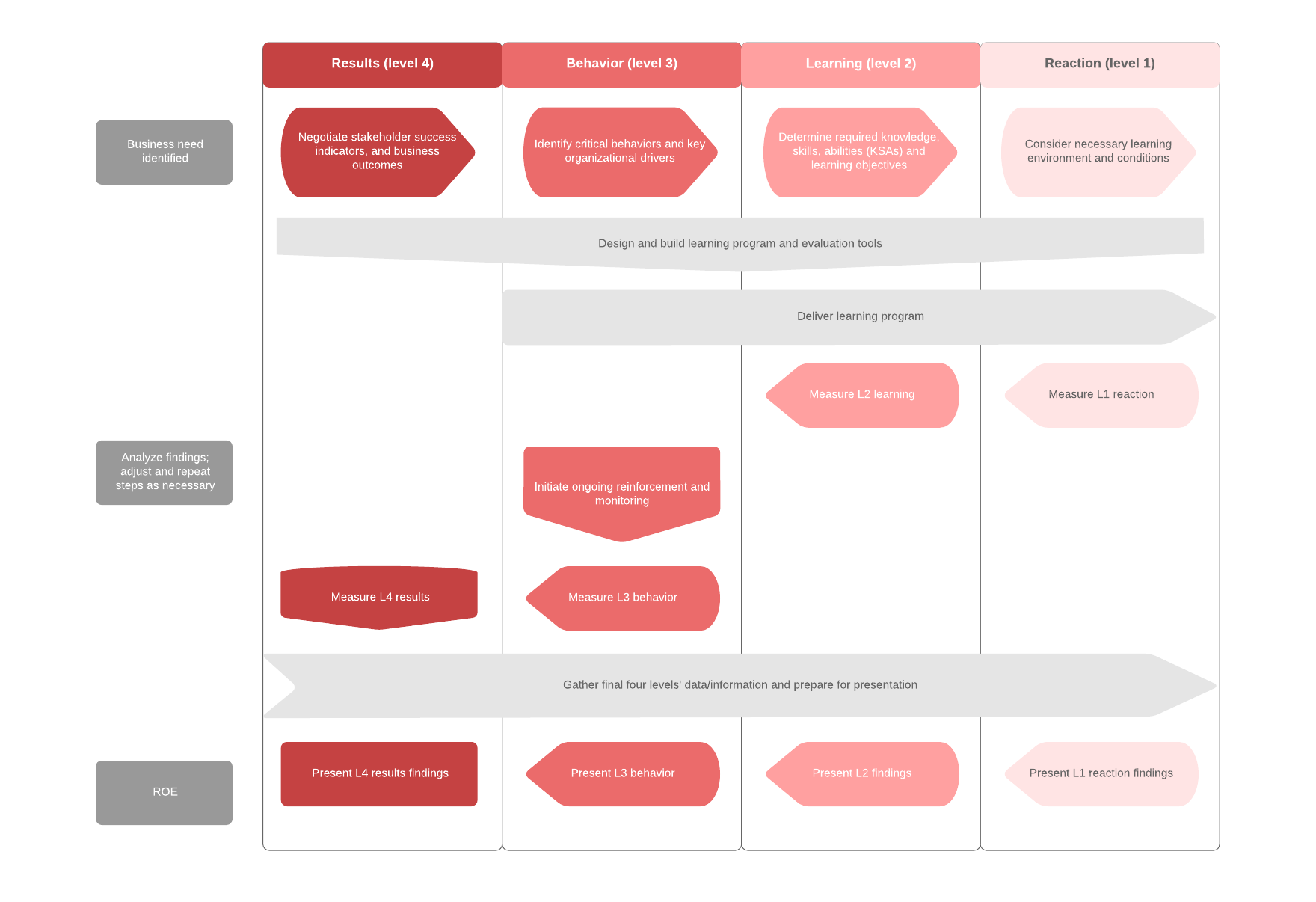
While the Kirkpatrick Evaluation Model is meant to help you improve existing training, you can also use it to start from scratch. Many trainers use the Kirkpatrick Evaluation Model backward as a guide for developing effective training. They begin by identifying the outcomes they hope to achieve from the training and use those desired results to design a program to achieve them.
However, when you identify the outcomes and metrics of success you’re aiming for in your training, you can design more effective programs with measurable results.
The takeaway
Despite its limitations, the Kirkpatrick Evaluation Model is still one of the most common training evaluation methods today.
The key to using it effectively is to make training evaluation an integral part of your training design from the beginning. By working backward on the Kirkpatrick 4 levels, you can develop training initiatives that are effective and impactful—and directly tied to measurable outcomes.
Use Lucidchart to keep your training processes on track
As you design your training programs, use Lucidchart to outline your processes as a flowchart and use swimlanes to make sure you hit each target in the evaluation model.
If you use a learning management system, you can even link data from the LMS reports (such as participation rates) directly to Lucidchart to visualize your training progress and make connections to ROI.
You can also bring Lucidchart into your corporate classroom as a learning tool. Visuals are a great way to increase engagement and improve knowledge retention (particularly for visual learners).

Learn more about the importance of employee training and development programs, and how Lucid can help.
Go now