
You probably hear about innovation all the time, and it’s easy to understand why it’s important at face value. But innovation isn’t just “nice to have” or a way to set your business apart—it can truly make all the difference between whether your org succeeds or fails.
For example, according to Kantar, businesses that are perceived as highly innovative grow 7x faster than competitors. On top of that, nearly half of CEOs believe that their company won’t be viable in five years if it stays on its current path. Similarly, 84% of top business executives believe their overall organizational success depends on implementing innovative strategies.
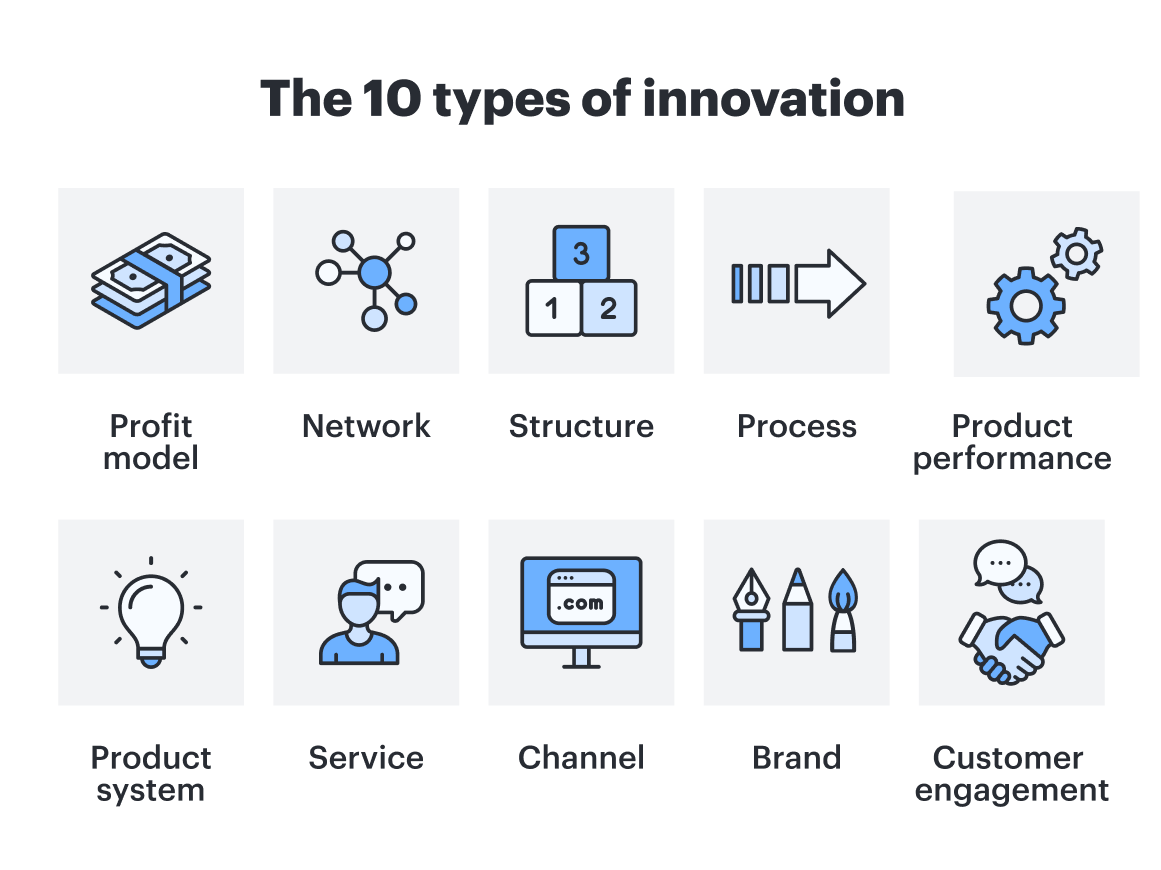
So it’s clear that innovation is important—no, vital—to your business. But it’s not all created equal. In fact, according to Innovation Scientist Larry Keeley, there are actually ten different types of innovation. And to truly reap the rewards of innovation, companies need to adopt as many as possible.
Ten types of innovation
In Keeley’s book, Ten Types of Innovation, he explains that most companies invest in less than two types of innovation, but companies that invest in at least five outperform the S&P 500 by over 200%. An awareness and understanding of each type can make all the difference in your company. In this article, we’re breaking down the different types of innovation in business and providing examples so you can better understand them and best identify which ones to implement in your org.
Three innovation categories
Before we dive into the specifics, note that each innovation type fits into one of three categories: configuration, offering, and experience. We’ll separate each of the ten types of innovation into these categories so you can see how they all work together to create a successful innovation culture.
-
Configuration: Deals with what goes on behind the scenes of production and development, including processes, operations, and more
-
Offering: Involves the product or service itself, including adding supplementary offerings or improving existing ones
-
Experience: Encompasses all elements that are customer-facing, including onboarding, support, and beyond

Wondering where to start? Engage with our innovation experts to develop collaborative teams and original strategies that will take your organization to the next level.
Contact salesConfiguration innovation types
Configuration innovation types deal with what goes on behind the scenes of production and development, including processes, operations, and more. At their core, these innovation types deal with the innermost parts of the business.
-
Profit model innovation
This type of innovation involves how your company makes money. Where is your revenue coming from? How can you increase it? The hype around subscription models in recent years fits perfectly within this category.
Examples
Examples of profit model innovation include the New York Times pivoting to a digital user subscription model instead of an ad-driven model or Netflix making the landmark swap from DVD rentals to streaming. Another example is the razor company Gillette, which sells inexpensive handles but expensive razor head replacements.
-
Network innovation
Network innovation leverages the network of existing customers to inspire new offerings. This type of innovation focuses on your relationship with different stakeholders, utilizing the ongoing expertise and suggestions from others to make improvements or boost the number or quality of services or products.
Example
Our favorite example of network innovation is LEGO Ideas, a platform that invites fans to come up with new LEGO sets. Then, other fans from around the world can vote on their favorite ideas. If a set gets enough public support, LEGO may actually bring it to life and manufacture it. Some of LEGO’s most hyped recent sets have been from LEGO Ideas, like the Home Alone house or Van Gogh’s “Starry Night.”
This model works well because it gives the company ideas of what fans want to see, allowing them to manufacture new products at a lower risk. It also promotes further investment and enthusiasm surrounding sets, driving further sales and customer loyalty.
-
Structure innovation
Structure innovation is fairly self-explanatory—it deals with how to structure the talent in your business, including aligning talent, managing skills, and organizing assets to produce your product.
Examples
W.L. Gore is a great example of structure innovation. This company has a horizontal business structure with small teams where all employees become shareholders after one year. Amazon revolutionized its operational structure by building a highly automated, tech-driven fulfillment network. Rather than outsourcing logistics, Amazon invested heavily in a proprietary system of fulfillment centers, robotics, and last-mile delivery capabilities. This shift allowed them to offer faster shipping (like Prime’s two-day and even same-day delivery) at scale—creating a structural advantage that’s nearly impossible for competitors to replicate.
-
Process innovation
The last type of configuration innovation is process innovation, which involves developing new strategies or methodologies to improve operations for making products so you can manufacture them more efficiently or cost-effectively.
Example
The fashion brand Zara has truly optimized process innovation. They’re able to take a sketch and turn it into a finished product for sale in stores in a matter of weeks—a revolutionary feat in the clothing industry. They produce fewer items with shorter lead times, which means that their clothing is always in style and reflects the latest trends.
Offering innovation types
Offering innovation types are about the product, service, or experience a company is providing. Unsurprisingly, this is the most popular innovation type category because it’s where everyone else tends to begin innovating. For that reason, there can be a lot of competition in this category, so don’t make the mistake of ignoring other innovation types in favor of this one. As long as you’re investing in other categories, you don’t have to work as hard to “play the game” of winning in this one, and instead can simply focus on keeping up with industry standards.
“Innovating is as much about discipline as it is around creativity.”
—Jeff Rosenbaugh, senior director of professional services, Lucid
-
Product performance innovation
The first type of offering innovation is product performance innovation, which involves either adding features and capabilities to your product or improving performance quality. This type can include your offering’s looks, efficiency, or more. In other words, in this type of innovation, you’re either making your products better or adding new products altogether.
Example
When Dyson introduced its Dual Cyclone™ bagless vacuum, it wasn’t just a sleeker design—it was a radical leap in product performance. Traditional vacuums lost suction over time as their bags filled. Dyson’s cyclonic separation technology maintained strong, consistent suction without the need for bags or filters. Now, bagless vacuums are the industry standard.
-
Product system innovation
This innovation type is similar to the last, but it’s all about adding complementary products or features or combining products creatively to create more value for the customer. What can you add to better address the needs of your consumers?
Example
Adobe shifted from selling standalone software (like Photoshop, Illustrator, and Premiere) to bundling them into Creative Cloud—a unified suite of tools with shared libraries, cloud storage, and cross-app integrations. Now, designers can move assets seamlessly from Photoshop to After Effects, or use Adobe Fonts and Stock across multiple tools. Updates roll out simultaneously, and features like cloud syncing and team collaboration work across the system.
Experience innovation types
We’ve arrived at our last innovation type: experience innovation. This type of innovation is solely focused on the business's customer-facing elements, like marketing and customer service.
Christopher Bailey, director of consulting services at Lucid, explains why he thinks these types of innovation are so important:
“I think experience innovation is the most impactful piece of all of this. Most innovations don’t look like their original ancestor, but when you look at it from this experience perspective, you start to open up so many more avenues to create great services, innovative products—all of that.”
-
Service innovation
Service innovation deals with the company's relationship with its customers. What does that relationship look like as a whole? How do you communicate and interact with each other? And how can you leverage that relationship to bring more value to the product and the customer’s experience with it? Unsurprisingly, a major focus of this innovation type is improving customer service.
Examples
Costco is also known for its customer service policies, as they’ll accept the return of literally any item, no questions asked and no receipt necessary. This innovative policy means customers can shop with confidence, knowing they won’t be stuck with any purchase that doesn’t meet their expectations.
Men’s Wearhouse is another great example of notable customer service, as they provide lifetime pressing for suits and coats purchased from them. So is Chewy, the pet supply company known for surprising customers with hand-painted drawings of pets based on photos they’ve uploaded in their profiles, or sending cards or flowers when a pet passes away.
-
Channel innovation
Channel innovation addresses how customers find your company and how you perpetuate the relationship once they do. How do you deliver offerings to them? How do you connect?
Example
Warby Parker reimagined how people buy prescription glasses by creating a direct-to-consumer online channel—but the real channel Innovation was their Home Try-On experience. Instead of requiring a physical store visit, customers could choose five frames online and try them at home for free before buying. This bridged the gap between digital and physical retail, making it easier and more comfortable to purchase something traditionally reliant on in-person shopping. It also created a direct feedback loop between Warby Parker and its customers, bypassing intermediaries and gathering data to optimize offerings.
-
Brand innovation
The rise of social media marketing has brought with it an increased emphasis on the importance of branding. Brand innovation deals with how your company and offerings are represented to others, and it typically involves a variety of initiatives to perpetuate, from company values to shopping experience to the design of marketing materials and more.
Examples
Dove redefined its brand from a basic personal care product to a platform for body positivity and self-esteem. With the “Real Beauty” campaign, Dove intentionally moved away from traditional beauty standards and used real, diverse women in its advertising. This was a strategic repositioning that changed what the brand stood for—from commodity status to a purpose-driven identity that emotionally resonated with a broad audience.
Patagonia is another great example. Not only do customers love their products, but they also love the steps toward activism the company takes, which give it a unique position in the market.
-
Customer engagement innovation
While all of the innovation types in this category are related, customer engagement specifically focuses on meeting customers' needs and desires. How can they be given a truly delightful experience? How can you involve them during every phase of the sale?
Example
We love the way American Girl has approached this type of innovation. Beyond quality dolls, the company has taken its offerings one step further to truly set itself apart in the toy industry. Not only do the dolls have accompanying books, movies, and accessory sets, but the company also offers a hospital you can send your dolls into if they need repair. Plus, their showcase stores offer memorable experiences for customers to enjoy with their dolls, like dining at a cafe, having fun at a photo studio, or getting matching hairstyles with your doll at a salon.
How companies can apply this framework
With so many different types of innovation in business, it’s easy to feel overwhelmed and believe you need to attack every category at once. But you don’t. Instead, approach the framework with these tips for applications in mind.
Audit current innovations
Before you try to make any drastic changes, start by auditing the innovations your company already excels at. Is there something you’ve applied or tried that works? Explore data and feedback to determine how your company tends to innovate naturally.

You can (and should!) measure innovation, but it’s not always easy to do. We walk you through the process in our blog article.
Check it outCommit to iteration
Not every innovative idea is going to be successful. In fact, the vast majority of ideas won’t be. Don’t let this discourage you—plan on failure. Then, if you continue to innovate anyway, at some point, you’ll strike innovation gold. Rosenbaugh describes it like this:
“Don’t be afraid to fail—or to change course when something isn’t working. Stay laser-focused on the prize you’re chasing, and don’t settle for adjacent wins when you’re aiming for something breakthrough."
Diversify innovation efforts
As we mentioned above, product innovation is by far the most popular type, so don’t become hyper-focused on it and ignore the other types. Expand into services, channels, and networks. As you’ve seen through the examples we’ve shared, many companies have truly set themselves apart with common offerings but creative, above-average branding, engagement, and more.
Use multiple types together
You’ve probably noticed that many of these innovation types relate to others, and some of the examples could have fit into multiple categories. Approach your innovation similarly. The more types of innovation you combine, the harder it is for competitors to copy. Anyone can add a similar feature to a product, but it’s much more difficult to replicate the entire structure of the business.
“What can competitors do if you’re focusing on product innovation? They can easily copy and mimic your product,” says Bailey. “You get greater competitive advantage when you combine across innovation types. Not only are you more competitively insulated, but you could come up with something that is far more innovative.”
Embed innovation as a discipline
Approaching innovation shouldn’t feel like a one-off product or task assignment. Instead, it should feel like an ongoing process that’s foundational to everything you do in your org. Truly, it should become a part of your company’s culture, where employees are encouraged to ask questions, try new things, voice ideas, and keep communication open. This strategy is truly the best way to set your company apart as an innovative one. Speaking to this, Bailey asks:
“How do we shift to take advantage of different types of innovation or even define a platform? This is a great opportunity to challenge those orthodoxies of what you do. Maybe you play in this place because it’s what you’ve always done. Well, let’s challenge that. Let’s ask ourselves, can we go and utilize additional types of innovations?”

Access our innovation management guide to unlock the best tools and techniques to scale innovation from industry leaders.
Read the guideUse Lucid to amplify your innovation
As you apply the types of innovation in your business, Lucid can help you stay organized and communicate efficiently. From templates that maximize brainstorming to AI capabilities that help you think outside the box to integrations with all your favorite apps for additional context and ease of use, Lucid makes it easier to share ideas and accelerate innovation.

We’re breaking down seven ways Lucid will boost your org’s innovation, plus sharing templates to help you get started.
Read now