
Imagine you’re a professional golfer. Every game, you use the same club. No matter the distance or the weather, you employ the same swing. And each time you swing, you use the same grip...even when the ball is three inches from the hole. It’s safe to say you’d only be famous for the number of games you’d lose.
The best sporting professionals know that they need to adapt their strategy for every game and every circumstance. The same thing applies to software development.
When you implement an adaptive strategy, you alter your development process for the circumstances. In this post, we’ll explain the key components of an adaptive strategy, its relation to Agile methodology, and how adaptive strategies can help prepare businesses to keep up with technological advancements so that your team can keep winning.
What’s an adaptive strategy?
An adaptive strategy is an iterative approach to software development that involves hypothesizing, experimenting, and adjusting as teams move through the process. It’s the practice of breaking free from the traditional linear process of software development by suggesting an ongoing learning process that does not separate the creation and implementation of strategy.
An adaptive strategy is not rigid, not calendar-based, and those at the top don’t impose it on those at the bottom. And, critically, an adaptive strategy means that your team can respond quickly to changing conditions.

Curious how an agile adaptive strategy improves product management? See how Roman Pichler uses Lucidchart for their own Agile planning.
Read on4 core practices of adaptive strategies
The best creativity works within parameters. The same goes with adaptive strategy. Though it’s very flexible, there are some set components.
Adaptive strategy is based on these key principles:
1. Eliminate top-down strategy
A top-down strategy means that there is some distance between those in upper management and those who will be implementing the strategy. And that means there’s some valuable knowledge that’s lost in the divide.
Instead of a small group imposing a strategy on a larger group, an adaptive process involves everyone and encourages collaboration. It can draw from insights and knowledge anywhere—even outside the business—and encourages everyone to contribute their ideas.
This is great for an up-to-date strategy that draws on the skillset of your team, and it also encourages ownership. Your team is much more likely to be engaged in the process when they feel their input was implemented into the creation of strategy.
There’s one more benefit that may not be as readily apparent: an adaptive process is inclusive, and you may notice that inclusivity spreads to other parts of your organization. Ideas can come from anyone, everywhere, and inclusivity is a core component of adding business value.
2. Continuously improve
It’s tempting to replicate what works over and over again. After all, it worked once, so why not stick with it? The problem is that the world isn’t static, so you can’t be either.
An adaptive strategy means constantly incorporating learnings to improve strategy. Instead of a yearly review of strategy, your business may wish to look at strategy every quarter.
If you want to be truly adapted, you should always be iterating your strategy, responding to changes as they occur or whenever new information becomes available. An adaptive strategy is constantly in flux and improving.
3. Experiment
Because an adaptive strategy is always in flux, you’re able to handle the risk of experimentation much better than if you were using a more rigid methodology. And experimentation is key to staying relevant in a rapidly changing, competitive market. An adaptive strategy means that if something goes wrong, you can simply change course.
The old adage “fail quickly” applies to adaptive processes: failing in adaptive strategy is completely welcome and expected. And when your team discovers what doesn’t work, they can use the skills they’ve gained to pivot to a direction that works better for them.
This culture of experimentation leads to smarter, more efficient processes and fosters an atmosphere of freedom that can result in innovations, ideas, and solutions that wouldn’t otherwise be allowed to flourish. And that means a more valuable business.
4. Start early
Each step in a traditional strategy has to be completed before the next can begin. And the strategy itself can take a year to develop, which means the strategy that was relevant when the planning began is out-of-touch by the time the strategy is implemented.
Adaptive strategy doesn’t work like that: all you need is the most relevant information about the most immediate steps. A fluctuating strategy means there’s no wrong time to start. Just begin and adjust as you go along. You can stay on top of trends and not worry about losing momentum.
Technology in adaptive approaches to strategy
As you can imagine, a strategy that’s not set in stone can also get messy. It’s important to take advantage of technology in your adaptive processes to help keep everyone on the same wavelength.
By incorporating new technologies into your business model through adaptive strategy, it’s easier to keep up with ongoing trends and innovation.
There are two main components of the technology you should be incorporating:
- Tech - Including automation, apps, and solutions that streamline processes.
- Data - Harnessing the power of analytics allows businesses to understand emerging opportunities and current trends.
Adaptive businesses have a definite advantage over traditional models when it comes to the way they harness technology because they can constantly experiment to find the best solutions for their processes. And if you incorporate a technological solution and discover it doesn’t work, adaptive strategy processes allow for you to simply abandon it in favor of something better.
Documenting technology and processes
Since adaptive strategy is always changing and your team will always be experimenting on it to improve strategy, it’s important to track changes so that you work with the most up-to-date information and don’t accidentally repeat previous experiments.
This is a great opportunity to use Lucidspark. Document your strategy, indicate which technologies you’ve used throughout the strategy, and save each iteration of your strategy. Plus, you can easily share documentation.
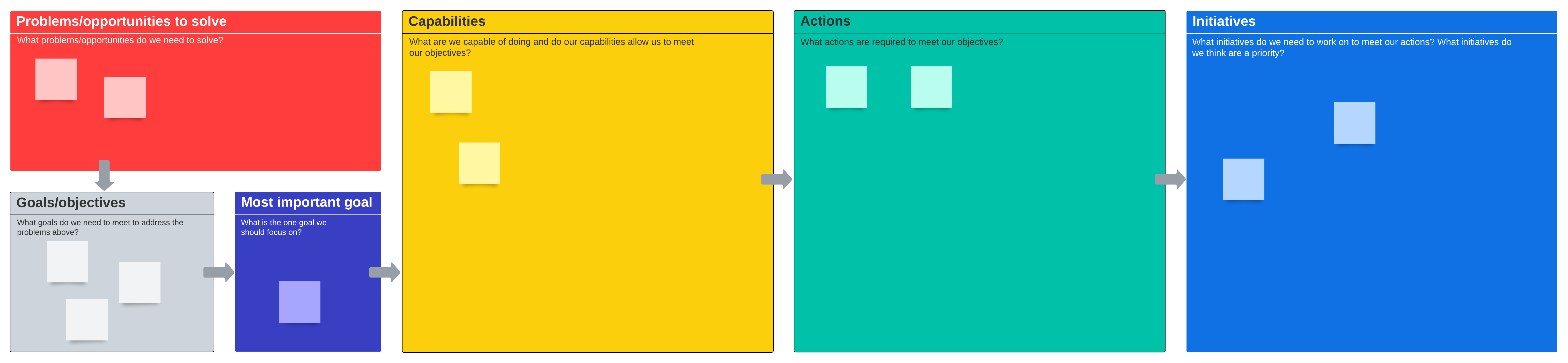
One thing you may discover is that by documenting your adaptive strategy, you’ll be able to understand parts of the process that could be experimented on to discover more efficient methods. Documenting your adaptive strategy within Lucidspark allows you to add commentary after something has been attempted, just as a scientist would add findings after they’ve conducted an experiment.
Adopting an adaptive strategy may feel uncomfortable at first. Your team may feel that determining its own process is much more work than simply adhering to a process that’s been foisted on them by higher in the organization.
You can get in front of that objection by showing them how much more efficient adaptive strategies can be and how much more thrilling it is to be part of a team that’s on the cutting edge of development. Your team won’t worry about stagnation or being bored. Instead, they’ll get to determine the process that works best for them.

Align your team during standups, sprint planning, and retrospectives so you can make your ideas a reality using Agile planning that way it was meant to be.
Get started
