Organizations benefit from diverse ways of thinking. That statement is not just a platitude—it’s backed by research, too. Research has found, opens in a new tab that teams that embrace diversity, and diverse thought, outperform less diverse teams and organizations. By bringing diverse perspectives and communication styles, opens in a new tab together, organizations can inspire collaboration, creative problem-solving, and brainstorming, and drive more engagement and loyalty among team members. It’s a win-win for both culture and innovation.
That said, from a strategic perspective, it’s important to channel different ways of thinking into actionable plans. The creative problem-solving process embraces two types of thinking: convergent and divergent.
Generally speaking, divergent thinking is all about no-holds-barred, creative brainstorming around a problem, while convergent thinking considers other dependencies to come to a feasible solution. The project management process requires both types of thinking. However, there’s a lot to gain from embracing divergent thinking before switching gears to a more pragmatic and practical convergent approach.
So, what is the difference between divergent and convergent thinking?
Below, we'll define each approach, review the pros and cons of convergent vs. divergent thinking, and discuss how to channel divergent thinking in your project management process.
What’s the difference between convergent and divergent thinking?
Introduced by psychologist J.P. Guilford in 1967 as part of a psychometric study of human intelligence, convergent and divergent thinking both play an essential role in finding the best solution to a problem.
Convergent vs. divergent
Divergent thinking takes the handcuffs off of traditional brainstorming with little concern about whether new ideas are feasible or practical—it’s a free-rein approach to problem-solving where inspiration and creativity thrive. Big problems call for big ideas, and when you’re approaching a new problem, it doesn’t serve innovation to think small. In an ideal world, what would be the perfect solution? What would you build if you had the leeway (and plenty of time) to test the most ambitious ideas that come to mind?
Convergent thinking embraces those big ideas but channels them into possible solutions to be considered in the context of other realities, capabilities, and limitations. What contingencies and dependencies might derail that plan? Do you have the resources, time, and budget you need? Will your proposed solution impact other parts of the product or system?
Some great ideas might face the chopping block if they’re too time, cost, or resource-expensive to pull off. Convergent thinking takes an analytic look at the problem and considers every idea and outcome to arrive at the best possible and most feasible solution.
The pros and cons of convergent vs. divergent thinking
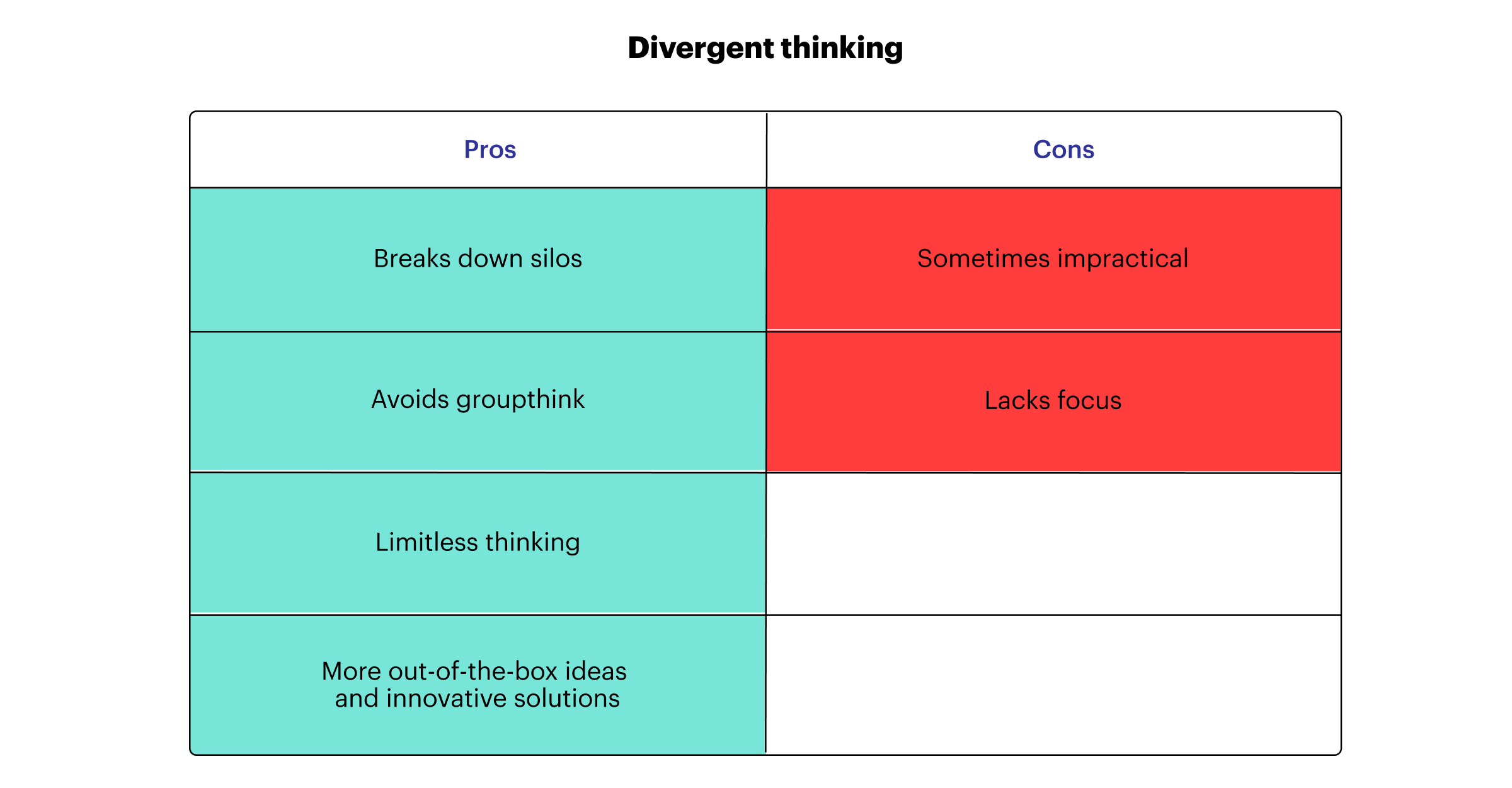
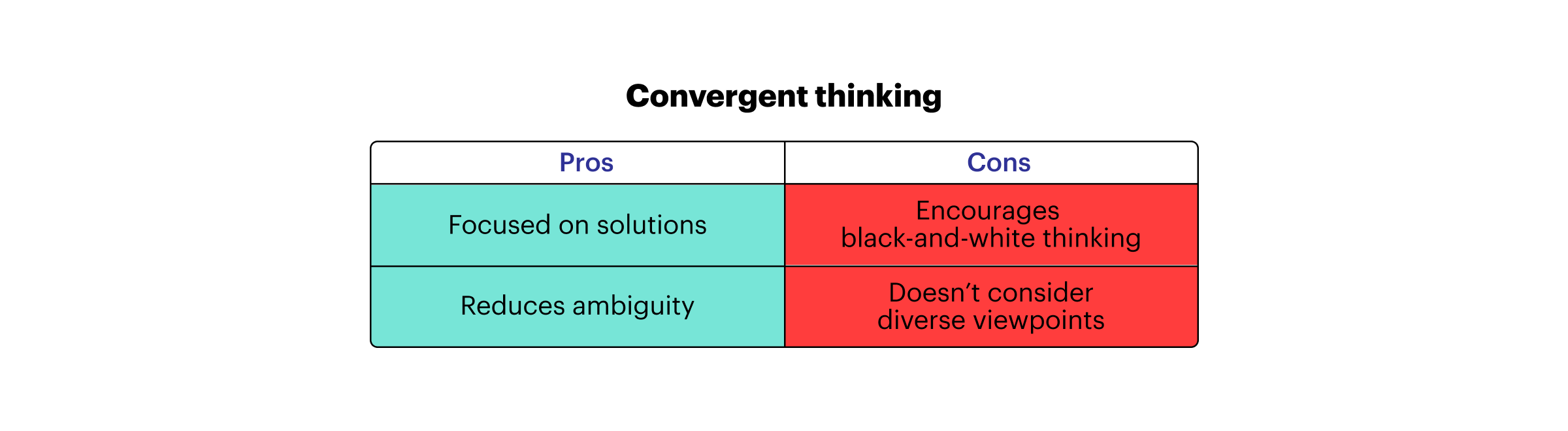
Not every situation requires the same type of thinking, and not every person thinks about problems the same way. Some people are risk-takers, brainstormers, and empathetic thinkers—coming up with innovative, creative solutions to complex challenges comes naturally to them. Others excel at coming up with creative yet practical solutions to a problem. Both divergent and convergent thinking have drawbacks and benefits.
Divergent thinking pros and cons
Convergent thinking pros and cons
Convergent vs. divergent thinking in project management
As a project manager, your goal is to keep work on track. Once you’ve established a project scope, deliverables, and a schedule, new viewpoints and divergent ways of thinking serve to derail your well-laid plans—or complicate the route to establish them. Convergent thinking, meanwhile, embraces structure and solutions. It keeps teams aligned and focused on a singular goal.
As appealing as this convergent way of thinking may be, can limit teams and innovative progress. It’s also an enemy of agile ways of working, opens in a new tab. By relying solely on solution-focused ideas, convergent thinking pigeonholes teams and leaves them reliant on old ideas and old ways of thinking about new problems. When you put restrictions on more creative thinking, you risk hindering the adaptability and flexibility that helps you learn and be innovative along the way. Success comes in the form of “getting things done” rather than innovation.
However, by embracing divergent thinking—particularly during the brainstorming and ideation phase of your project management process—you can tap into a wider pool of knowledge and encourage new solutions. Even if your team can’t ultimately implement those ideas, you’ve taken the reins off your idea of what’s possible.

Try ready-to-use templates for your team’s next ideation session.
Try for freeHow to encourage divergent thinking
As leaders and project managers, it's easy to think of yourself as the calendar keeper or the goad needed to get people to reach their goals. After all, projects need to become realities, and that's not going to happen by magic!
It's critical for leaders to shepherd projects along and produce viable outcomes. But seeing the role in that narrow way makes it more likely that you will overcommit to the details of a project (the planning and logistics) rather than focusing on the big picture. The best project managers help people dream big and deliver. And by combining the power of divergent and convergent thinking, you can help your team excel at both.
Make time for both divergent and convergent types of thinking
Divergent and convergent thinking are both critical to the success of a project, but they mix about as well as oil and water. To encourage people to maximize the benefits of both, start by separating the two processes and following a natural flow of divergent thinking vs. convergent thinking.
Here’s what that might look like in the course of a project:
Phase 1: Divergent thinking
At the beginning of a project, get the creative juices flowing with a true brainstorm session, opens in a new tab. A true brainstorm is different from the quick, ad hoc list-making activities that often pass for the name. In true brainstorming, there are no wrong answers, and there's enough time between the creative phase and the evaluation phase to let new ideas simmer.
Most companies mix brainstorming and evaluation into the same meeting with disastrous results. Most employees won't share their early ideas if they feel like they'll be shot down (38% of employees say they won’t take initiative if they think leaders won't explore their ideas fully), which reduces creativity, morale, and doesn’t always lead to the best solutions.
So educate your employees on the difference between convergent vs. divergent thinking, then create some meetings where the sole point is to come up with big ideas.
Phase 2: Convergent thinking
After people have had some time to mull them over, bring your team back together to analyze the ideas according to specified project goals and existing limitations. That way you'll get fresh thinking alongside your deliverables.
Implement ways to collaborate
Sometimes project managers worry that divergent thinking will result in endless ideation meetings that will bog down the process. But investing in smart collaboration tools and processes can help your team stay nimble while cutting the logistical fat.
The first form of collaboration is human-centered. If you want to get the best results, create teams with people who think differently. While everyone is capable of both divergent and convergent thinking, pairing people who excel at one with people who excel at the other can help your team nail both vision and execution. This is especially true if you've educated your employees on the benefits of both ways of thinking and clearly delineated which part of the process happens when.
You can also invest in a project management software that allows people to communicate in real time about projects and ideas, automates busywork, and allows for flexibility on the organization level. Collaborating in this way cuts down on unnecessary meetings, confusion, and over-planning that robs teams of the opportunity for divergent thinking.
Team leaders don't have to choose between planning and brainstorming or productivity and creativity. By creating clear containers for different types of thinking, you can have both—and a better product.

Inspire creativity with these 6 brainstorming templates.
See templates