The adoption of DevOps processes has been growing for years. With the onset of the COVID-19 pandemic, interest in DevOps soared as companies moved to hybrid and remote work en masse, and speed, efficiency, and flexibility became top strategic priorities. One survey found that 44.3% of professionals had either initiated or accelerated the adoption of DevOps practices at their organization as a result of the COVID-19 outbreak.
Even as businesses begin to stabilize following the disruption of the pandemic, DevOps adoption isn’t slowing down.
In fact, the DevOps market is expected to grow to $24.71 billion in 2027—up from $10.84 billion in 2023.
As the future of IT operations increasingly invests in DevOps, it’s important to understand what the DevOps process looks like and how organizations can best implement this approach.
What is DevOps?
At its core, DevOps is a philosophy and practice focused on agility, collaboration, and automation within IT and development team processes.
Traditionally, software development occurred in silos, with IT and development working independently within their own teams and processes. This separation and competing values created an environment rife with miscommunication, poor alignment, and production delays (some have even nicknamed the operations department the “War Room”).
DevOps is the response to the “us vs. them” culture of development.
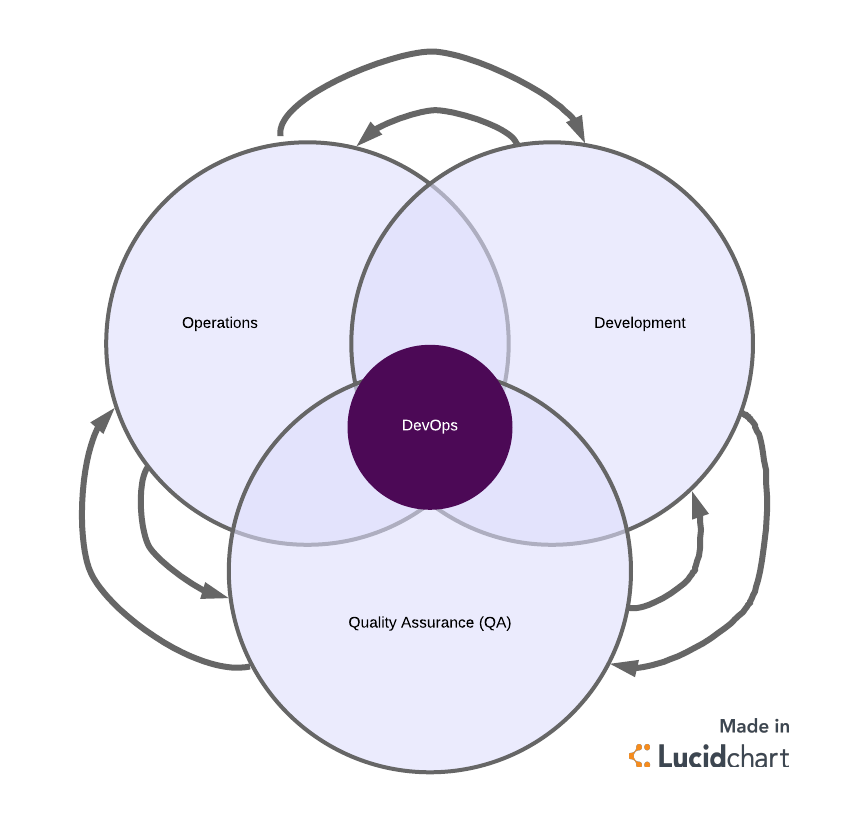
The goal is to bridge the gap between IT operations and development to improve communication and collaboration, create more seamless processes, and align strategy and objectives for faster and more efficient delivery.
DevOps principles
Though DevOps is a practical methodology, it is also fundamentally a mindset and cultural shift in an organization. Several key principles underscore this philosophy:
- Automation: Automate everything, such as workflows, testing new code, and how your infrastructure is provisioned to cut down on waste and overwork.
- Iteration: Write small chunks of code during a time-box sprint to support releases and sub-releases that increases the speed and frequency of deployments.
- Continuous improvement: Continuously test, learn from failures, and act on feedback in order to optimize performance, cost, and time to deployment.
- Collaboration: Unite teams, foster communication and breakdown silos between development, IT operations, and quality assurance.
The principles of DevOps often extend the lean agile mindset to operations primarily with a focus on automation and tooling to accomplish faster deployment.
Automation (and the tools that support it) allow developers and IT professionals to combine their efforts into one seamless process and adopt agile practices like continuous integration, delivery, and deployment. This process enables collaboration throughout the entire development pipeline from concept and builds to deployment and testing.
Additionally, DevOps principles prioritizes iterative processes that make space for continuous testing and feedback. Again, this practice makes it possible to accelerate the development process, but it also improves the quality and security of the products.
By continually testing, monitoring, and iterating on feedback with smaller but more frequent deployments, implementing the principle of DevOps in your organization successfully closes the loop between users, developers, and IT operations.
Benefits of DevOps
While it isn’t a magic bullet, DevOps processes can solve many of the common pain points surrounding a traditional IT organization.
Its focus on collaboration, automation, and agility can have significant benefits, including:
- Faster time to market
- Higher ROI
- Greater user/customer satisfaction
- Increased efficiency
- Improved collaboration
- Early detection and correction of issues
As teams work together seamlessly, supported by both process and culture, one of the many benefits of DevOps includes greatly reduced risk of miscommunication or misalignment. Clear communication results in increased efficiency and, ultimately, higher-quality products.
Additionally, agile practices, such as continuous integration and deployment, combined with automated testing and regular feedback both accelerate the development process and ensure that bugs or other issues are detected and managed early.
Altogether, it’s no wonder so many organizations are rushing to adopt this mindset in order to reap the benefits of DevOps processes. When implemented correctly, a DevOps process results in better products, happier customers, and healthier bottom lines.
The DevOps process flow
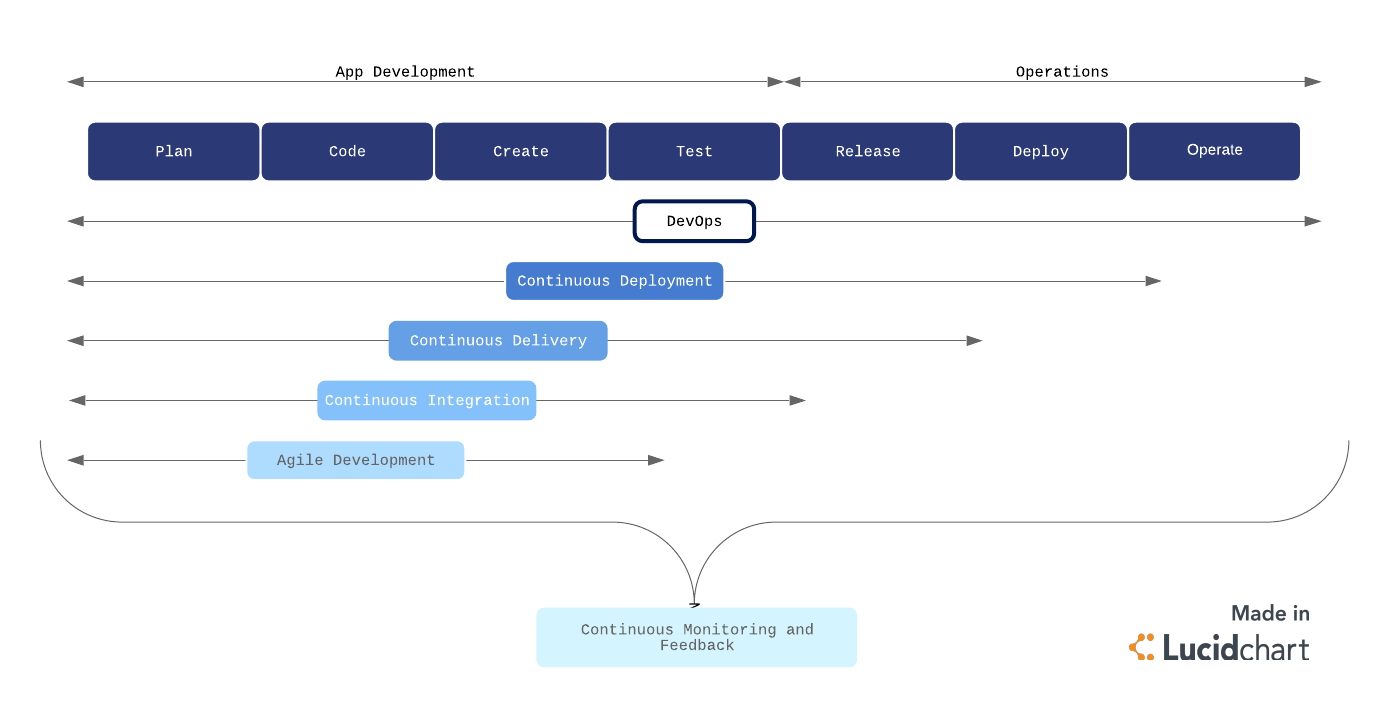
The DevOps process flow is all about agility and automation. Each phase in the DevOps lifecycle focuses on closing the loop between development and operations and driving production through continuous development, integration, testing, monitoring and feedback, delivery, and deployment.
Continuous development
Continuous development is an umbrella term that describes the iterative process for developing software to be delivered to customers. It involves continuous integration, continuous testing, continuous delivery, and continuous deployment.
By implementing a continuous development strategy and its associated sub-strategies, businesses can achieve faster delivery of new features or products that are of higher quality and lower risk, without running into significantly bandwidth barriers.
Continuous integration
Continuous integration (CI) is a software development practice commonly applied in the DevOps process flow. Developers regularly merge their code changes into a shared repository where those updates are automatically tested.
Continuous integration ensures the most up-to-date and validated code is always readily available to developers. CI helps prevent costly delays in development by allowing multiple developers to work on the same source code with confidence, rather than waiting to integrate separate sections of code all at once on release day.
This practice is a crucial component of the DevOps process flow, which aims to combine speed and agility with reliability and security.
Continuous testing
Continuous testing is a verification process that allows developers to ensure the code actually works the way it was intended to in a live environment. Testing can surface bugs and particular aspects of the product that may need fixing or improvement, and can be pushed back to the development stages for continued improvement.
Continuous monitoring and feedback
Throughout the development pipeline, your team should have measures in place for continuous monitoring and feedback of the products and systems. Again, the majority of the monitoring process should be automated to provide continuous feedback.
This process allows IT operations to identify issues and notify developers in real time. Continuous feedback ensures higher security and system reliability as well as more agile responses when issues do arise.

Use value stream mapping in DevOps.
Learn howContinuous delivery
Continuous delivery (CD) is the next logical step from CI. Code changes are automatically built, tested, and packaged for release into production. The goal is to release updates to the users rapidly and sustainably.
To do this, CD automates the release process (building on the automated testing in CI) so that new builds can be released at the click of a button.
Continuous deployment
For the seasoned DevOps organization, continuous deployment may be the better option over CD. Continuous deployment is the fully automated version of CD with no human (i.e., manual) intervention necessary.
In a continuous deployment process, every validated change is automatically released to users. This process eliminates the need for scheduled release days and accelerates the feedback loop. Smaller, more frequent releases allow developers to get user feedback quickly and address issues with more agility and accuracy.
Continuous deployment is a great goal for a DevOps team, but it is best applied after the DevOps process has been ironed out. For continuous deployment to work well, organizations need to have a rigorous and reliable automated testing environment. If you’re not there yet, starting with CI and CD will help you get there.
Implementing DevOps workflow in your organization
If you haven’t yet implemented a DevOps process in your organization, the task can seem daunting. Keep in mind—it is not only a process shift but a cultural shift as well.
As you strive for successful DevOps workflow adoption, consider implementing it in stages. Depending on where your organization currently stands, you may want to build on an agile approach for DevOps implementation.
A gradual implementation sequence might look like this:
- Establish an agile development process
- Adopt cloud computing
- Adapt your processes to a CI and CD workflow
- Automate your software deployment
- Automate software testing
- Implement continuous deployment
Keep in mind that DevOps automation brings with it both an infrastructural and tooling shift. Without the proper infrastructure and tools to support your processes, you risk having gaps in your DevOps process flow. To create a true DevOps environment, each stage of the development pipeline should be as automated and agile as possible.
Also consider how visuals can help you map out your DevOps processes and understand everything from who is working on what, to timelines, and process flows. Visuals can ease the implementation process, keeping everyone on the same page from the start.
DevOps tools to help you map your processes
While DevOps is as much about mindset as it is about process, there are still many moving parts to keep track of. As you adapt your processes to a DevOps environment, consider using these DevOps tools to stay on point.
- Git: A distributed source code management DevOps tool that allows you to track your development progress. Easily save or revert back to different versions of your source code and leverage features like branching, staging areas, and different workflow options.
- Lucidchart: A visual workspace that helps developers and IT managers create robust, easy-to-understand diagrams of processes, teams, and data. You can use Lucidchart as a DevOps tool to model your new DevOps process flow to train team members, document handoffs, track ongoing development progress, and keep everyone on the same page.
- Kubernetes: Take containerization to the next level by grouping into logical units, deploying in clusters, and automating distribution and scheduling. Kubernetes is a popular open-source system and DevOps tool that helps teams move their projects forward at scale.
- Raygun: Monitor your errors and crash reports with Raygun, an application performance monitoring platform. This DevOps tool can help you diagnose issues and track the error all the way back to a specific line of code, function, or API call.
One of the biggest challenges for IT managers is managing a large toolchain. Whatever tools and applications you use to make DevOps work, Lucidchart can help you keep everything straight.
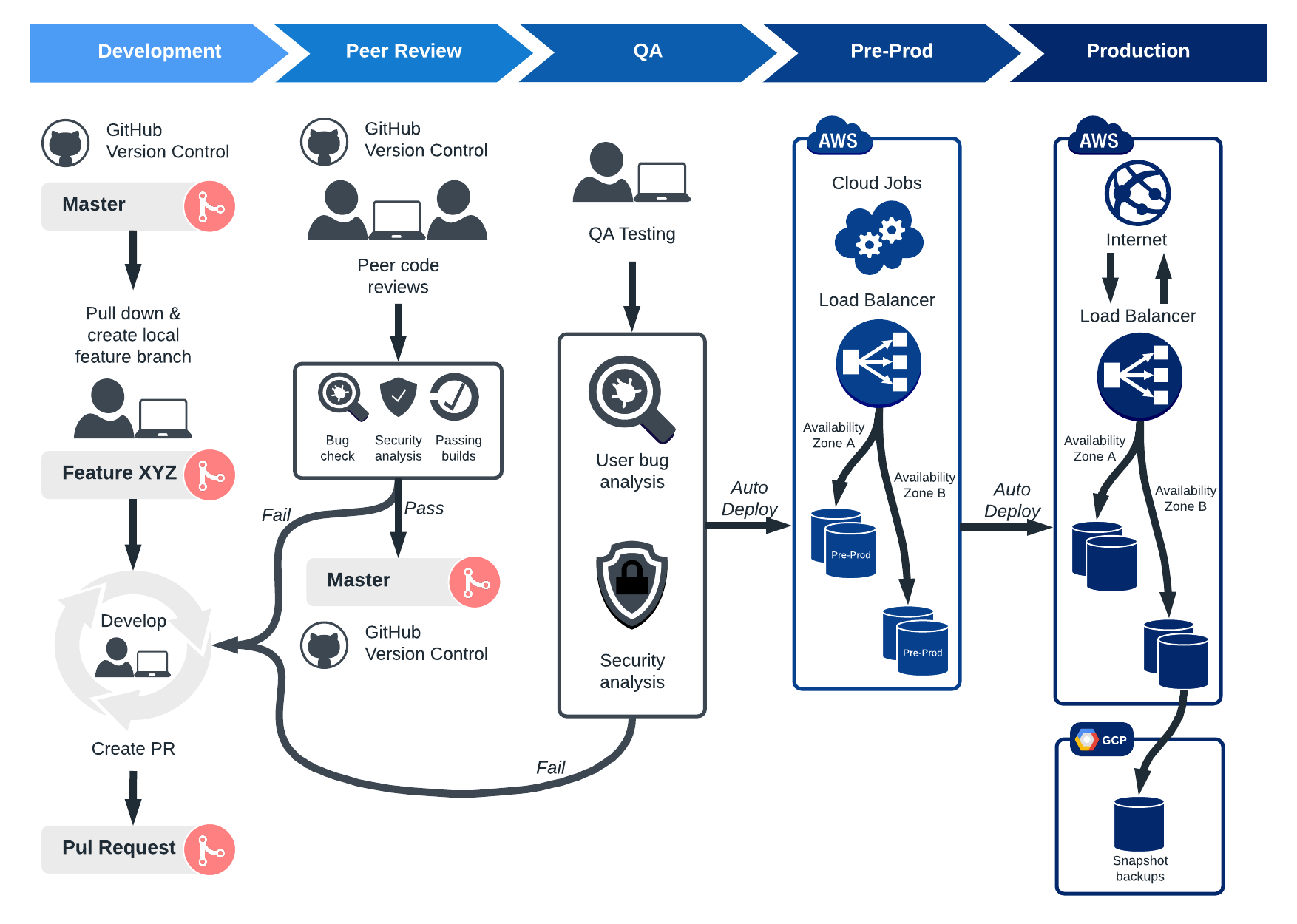
Lucidchart can help you map out your toolchain and identify how each tool interacts with your DevOps processes. Plus, data linking allows you to connect your diagrams with live source data. You can monitor your application status in real time so you can proactively address issues and communicate with team members to resolve problems.

Optimize your DevOps strategy
Visualize your DevOps processes and deploy quality products with Lucidchart
Learn how