Everyone knows that collaboration is a critical functionality in any organization, and everyone knows their collaboration can be improved. However, where to start can often be a tricky question. Collaboration blind spots could be unintentionally slowing you down, and uncovering those blind spots can help you accelerate work to accomplish key business initiatives.
That’s where a collaboration assessment comes in, and Lucid’s here to help. We’ve developed a collaboration evaluation that you can use for your team to identify exactly which qualities of collaboration your team excels at and which areas need focus and improvement.
This blog post will walk you through the key collaboration areas that every team should be strong in, and you’ll learn tips on how to effectively evaluate your team’s collaborative effectiveness.
What is a collaboration assessment?
A collaboration health assessment guides teams through a discovery process that helps them step back and evaluate how they are systematically collaborating, and addresses collaboration as a fundamental capability of business. Many teams have a vague sense that positive collaboration drives business results—but what exactly is positive, healthy collaboration?
On the professional services team here at Lucid, we’ve had years of experience in helping organizations collaborate better. After conducting a quantitative and qualitative analysis across various roles and organizational levels, we've identified five key areas that companies should be secure in for successful collaboration. These areas are:
-
Clarity
-
Impact
-
Environment
-
Conflict
-
Autonomy
Together, these five areas form what you can consider your collaboration North Star: principles that anchor effective and equitable collaboration for your entire team.
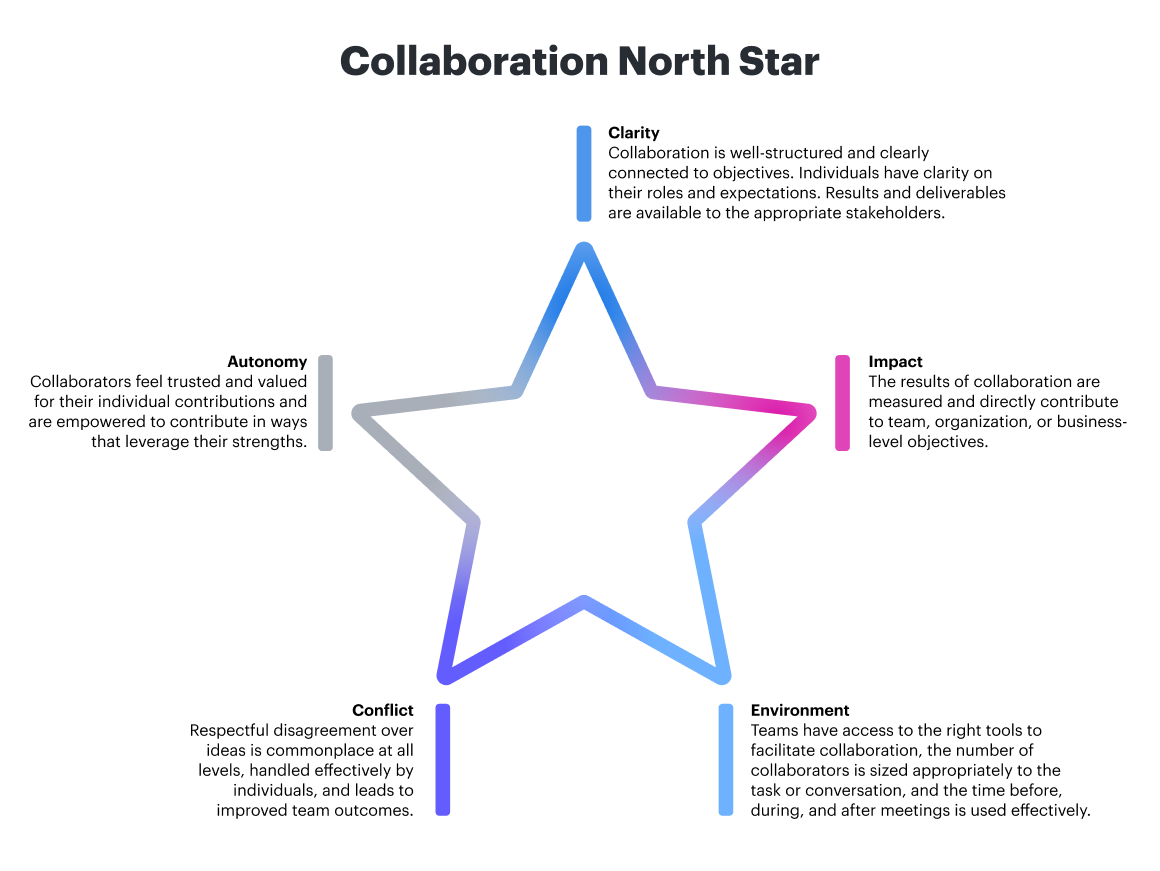
Using this collaboration North Star as a standard, we can assess how your team is collaborating, where they are strong, and where there is room for improvement. This assessment can also help you identify organizational behaviors that improve overall productivity and psychological safety, opens in a new tab for your team, so you can foster those behaviors for organizational development.
Whatever your business’s goals may be for collaboration, it’s crucial to identify what needs to be improved first. Hence, the North Star—five key areas that will help guide you onward.
The benefits of conducting a collaboration health assessment
The great thing about a collaboration assessment tool is that it provides a way for you to identify what exactly needs to be changed on your journey to improve collaboration. After all, you can’t fix what you don’t know is broken. An assessment is the first fundamental step to understanding key collaboration areas that need to be strengthened; then you can approach the process of improving collaboration strategically.
Conducting an assessment helps you get feedback and data on the current state of your collaboration so you can make more informed decisions. It provides a clear opportunity for team members to provide feedback on what’s working well and what isn’t, helping you gain insight into which collaboration gaps are the most critical. Doing a collaboration health assessment with your team can also help you strengthen psychological safety, enhance communication, and address conflict more effectively.
At Lucid, we’ve not only created a collaboration health assessment template, but our template specifically uses intelligent capabilities to help you automatically see areas to strengthen. Our assessment utilizes Visual Activities, a feature that helps you gather the input of every member of your team and quickly see results in one central spot—allowing you to visualize the data in different ways. Check out Lucid’s collaboration assessment template and read on for more information on how to use it effectively.

The five key qualities to assess for collaboration
The following are the five qualities that define collaboration as a whole, forming a North Star you can aim for as you identify how to improve your collaboration.
We’ll walk you through some criteria for assessing each area. Share our collaboration assessment template with your team and have each individual answer the questions. Once you’ve gathered responses, you can dig into the automatically aggregated results to view your strengths and weaknesses and decide on action steps as a team.
Remember, each of these areas is equally important for collaboration and should work together to foster a healthy work environment.
Clarity
Often for collaboration to be successful, you need to have a strong “why.” What is your business trying to achieve, and how do individual employees play their part? It helps to ensure that people have clarity on their roles and expectations. There also should be clear ways to communicate, ask questions, and receive feedback so everyone understands where to get the information they need to move initiatives forward.
To assess clarity, ask your team questions such as:
-
How clear are the goals or purpose of our team or collaboration?
-
Is the team aligned on why the company has invested in our team or the value we are expected to return on that investment?
-
Does everyone clearly understand their roles and responsibilities in our collaboration?
-
Are resources and deliverables easily accessible for collaborators and stakeholders?
To provide clarity among your team, it helps to use visual collaboration as a single source of truth and provide a place for everyone to gather and centralize information. With visual collaboration, not only can you host all of your documentation in one place for easy access, you can bring everyone together to collaborate and ensure your team has clarity for their tasks and interactions.
Create a single source of truth for your team
Learn how to build and implement a single source of truth in our in-depth guide.
Explore our guideImpact
This area of collaboration ties closely with clarity. To have truly successful collaboration, it’s important to make the connection between your “why” and how it impacts people on the individual level. Connect individual tasks to overarching objectives and make it easier for employees to see exactly what kind of impact they make as they support those objectives.
To assess impact, ask:
-
Do people understand company-wide objectives and team objectives, and can they connect their individual impacts to these larger objectives?
-
Is the impact of meetings and collaboration regularly evaluated, and if they are no longer useful, are they discontinued?
-
How is success measured, and is everyone familiar with those metrics?
-
Is there accountability to impact?
People should not only be aware of the impact they make, they should be able to see their impact, whether that’s through quantifiable collaboration metrics, opens in a new tab or notes of appreciation from colleagues. Pinpoint ways that you can improve this awareness and visibility to increase people’s sense of impact in collaboration.
How emphasizing impact helps build high-performing teams
Highlighting individual impact is one of the ways you can create a high-performing team. Learn more in our in-depth guide.
Check it outEnvironment
A comfortable, efficient environment is extremely important for collaboration. When you prioritize creating the right environment for people to confide in each other and build off of each other, this fosters connectivity. It’s important to take into account each individual and provide a central place for everyone to come together and contribute equally, especially for distributed or hybrid teams.
Consider where and how you facilitate collaboration, and ask yourself questions such as:
-
Do we collaborate in a setting that is comfortable and effective for everyone involved?
-
Do we have the right tools to collaborate and ensure that time is used effectively before, during, and after our collaborations?
-
Have we established cultural norms, such as how to communicate and how often to collaborate in real time versus what can be done asynchronously?
It also helps to make sure the number of contributors is appropriately sized to the task at hand and that any questions or ideas are welcomed. When people feel that they’re working in a safe, welcoming environment, this makes it easier to collaborate.
Set up your hybrid workplace for maximized collaboration
If you work on a hybrid team, learn how to make the most out of your environment for effective collaboration.
Read moreConflict
In successful collaboration, conflict is not only welcomed, but it can also lead to improved outcomes by providing a safe environment for discussion and dissent. Assess whether constructive conflict is taking place by asking questions such as:
-
Do people feel comfortable disagreeing with their colleagues, and how does our collaboration encourage this?
-
Do leaders and senior members take added measures to ensure they aren't subconsciously stifling dissent?
-
Can our teams have difficult and sensitive conversations without becoming offended?
-
Once decisions are made, does the team come together to address action steps?
Embracing conflict can help foster psychological safety and build meaningful relationships while uncovering a more diverse range of ideas. Don’t be afraid to have contributory dissent in your collaboration; it’s a healthy way to express differences. We encourage teams to use Visual Activities in Lucid to uncover areas of disagreement and make it easier to start having conversations on why that conflict is there.
How contributory dissent helps collaboration
Learn how you can encourage healthy disagreement and debate among your team to help people express their differences.
Read moreAutonomy
When your employees have autonomy, people feel valued for their individual contributions and are empowered to leverage their individual strengths. The more autonomy people have, the more engaged and invested they are—not only in everyday work tasks but also in supporting larger company-wide goals.
To assess autonomy, ask questions such as:
-
Do people feel empowered to diverge as appropriate and explore adjacent problems and opportunities during the discussion?
-
Is the structure of the collaboration sufficiently flexible to meet new opportunities and problems if they arise?
-
Are people given opportunities to leverage their strengths?
-
Does everyone have an equal opportunity to voice their ideas?
Collaboration equity is key to autonomy. Using visual collaboration helps equal the playing field by providing everyone the same opportunity to contribute questions, ideas, and feedback. In Lucid, people can use sticky notes and other features like Visual Activities to have their voices heard, no matter their collaboration type or level of seniority.
How to promote collaboration equity
Learn more about what collaboration equity is and how to foster it on your team.
Read the guideTips on how to use a collaboration health assessment for more successful collaboration in the workplace
After our breakdown of each of the five key areas to collaboration, you might be ready to give a collaboration health assessment tool a try. Before you start, here are some tips on how to use an assessment tool effectively:
-
Remember, all five areas are essential. It’s crucial that each of the five collaboration areas we’ve identified work together. For example, conflict has a lot to do with the environment, and clarity helps you define impact. The value of these areas lies in strengthening all of them. If you’re strong in four areas, that doesn’t necessarily mean you have healthy collaboration.
-
Use Visual Activities in Lucid to guide your assessment. By using Visual Activities, you can use your collaboration assessment with a large number of people all at once to quickly and effectively assess collaboration. Visual Activities also make it easier to see areas of disagreement and identify the areas where you can make improvements. Plus, Lucid’s Visual Activities support a lot of what we’ve already discussed—ensuring that everyone has an equal chance to be heard, for example, and providing a safe environment for disagreement. Consider using private mode to encourage psychological safety.
-
Improvement doesn’t happen overnight. Assessing your team’s collaboration is just the first step toward improving. Use your collaboration assessment tool as a North Star to guide you along your journey, consistently checking in with team members about what’s getting better and what’s not. Improvement involves feedback loops, and you may need to revisit your assessment tool over and over again.
-
Determine action steps after conducting the collaboration assessment with your team. Once you’ve uncovered your areas of weakness, discuss together the steps you can take to strengthen those areas. You can facilitate a brainstorming session right in the same template as the collaboration assessment, so those next steps are identified when the information is still top of mind. By coming up with ideas for improvement together, your team will already be well on its way to strengthening the way you work.
-
Use the assessment to scale collaboration improvements throughout your organization. Achieving business initiatives—like process improvement, improved agility, and cloud transformation—require the entire company to be aligned. When you’re ready, Lucid helps you scale improvement on the organizational level so that collaboration is strengthened across teams.
Assess and improve collaboration with Lucid
It’s not always easy to identify how you need to improve collaboration, but that’s where Lucid is here to help. Lucid’s professional services team can walk you through a collaboration health assessment and help you determine which areas of collaboration you need to strengthen. With our personalized support services and customized training, we can help you identify specific action steps so you have everything you need to enhance your team’s collaboration and drive business transformation.

Contact us today
Get in touch with our team and learn more about how Lucid’s tailored services help you accomplish your organizational goals.
Learn more