-
VUCA stands for the volatility, uncertainty, complexity, and ambiguity that companies face during rapidly changing times.
-
Visualizing work processes, creating a unified vision, and fostering adaptability are key aspects of a successful VUCA approach.
- Lucid’s templates and diagramming capabilities help leaders establish a VUCA strategy that strengthens business resilience.
From rapidly changing market conditions to uncertainty of what’s next, it can seem like businesses are constantly trying to stay afloat.
The VUCA framework helps companies interpret challenges and develop strategies to become more resilient. By using a framework like VUCA, leaders and decision makers can strengthen organizational adaptability to remain resilient and successful despite changing times.
Learn more and get strategic tips on how to use VUCA for your business with our breakdown of VUCA below.
What is VUCA?
VUCA is a framework that was developed by the U.S. Army War College in 1987 to describe a more complex world after the end of the Cold War. A “VUCA world” is one in which people face volatility, uncertainty, complexity, and ambiguity. Situations are dynamic, unpredictable, and constantly shifting due to disruptions.
While VUCA was first created in a war context, the framework has been adapted for strategic leadership at companies around the world. VUCA can be used to determine how businesses perceive and adapt to challenges.
Elements of VUCA
While VUCA can be challenging, there are approaches you can take to face it. We’ll break down each element of VUCA and provide strategies you can implement to effectively adapt.
Volatility
Volatility is the rate of dynamic change. When change occurs rapidly—for example, during the COVID-19 pandemic, when many people lost their jobs or were sent to work from home—this can create instability. During times of volatility, companies are constantly attempting to adjust and struggle to remain competitive or effective.
To adapt to volatility, businesses can practice operational resiliency, focus on strategic decision-making, and invest in employee skills so that employees can take on a variety of scenarios. Proactive, long-term planning helps companies survive through turbulent times and seize opportunities when they emerge.
Make sure communication is strong so employees understand the business’s plans. Developing and communicating a strong vision is essential for dealing with volatility.
In fact, Jeff Rosenbaugh, Lucid’s senior director of professional services, recommends using the 7x7 concept, in which you communicate about a change to your employees at least seven different times in seven different ways. Many people are surprised to hear about this concept, but when facing volatility, repetition and constant communication is key.
Uncertainty
Uncertainty is the lack of predictable or available information. During times of uncertainty, it’s difficult to know what will happen next. Businesses don’t have clarity into customer expectations or what their competitors are doing.
There are different types of uncertainty that may impact businesses:
-
Economic uncertainty, such as recessions
-
Technological uncertainty due to new technologies, such as the development of AI
-
Social uncertainty, like shifting consumer trends
-
Environmental uncertainty, such as disruptions to a supply chain that makes it difficult to plan production or delivery
To adapt to uncertainty, it helps to diversify resources such as revenue streams and supply chains. Train employees on new technologies, monitor industry trends, and conduct scenario planning to prepare for different factors that may make an impact. Fostering a culture of collaboration and adaptability empowers employees to respond effectively to uncertainty.
Complexity
Complexity refers to the interdependence of and interconnectivity between different parts of a system. Employees, products or services, customers, and competitors make up an evolving system that constantly interacts with itself. The more parts within a system, the more complex it is.
For example, a global company that has international offices with a distributed workforce and multiple products will face more business complexity than a local bakery that specializes in cupcakes.
Complexity is inherent in every business, but there are a few strategies for navigating complexity. Performing retrospectives with your team can help people understand and manage complexity, since retrospectives provide an opportunity to learn and reflect together.
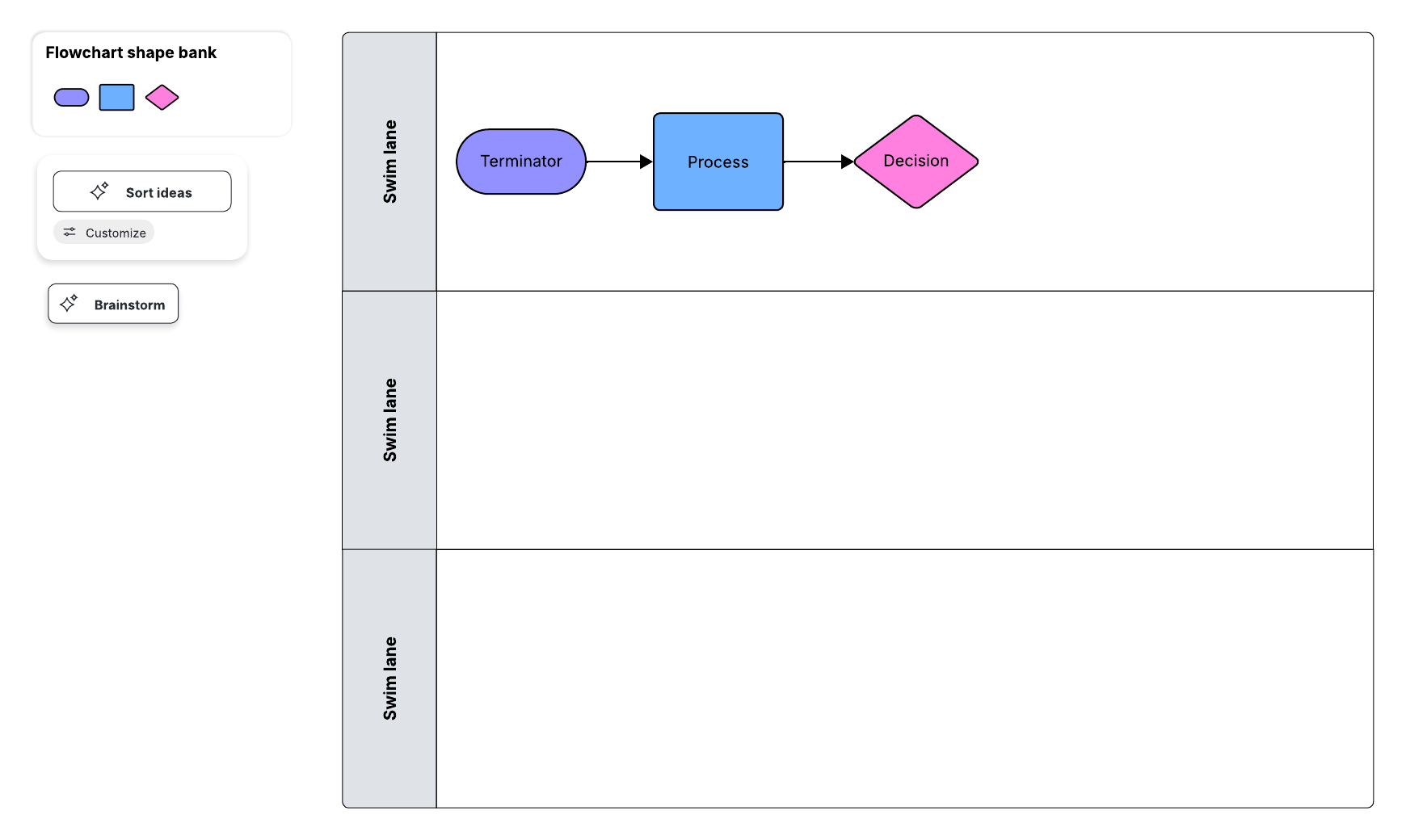
Visualizing processes is another great approach, using diagrams to map business processes and systems. Visualizing complexity makes it easier to understand the interdependence of relationships and identify bottlenecks.
Ambiguity
Ambiguity is when the meaning or understanding of something is unclear. Even when information is provided, sometimes it’s hard to fully know what’s going on or what can be done to improve or resolve a problem.
Unlike uncertainty, where information is lacking, ambiguity occurs when relevant information is available but the general meaning or understanding is still unknown. For businesses, ambiguity may occur when responsibilities are unclear, there is no defined target audience, or metrics for success have not been established.
Some approaches that teams can take to resolve ambiguity include developing problem-solving skills and planning possible alternatives. A few problem-solving techniques include brainstorming and conducting an analysis such as a SWOT analysis or root cause analysis.
Problem solving helps people in ambiguous situations use available information to make informed decisions. Another way to manage ambiguity is to establish clear channels of communication and communicate often.
How to use VUCA for your business
While a VUCA world is intimidating, adapting the VUCA framework and establishing an approach helps companies navigate complex, unpredictable business environments.
Use Lucid to create and share a unified vision of your VUCA approach as you encourage teams to practice agility and embrace change. In Lucid, you can map out workflows, enhance transparency, and facilitate decision-making thanks to collaborative features and intelligent diagramming capabilities.
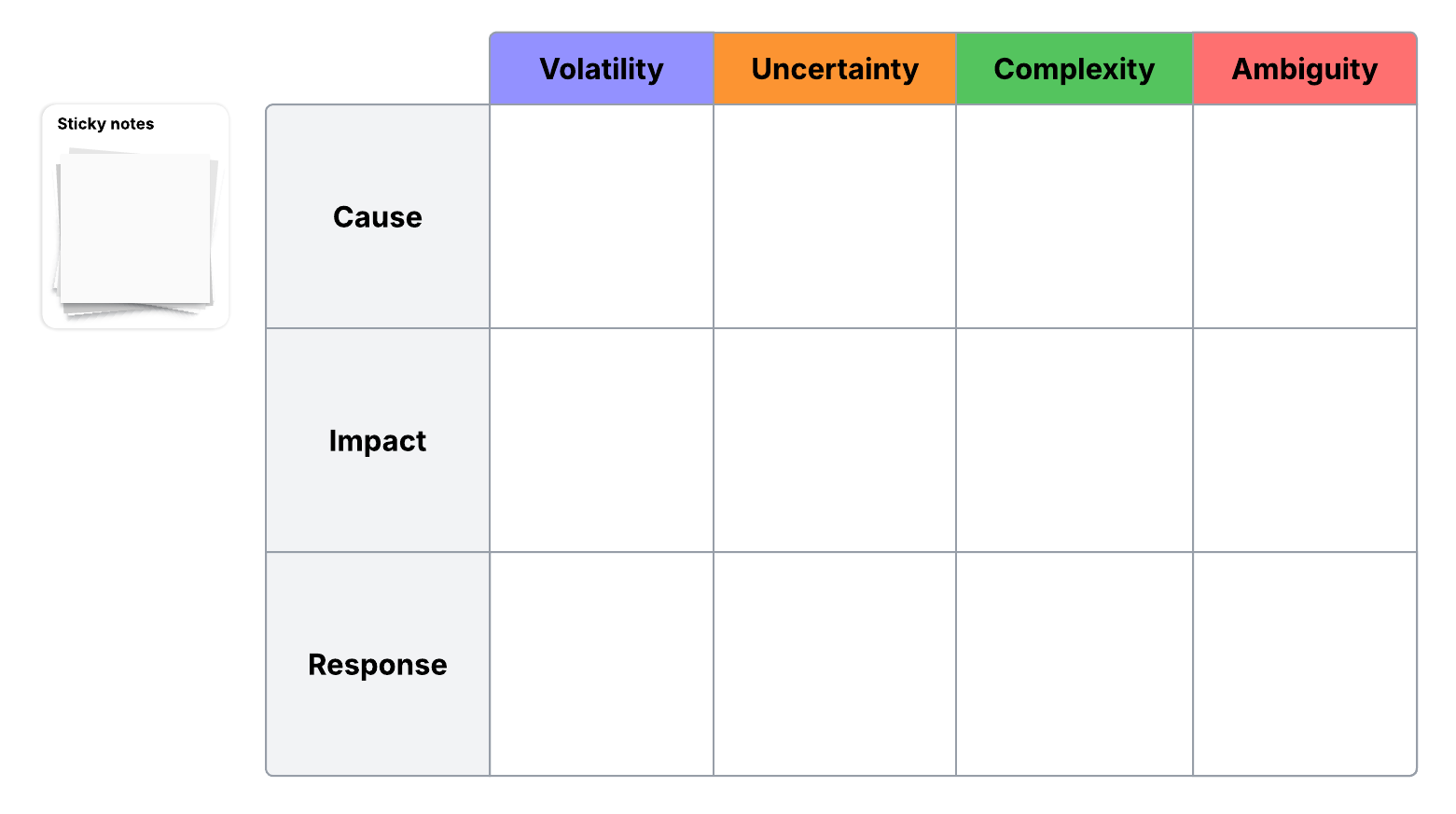
In volatile, uncertain times, communication and understanding are more important than ever. To get started on your VUCA approach, use the following template to develop a comprehensive approach to risk management and prepare teams for fluctuating market conditions.
A VUCA world can be difficult for leaders, but having a plan and communicating your strategy to employees makes all the difference. Strengthen communication and resilience for your business by using Lucid for your VUCA approach.

Learn more about effective risk management
Learn the five key steps to risk management to strengthen your business even during uncertain and complex times.
Read more