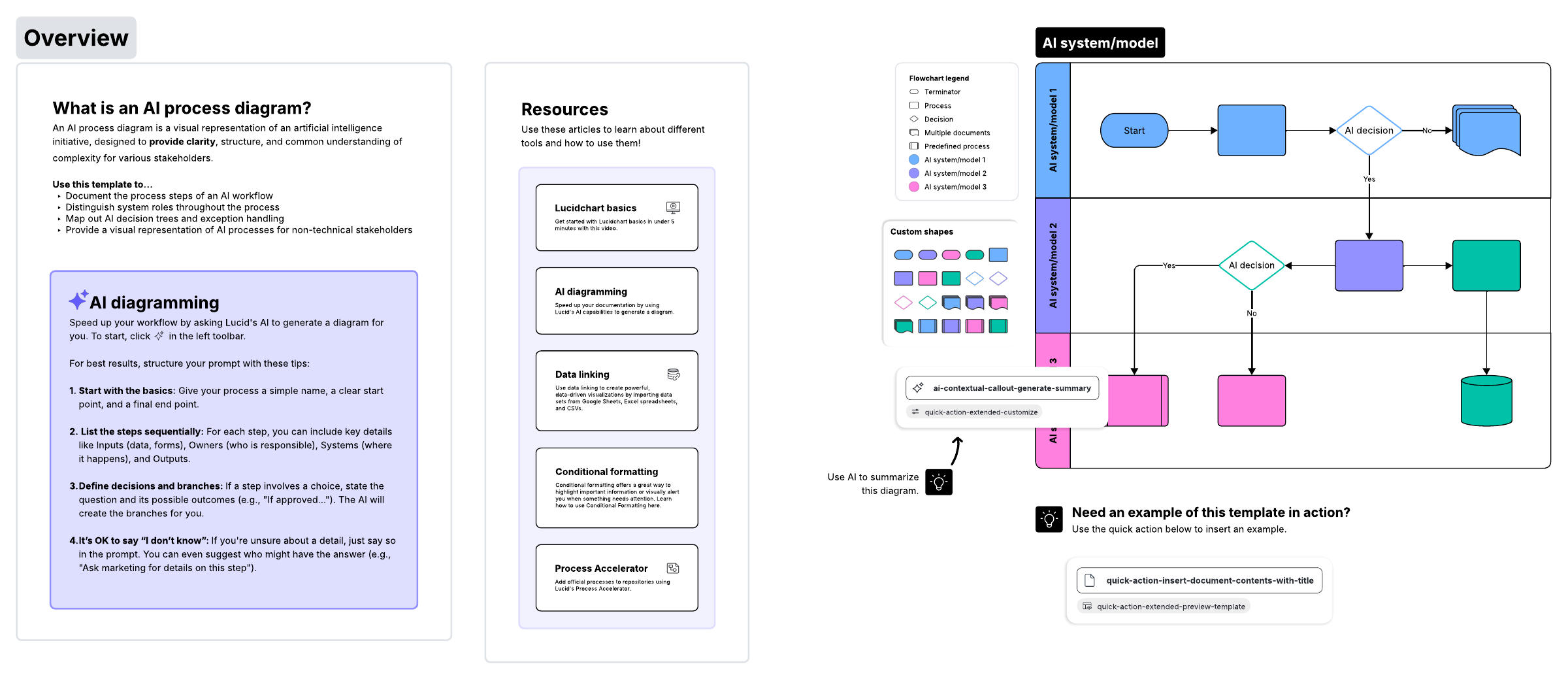
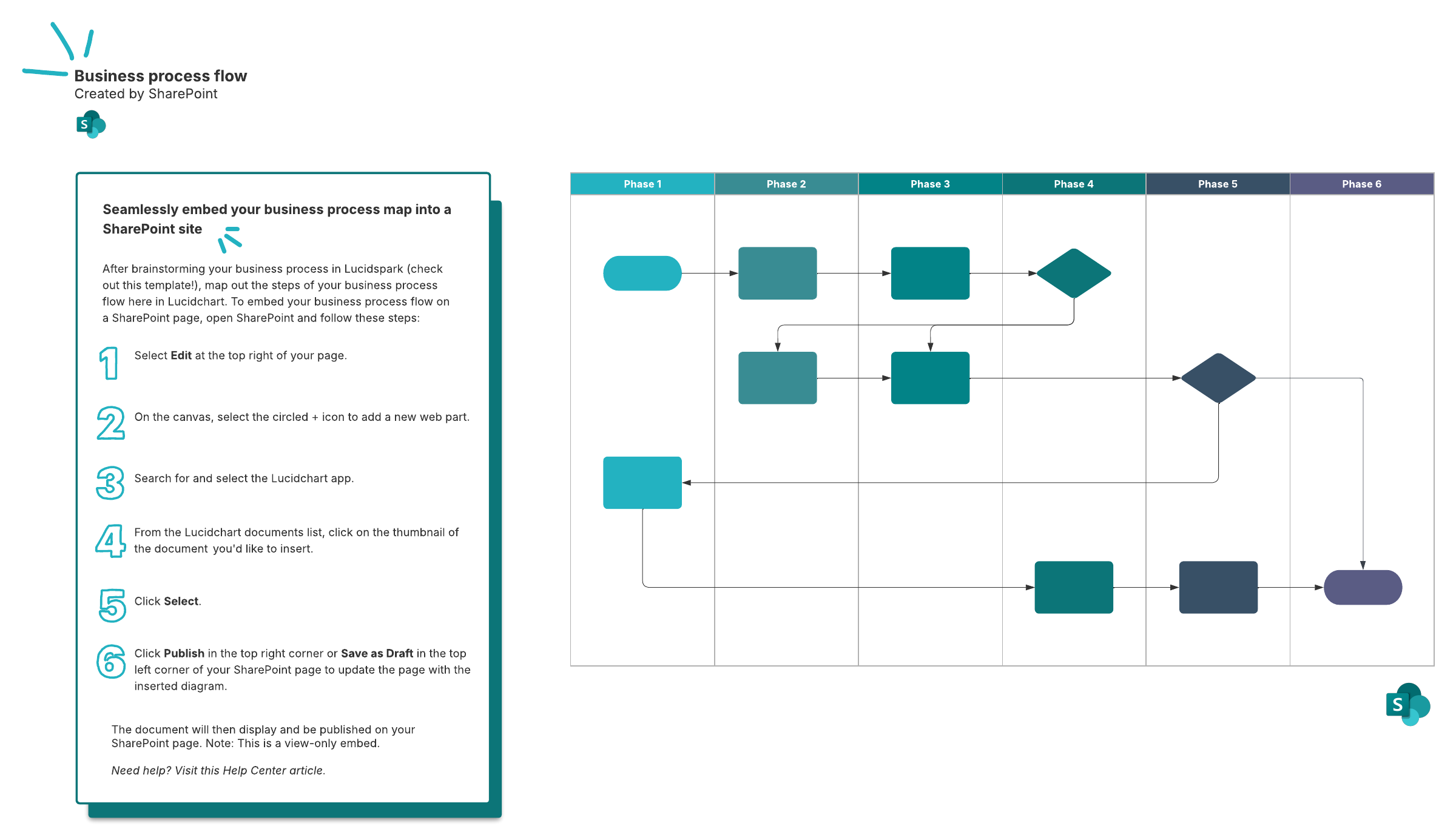
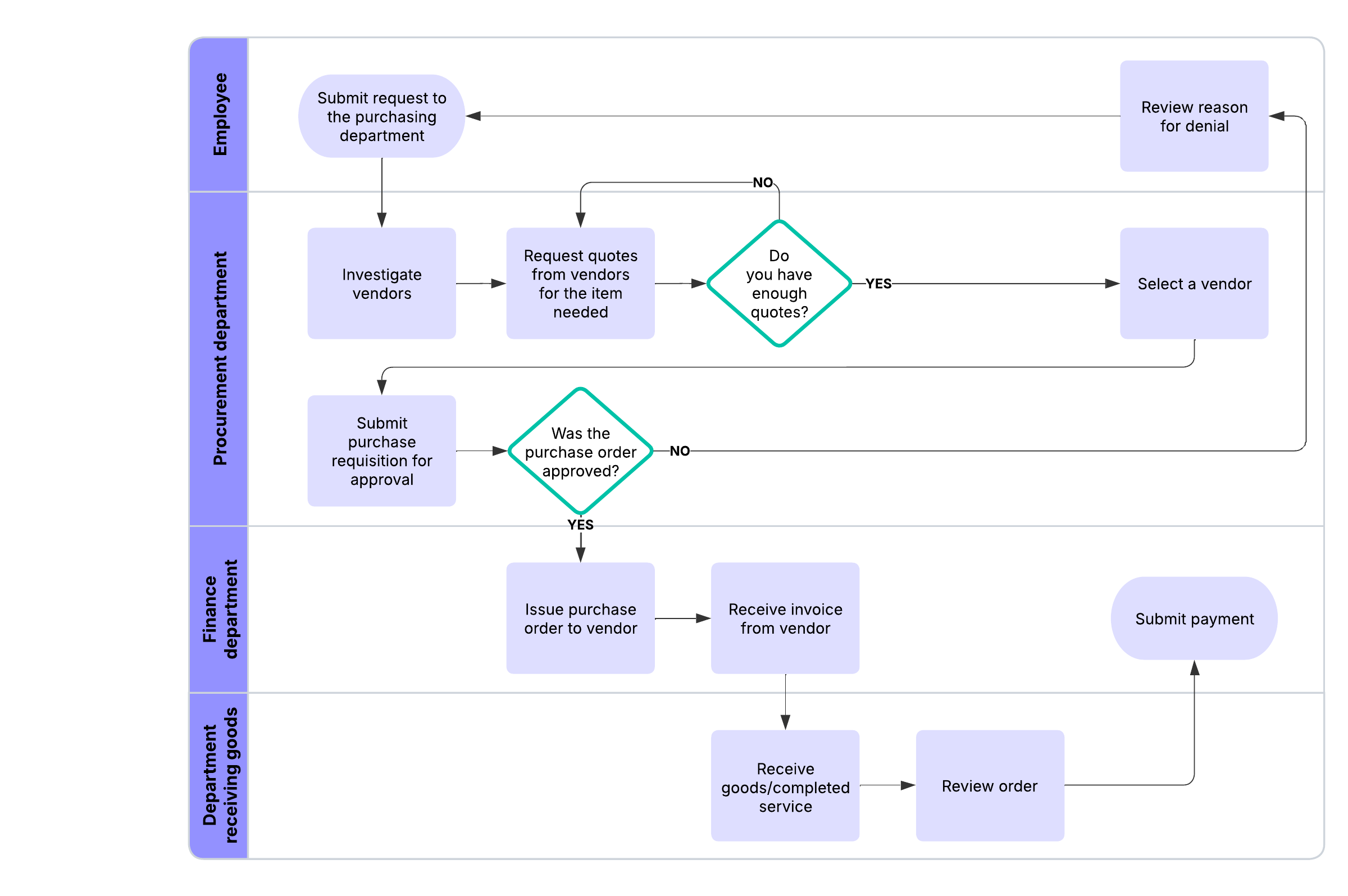
Lucidchart is the best process flow diagram software available because it offers extensive features and shapes relevant to every industry trying to map out the process flow for any type of department, campaign, or means of standardization for a company or team. Learn the essentials of process flow diagrams (PFD), including the history, benefits and helpful tips with this guide.
What is a process flow diagram?
A Process Flow Diagram (PFD) is a type of flowchart that illustrates the relationships between major components at an industrial plant. It's most often used in chemical engineering and process engineering, though its concepts are sometimes applied to other processes as well. It’s used to document a process, improve a process or model a new one. Depending on its use and content, it may also be called a Process Flow Chart, Flowsheet, Block Flow Diagram, Schematic Flow Diagram, Macro Flowchart, Top-down Flowchart, Piping and Instrument Diagram, System Flow Diagram or System Diagram. They use a series of symbols and notations to depict a process. The symbols vary in different places, and the diagrams may range from simple, hand-drawn scrawls or sticky notes to professional-looking diagrams with expandable detail, produced with software.

History
This type of diagram has its roots in the 1920s. In 1921, industrial engineer and efficiency expert Frank Gilbreth, Sr. introduced the “flow process chart” to the American Society of Mechanical Engineers (ASME). Over the next several decades, the concept spread throughout industrial engineering, manufacturing and even business, in the form of Business Process Diagrams, opens in a new tab, and information processing, in the form of Data Flow Diagrams, opens in a new tab and other chart types.
Purpose and benefits of process flow diagrams
A Process Flow Diagram has multiple purposes:
- To document a process for better understanding, quality control and training of employees.
- To standardize a process for optimal efficiency and repeatability.
- To study a process for efficiency and improvement. It helps to show unnecessary steps, bottlenecks and other inefficiencies.
- To model a better process or create a brand-new process.
- To communicate and collaborate with diagrams that speak to various roles in the organization or outside of it.
Process flow diagram symbols and elements
The most common PFD symbols in use today come from agencies such the International Organization for Standardization, opens in a new tab (ISO 10628 – Flow Diagrams for Process Plants, General Rules), the German Institute for Standardization (DIN), opens in a new tab and the American National Standards Institute, opens in a new tab (ANSI.) However, many companies use their own symbols, which are often similar but vary as they become more detailed.
You can find a comprehensive list of standardized symbols with our PFD symbols guide, opens in a new tab.
A typical PFD for a single unit process will include these elements:
- Major equipment: Including names and ID numbers. Examples include compressors, mixers, vessels, pumps, boilers and coolers.
- Process piping: Moves the product, usually fluids, between equipment pieces.
- Process flow direction
- Control valves and process-critical valves
- Major bypass and recirculation systems
- Operational data: Such as pressure, temperature, density, mass flow rate and mass-energy balance. Values often will include minimum, normal and maximum.
- Composition of fluids
- Process stream names
- Connections with other systems
What to exclude in a PFD
Typically, these more detailed items are omitted:
- Pipe classes and pipe line numbers
- Process control instruments
- Minor bypass values
- Isolation and shutoff valves
- Maintenance vents and drains
- Relief valves and safety valves
- Code class information
Other Types of PFDs
When the diagram needs to show multiple unit processes at a plant, it becomes more of an overview, containing less detail. These are also called Block Flow Diagrams and Schematic Flow Diagrams. Each block can depict a single piece of equipment or a stage in a process. A rectangle is usually used to show a piece of equipment and labels illustrate function. The process flow is usually shown from left to right, and arrows show flow direction.
On the other hand, a Piping and Instrument Diagram (P&ID), opens in a new tab is more technical, describing mechanical details for piping designers, electrical engineers, instrument engineers and other technical experts who need this detail more than they need process details. P&IDs take the conceptual aspects of a PFD and add detail about the equipment, process sequence, process and utility piping, bypass lines, instruments, valves, vents, drains and other items.

How to research and plan the process flow
-
Define the scope of your process to be studied and what you hope to gain.
-
Decide on what level of detail is needed for your purposes. For a sophisticated process, different versions of the diagram may be drawn to communicate with people in different roles.
-
For an advanced process such as at an industrial plant, the research may be done through a project team, quality control group or a consultant. For a smaller, more basic process, you might do this yourself, perhaps even starting with sticky notes.
-
Study the equipment, activities and relationships through observation and interviews. If you’re modeling a brand-new process, study whatever data is available, including standards for whatever is being produced in the process.
-
Draw a draft diagram and confirm it with people involved in the process. Make any necessary changes, additions or deletions in collaboration with them.
- Now the diagram(s) can be used for its intended purpose of documentation, quality assurance, improvement or whatever other goal there might be.

Tips for process flow diagrams
-
These diagrams can have a lot of value for even a basic process. If you’re new to PFDs, try it out, gathering sufficient detail for your purpose. Don’t worry about the chart itself at first. Just capture the information on sticky notes or sheets of paper.
-
Move on to diagram software once you have your information. With intuitive software like Lucidchart, opens in a new tab, it’s not hard to create professional-looking diagrams to clearly communicate a process flow to your colleagues. The software also may help you to highlight missing data in your diagram.
-
Be consistent with your symbols to avoid confusion. Remember who your intended audience is, and do whatever makes the most sense to give them what they need for the intended purpose. If you’re using diagram software, it will include a set of symbols to use.
-
On a sophisticated PFD, you may need to use standard symbols such as ISO 10628 to clearly communicate and collaborate with diverse audiences such as other companies or agencies.
- Include a symbol key on your diagram for clarity.
How to make process flow diagrams with Lucidchart
With Lucidchart, you have an intuitive platform for creating Process Flow Diagrams. Use our categorized library of symbols to easily build your diagram into a professional presentation. It’s also easy to collaborate with colleagues with our platform, rather than trying to email charts back and forth. Permissions can be set to viewing, commenting or editing, in order to maintain control over the diagramming.
All the diagramming is done in the cloud, requiring no downloads, just an internet connection. Lucidchart works on virtually all operating systems and web browsers. See how easy creating process flow diagrams can be by starting a Lucidchart free trial.
Have you previously used Microsoft Visio for charts? Use our file import tool to bring those legacy diagrams into Lucidchart, where you can view and edit them.

Lucidchart's intuitive drag-and-drop interface makes it easy to create professional process flow diagrams to help improve efficiency within your organization. Want to make a process flow diagram of your own? Try Lucidchart. It's quick, easy, and completely free.
Sign up free