Key takeaways
- In a survey conducted by Lucid Software, 66.8% of respondents say AI has made knowledge sharing faster and more efficient.
- 57.1% use AI to strengthen collaboration with teammates.
- Faster work and continuous collaboration are increasing the need for shared context and better-connected systems across organizations.
AI is no longer experimental. It’s becoming part of how work moves through organizations every day. Teams are moving faster, and knowledge sharing is happening more quickly across workflows. At the same time, organizations are running into new operational challenges as AI-generated work scales across systems, workflows, and teams.
To better understand these changes, Lucid surveyed approximately 1,300 users of its AI features as part of its AI at Work Research. The findings were paired with aggregated AI usage trends within the Lucid platform to better understand how AI is transforming collaboration, coordination, and execution across teams.
Work is moving faster across teams
Teams are already seeing AI accelerate the path from ideation to action.
Knowledge sharing is becoming noticeably faster across organizations, with 66.8% of respondents pointing to improved speed and efficiency. Many also point to better decision-making, with 45.3% saying AI is helping teams process information with greater clarity. AI is also shaping team coordination more broadly, with 27.8% reporting stronger alignment and enhanced collaboration.
That momentum is also reflected in Lucid’s product data. Lucid intelligent feature usage increased 67% over the past year, and one in three documents created on the platform now includes AI or data-linked functionality. Usage of AI features also jumped 49.4% between December 2025 and January 2026 alone.
Together, these trends point to a broader shift. AI is increasingly becoming part of the workflow itself, shaping how teams communicate, align, and move work forward.
AI is strengthening collaboration across teams
While individual productivity gains still tend to dominate the conversation, teams are increasingly using AI to improve how work is shared, refined, and developed together.
More than half of respondents (57.1%) say they primarily use AI to enhance collaboration with teammates, while only 4.9% say they primarily use AI to replace collaboration altogether. The data shows AI being used more as a collaboration enabler than a replacement.
In practice, AI is becoming part of how teams work through ideas in real time. Teams use it to accelerate brainstorming, summarize information, and generate initial drafts that serve as starting points for discussion and iteration. Lucid’s product data reinforces this trend. Users who actively use Lucid AI features are 25-30% more likely to collaborate again the following week compared to the average user.
Rather than replacing teamwork, AI appears to be reinforcing it, helping teams move faster while staying engaged in the work together.
The hidden challenge: AI is exposing coordination gaps
While AI is helping work move faster, it is also increasing pressure on the systems that keep work organized and connected.
Many organizations are already feeling that strain. 40.3% of respondents say knowledge is spread across multiple tools and systems. Another 18.9% say organizing information has become more challenging in AI-enabled environments.
Documentation shows a similar pattern. More than half of respondents (50.8%) describe their documentation as functional but still incomplete, while 21.6% say it is still developing and often produces inconsistent AI outputs. 4.7% say it actively creates barriers to accurate AI outputs.
This data highlights a broader operational challenge. As teams generate more content and decisions through AI, organizations become increasingly dependent on shared context and structured information to keep work aligned across workflows.
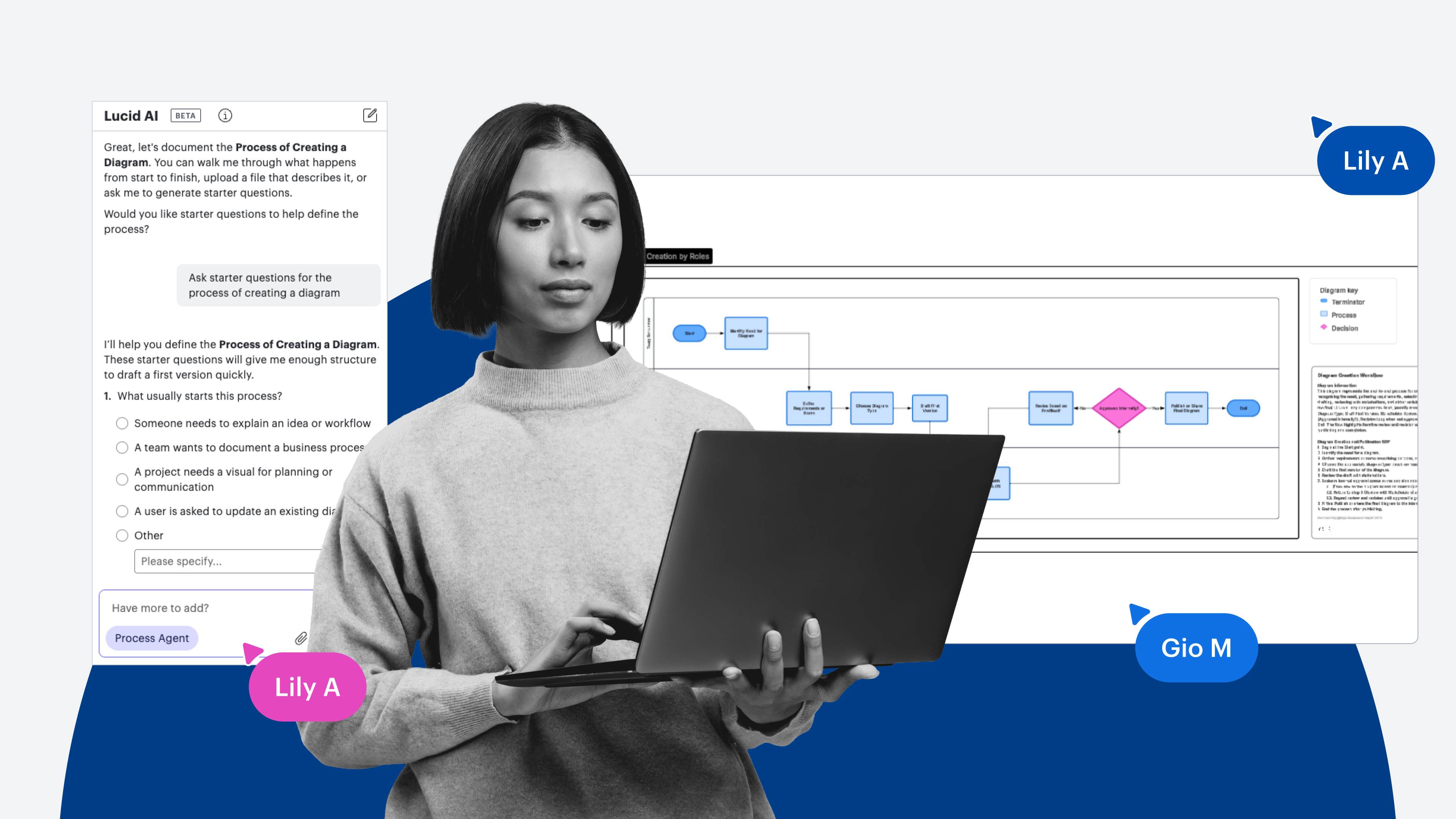
This is where Lucid’s Process Accelerator comes in. This add-on for the Lucid Suite helps teams establish a governed source of truth for process documentation, so AI systems and teams are working from approved, up-to-date information. By centralizing documentation in structured repositories with built-in approvals and version control, organizations can stay aligned and maintain consistency as work becomes more distributed and fast-moving.
The connection is becoming clearer: Teams are more likely to sustain momentum when AI helps organize and structure information in ways that support continuity and collaboration.
The opportunity: Building the infrastructure for AI-enabled work
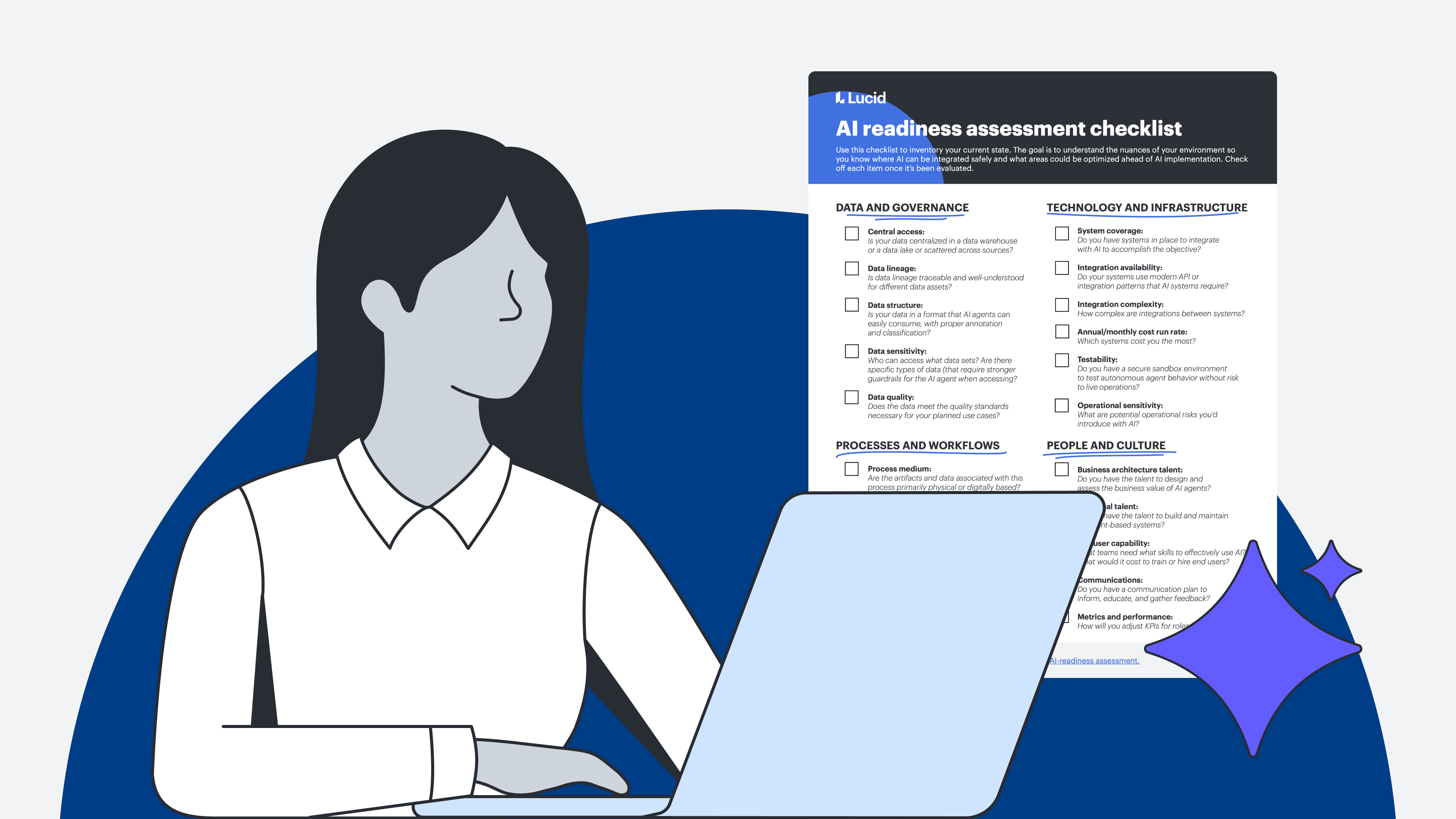
As AI accelerates how work is created and executed, the challenge is no longer just adoption. It’s creating the infrastructure that keeps execution moving in lockstep with strategy, systems, and organizational change.
Organizations need better ways to connect information, maintain alignment, and preserve visibility across increasingly distributed workflows. Without shared context, the speed of AI-driven work becomes harder to maintain at scale.
This is where AI maturity is beginning to take shape, not just in the models organizations adopt, but in the systems that support them. The teams best positioned to benefit from AI will be the ones that can clearly structure work, connect knowledge across teams, and maintain continuity as work evolves.
Lucid helps organizations create that shared operational context by making work visible and structured across people, processes, and systems. As AI becomes part of everyday execution, that shared visibility becomes critical infrastructure, helping organizations stay aligned, adapt faster, and produce more impactful AI outcomes across the company.