Key takeaways
-
Implementing a human-centric AI change management plan addresses the emotional impact and cultural resistance associated with AI, leading to more successful AI adoption.
-
Benefits of AI change management include reduced resistance, minimal business disruptions, and workforce readiness.
-
Strategies for AI change management include leading by example, reimagining workflows to integrate AI, creating clear guidelines around usage, and providing continuous support through feedback loops to maintain momentum.
Adopting AI at scale for your business requires much more than a simple software rollout. AI adoption involves an entire cultural shift and realignment as the technology is fully integrated into daily workflows and routines. According to a recent survey by Lucid, the top reasons for AI implementation failure include cultural resistance (27%), lack of clearly defined parameters (26%), and lack of transparency around processes and best practices (25%).
Change management is often a hidden blocker to successful AI adoption. A structured, intentional AI change management plan that accounts for people’s emotions and the potential disruption of AI can help employees more readily adjust to using AI within their workflows. A plan also helps your business maintain productivity while boosting innovation.
Read on to learn AI change management strategies, from a focus on leadership alignment to creating clear guidelines for AI usage.
Benefits of AI change management
Change management is particularly important for AI adoption since AI represents a fundamental shift in the way people work. Since AI is uniquely disruptive to business, encouraging employees to use AI will likely meet some resistance.
AI requires a human-centric, tactical approach that addresses emotional impact and employee confidence. Christopher Bailey, Director of Professional Services at Lucid, explains:
“The emotional and psychological impact of AI is currently the primary nuance of AI change management versus traditional change management. There are real concerns and uncertainty around AI. Companies need to create the case for change and be transparent about their goals. Make clear what human-AI collaboration should look like in the future, and what human-centered outcomes you’re looking for.”
Being intentional about your change management approach can help secure employee confidence and buy-in for implementing AI. Some other benefits of AI change management include:
-
Higher adoption rates
-
Institutional AI use, not just individual use
-
Workforce readiness
-
Reduced resistance
-
Minimal business disruptions
-
Ethical and responsible use (by establishing governance for compliance)
AI change management strategies
As you prepare to adopt AI at scale across your business, complete an AI readiness assessment to determine whether your organization is truly AI-ready and strategize where various AI tools will make the most systemic impact.
A careful assessment helps you maximize your AI adoption by evaluating your current processes, systems, data, and people. You’ll identify complexity, risk, and opportunities as you gather input on where AI can be implemented.
Ensuring your processes are documented and you’re technologically ready for AI will help smooth the transition, as well as following these AI change management strategies for effective AI adoption.
Strategy #1: Secure leadership alignment and sponsorship
AI change management begins at the top. Leaders need to do more than simply support AI adoption; they also need to model the behavior that the whole organization will be expected to emulate. McKinsey’s State of Organizations 2026 report found that leaders who model adaptable behaviors are almost twice as likely to have organizations that can quickly adapt to change.
For AI in particular, leaders also often own governance decisions and are the ones who will be communicating the “why” before anyone else. They answer questions from their teams and need to be aligned on the plan for AI implementation. Leaders should be:
-
Aligned on use cases before announcing them broadly
-
Transparent about what they know and what they don’t know
-
Familiar with the goals and milestones for AI adoption
-
Actively participating in the same culture of experimentation that they’re asking their teams to adopt
Ensuring leadership alignment is a good opportunity to identify AI change champions within different teams or parts of the business. Your AI change champions are influential employees who advocate for AI adoption and facilitate transformation as they boost engagement, help their peers adapt, and support initiatives from the ground up.
While champions are important in any change management strategy, they are especially important given the hesitation and uncertainty surrounding AI. As Jeff Rosenbaugh, Senior Director of Professional Services at Lucid, says, “Identify your early adopters. Let them shape the narrative through their genuine enthusiasm.”
Strategy #2: Create a strategy and communication plan
Align leaders, teams, and stakeholders on what your AI adoption will look like and what’s expected of each role with a communication plan. A successful plan requires a thoughtful approach that focuses on the people on the ground who will interact with and implement AI solutions, while highlighting the benefits of AI adoption.
Leaders should have radical honesty and be transparent. This is an especially valuable time to address the environmental and economic impact of AI use and make explicit your reasons for adopting AI. Creating your communication plan with careful thought and intent goes a long way toward building trust.
“It’s about being honest about what you know and what you don’t know across the board. Standard change practices are important, but one that is underrated is just telling the truth. This allows people to opt in through their behavior rather than creating a situation where everyone is just anxious.”
—Jeff Rosenbaugh, Senior Director of Professional Services, Lucid
Clarifying how AI will positively impact roles or workflows can help reduce resistance and address any concerns. Focus on the outcomes; what does “good” AI adoption look like for your organization? How will success be measured? Leadership should define the answers to these questions before asking employees to adopt AI.
Since the technology behind AI is constantly evolving, information and opportunities change quickly. Using dynamic documentation that you can update as you go—rather than a static document like a slide deck—is a great way to continually revise your strategy and keep employees informed. By continuing to develop and communicate your reason for change, employees feel more comfortable and confident in using AI.
Strategy #3: Reimagine workflows
AI adoption isn’t as simple as applying AI to current processes and assuming that’s good enough. The technology and promise of AI represent an entirely new way of learning, thinking, and creating, completely reconfiguring how work will take place.
You need to reimagine workflows and review processes with teams to identify where the opportunities are. There are two main ways you can implement AI: using AI to complete discrete, stand-alone tasks, or using AI agents.
Identify areas within your workflows where you can insert generative AI to help people accomplish tasks. This is when AI acts most like a tool that people can use. You can also expand into agentic AI, opens in a new tab, providing it with decision logic and context to achieve desired outcomes.
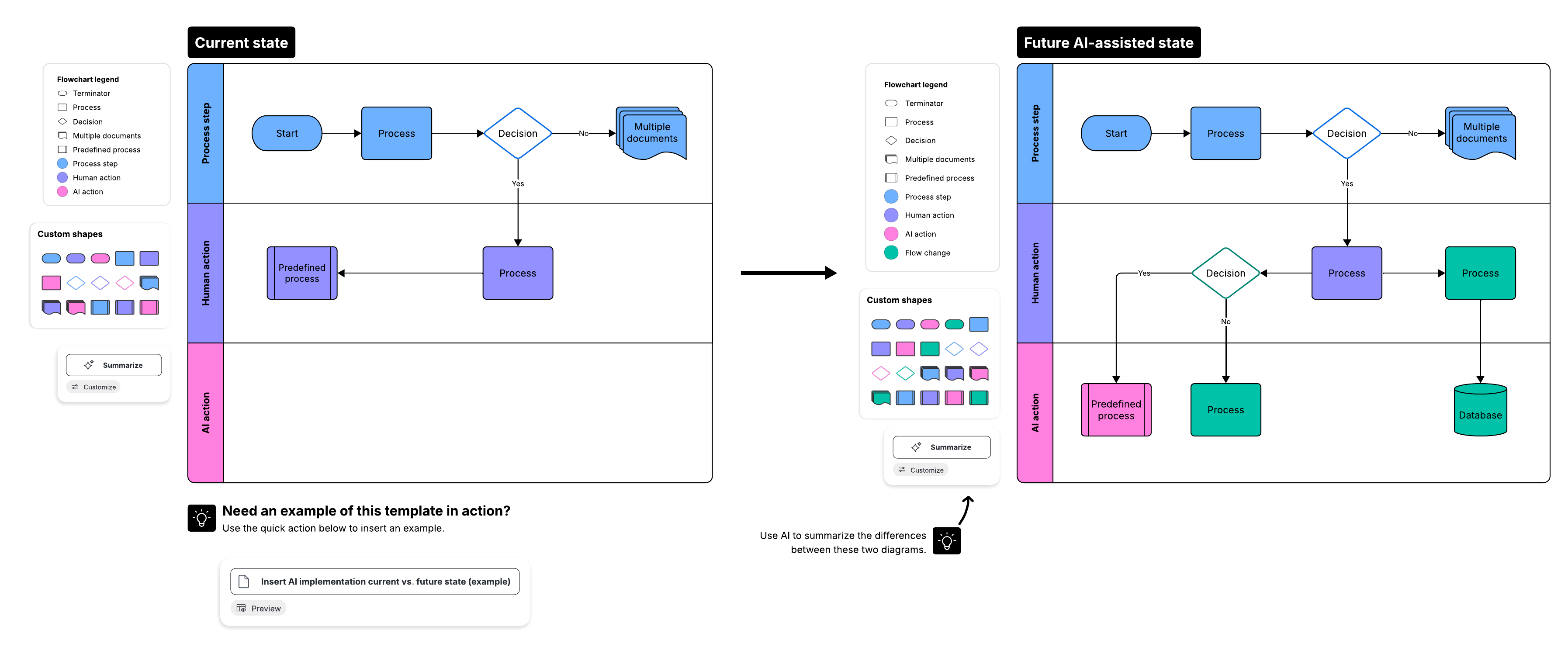
Reimagining workflows requires some unlearning as people let go of old ways of doing things and move on from legacy processes. In some cases, people may need to learn entirely new skillsets or pivot to focusing on what they can now solve with AI.
This stage of adoption can be challenging, and it’s important to foster a culture of psychological safety. Involve employees directly in the process of where AI can be implemented, and make it clear that employee participation is part of what will make using AI successful. Invite people to provide ideas and feedback.
Giving employees a say in which work processes to automate, and how, can make the value of AI clearer, thus increasing buy-in and encouraging change to become habitual.
Strategy #4: Provide AI skills training to employees and empower learning
Providing employees with training and learning opportunities is essential for AI change management. Set up training sessions so employees can learn about multiple AI tools that support their use cases, such as using Claude for coding for technical teams. Create channels for people to share their learnings and ask questions.
Some employees will likely already be familiar with AI tools and use them in their personal lives, while others haven’t used AI at all yet. Conducting a survey to determine AI familiarity can help you determine people’s comfort and skill levels. For people who need to learn basic AI skills for the workplace, such as effective prompting, establish opportunities for them to receive those skills.
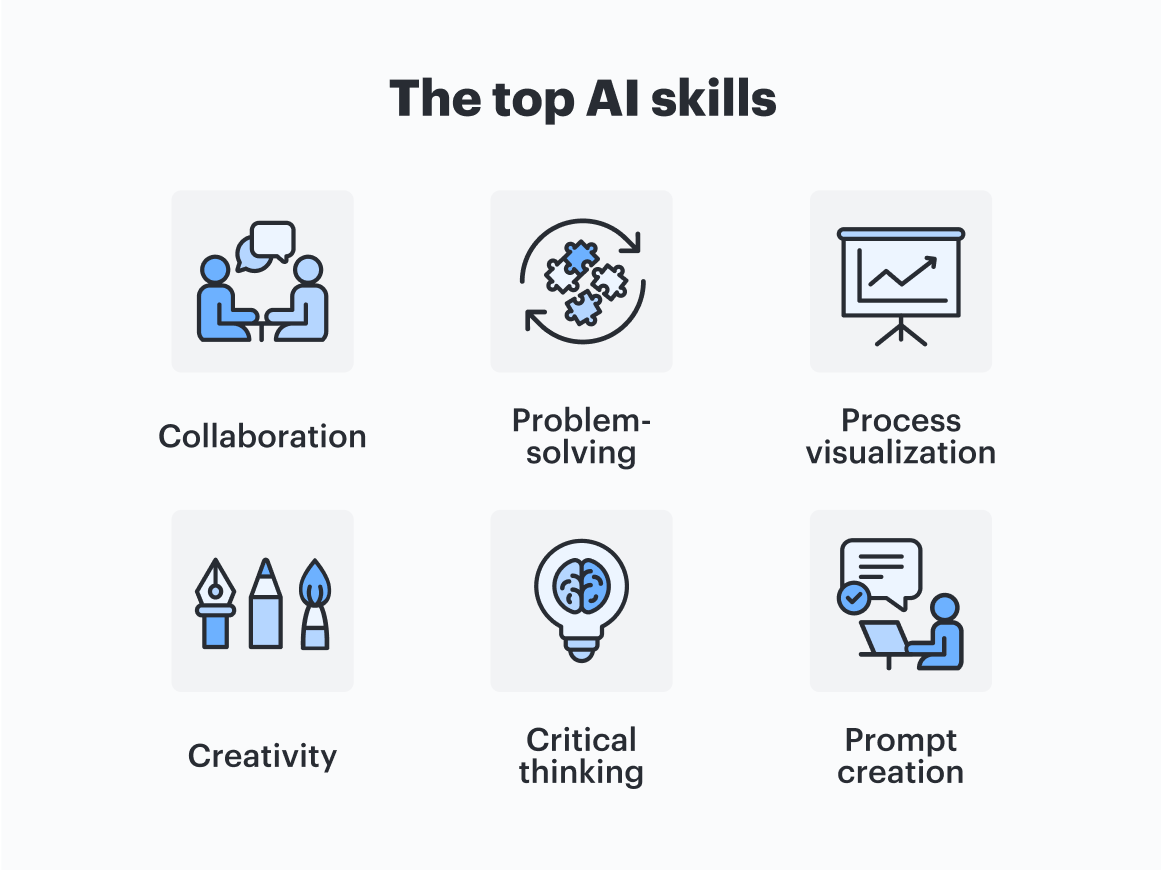
Dedicate time for experimentation and empower your employees to learn as much as they can about how to use AI and identify ways to incorporate it into their workflows. You can tap into your AI champions here to encourage and support people in their learning. Ask people to provide feedback and share their findings, success stories, and failures—especially if they discover a way to implement AI that their peers could benefit from.
Strategy #5: Create clear guidelines around usage
As you encourage a culture of AI experimentation, creating concrete guidelines is part of your AI change management strategy. You need to make clear:
-
A governance plan to address security risks
-
Which AI tools are approved to use for work purposes, and which ones shouldn’t be used
-
What type of data employees can put in the tool, i.e., refraining from using private data or confidential company information while prompting a chatbot
-
Processes and best practices
While setting limits may create some frustration from the outset, in reality, constraints help breed innovation. Adding constraints directs focus, encourages creativity, and fosters strategic decision-making.
For AI in particular, effective governance isn’t just about security; it creates boundaries for teams to concentrate on specific, safe areas for experimentation. It’s essential to have resources available for employees who have questions about your company’s AI usage policies. These resources should be readily available for anyone to access, especially leaders and your AI champions.
Strategy #6: Monitor adoption and provide continuous support
AI adoption isn’t a one-and-done initiative, but an iterative process that will take time. Since the technology behind AI changes quickly, your change management strategy must be just as dynamic.
To ensure that the initial momentum behind your AI adoption doesn’t stall, create a cycle of feedback and refinement. While metrics can show progress, they only tell part of the story, and establishing feedback loops is essential. Monitor adoption by tracking both quantitative data and qualitative data.
You can host AI office hours where employees ask questions, troubleshoot problems, or showcase examples of using AI. These examples don’t always have to be successful; sometimes sharing how AI didn’t work can be just as helpful. As employees discover new use cases for AI, you will likely need to iterate on governance guidelines and continually update your usage policies.
Another way to provide continuous support is to invest in long-term AI literacy and skills. Create a library of learning materials, use cases, and other resources for employees as you commit to professional development. By taking a long-term, iterative approach, you can create a culture that’s open to new ideas and opportunities while reinforcing support for employees.
Ensure you’re ready for AI adoption and transformation
Remember, AI adoption isn’t a one-time rollout; it’s an ongoing process. Organizations that are successful in AI change management ensure leadership alignment, involve employees in reimagining workflows, and take an intentional approach to the unique disruptiveness AI can bring. Leverage your AI champions, implement feedback loops, and provide employees with the outlets they need to experiment and gain AI skills.
Scaling AI represents an entire business transformation, and companies that make sure they’re prepared for AI transformation are often in a better position to see their AI initiatives succeed. Learn more about AI transformation and what steps you can take to ensure your business is ready.

Closing the AI transformation gap
Get the steps you need to make sure your business is prepared for agentic AI.
Read more