
Innovation is a quality that many companies value in their workforce. Workers are often encouraged to be more innovative, and they’re incentivized to spark new ideas that deliver higher value for customers.
But what does it really take to be innovative? Innovation isn’t a mystical talent—it’s a skillset you can build. The good news? Chances are, you probably already have the foundation. With the right mindset and a few key strategies, anyone can sharpen their ability to think differently, challenge the status quo, and turn bold ideas into reality.
In this blog post, you’ll discover the innovation skills you need to become a more innovative person at work, along with some tips and templates that can help you kickstart innovative brainstorming sessions, experiments, decision-making, and more.
What are innovation skills?
Innovation skills are specific tactical skills that help people solve complex business problems, such as developing a new product or improving an established process. While there are innovation skills for leaders, we’re focusing on innovation skills for individuals. Anyone can be innovative at work; you don’t have to be on a designated innovation team or in any specific role or level.
Innovation skills involve more than just thinking outside the box. You should be able to identify customer’s problems, test your ideas, explore new opportunities, and share your knowledge. To truly be innovative on an individual level, you should practice a special set of skills such as effective customer research, curiosity, and experimentation.
Whether or not your company has an established innovation strategy or is just beginning the journey, that intention to fuel innovation goes nowhere if employees don’t have the skillset to support it.
Why innovation skills are important to have in the workplace
Investing in innovation skills training helps make innovation more consistent across the board. By developing innovation skills, you’re not counting on a random stroke of genius or a bolt from the blue to solve business problems. Instead, you’re building a tactical skillset that can be applied to any issue that arises, whether it’s improving an internal process, responding to external events, or bringing a new solution to market. Innovative people are more adaptable and better able to respond to change.
Individuals who hone innovation skills are also likely to feel more engaged at work, as people are able to connect their accomplishments with high-value initiatives and can see their ideas make an impact. Again, anyone can be innovative, and investing in innovation skills helps people more actively make contributions to larger team goals.
The top 6 innovation skills to know and develop
So, innovation skills are important to invest in, but what are these skills exactly? And how does one improve their innovation skills? The following are the top six innovation skills to know and practice in the workplace. Together, they provide the key ingredients for individuals to develop the necessary skillset for sustainable innovation.
Customer research
At its core, innovation is about fundamentally understanding your customer’s problems. Many teams make the mistake of focusing on building solutions without taking the time to understand what exactly their customers need. Through observation, data-collecting, and active listening, you can learn about your customer and the problems they face—which is the first step to uncovering innovative solutions.
A “customer” is defined as someone to whom you need to deliver a service or product. In some cases, your “customer” might not always be an actual customer of your company’s product. For example, if you’re innovating on an existing internal process, your customers will be your coworkers or people on other teams.
To improve your customer research skills, you can take steps such as:
-
Creating a research plan
-
Building user personas
-
Crafting customer journey maps
-
Sending out customer surveys
Effective customer research involves asking your customers the right questions in the first place. Try to avoid asking customers only “fluff” questions that are too broad or require people to predict their own behavior. Start with questions that are specific, unbiased, and focused on the past. For example, instead of asking, “How do you think this product could help you?” Ask, “When in the last week would this product have been able to help you complete your work?”
An important aspect here is curiosity and an unassuming, humble mindset. Innovative people don’t just assume that they know a problem or will land on the best solution right away. Instead, they’re constantly open to different perspectives and alternatives. For innovation, this curiosity is especially important for understanding the customer. Use your curiosity to focus on providing a solution for customers that’s both useful and new.
It’s helpful to have a central place to document your customer research and record feedback. By using a visual collaboration platform, you can use templates to kickstart your research and keep a historical record of your findings. Having everything in one place helps you build a document repository that turns into an innovation repository as you explore potential solutions to the problems your customers are facing.

Transform your documents into an innovation repository
Learn key tips for building an innovation repository to boost innovation.
Read moreDivergent thinking
As you explore your customer’s problems and come up with innovative solutions, another tactical skill to have is divergent thinking (which should be paired with convergent thinking; more on that below). Divergent thinking is the ability to come up with a variety of ideas in response to a problem. As you collect customer research, divergent thinking helps you explore multiple perspectives and possibilities, leading to solutions that may otherwise have gone undiscovered. Divergent thinking also helps you understand further where your customers are coming from and the problems they’re facing.
Brainstorming sessions are a great time to practice divergent thinking. To host an effective brainstorming session that leads to a variety of unique and creative ideas, start off with a template that encourages people to think outside the box. Set a timer, break up into small groups if necessary, and don’t worry about duplicate ideas as you brain-dump.
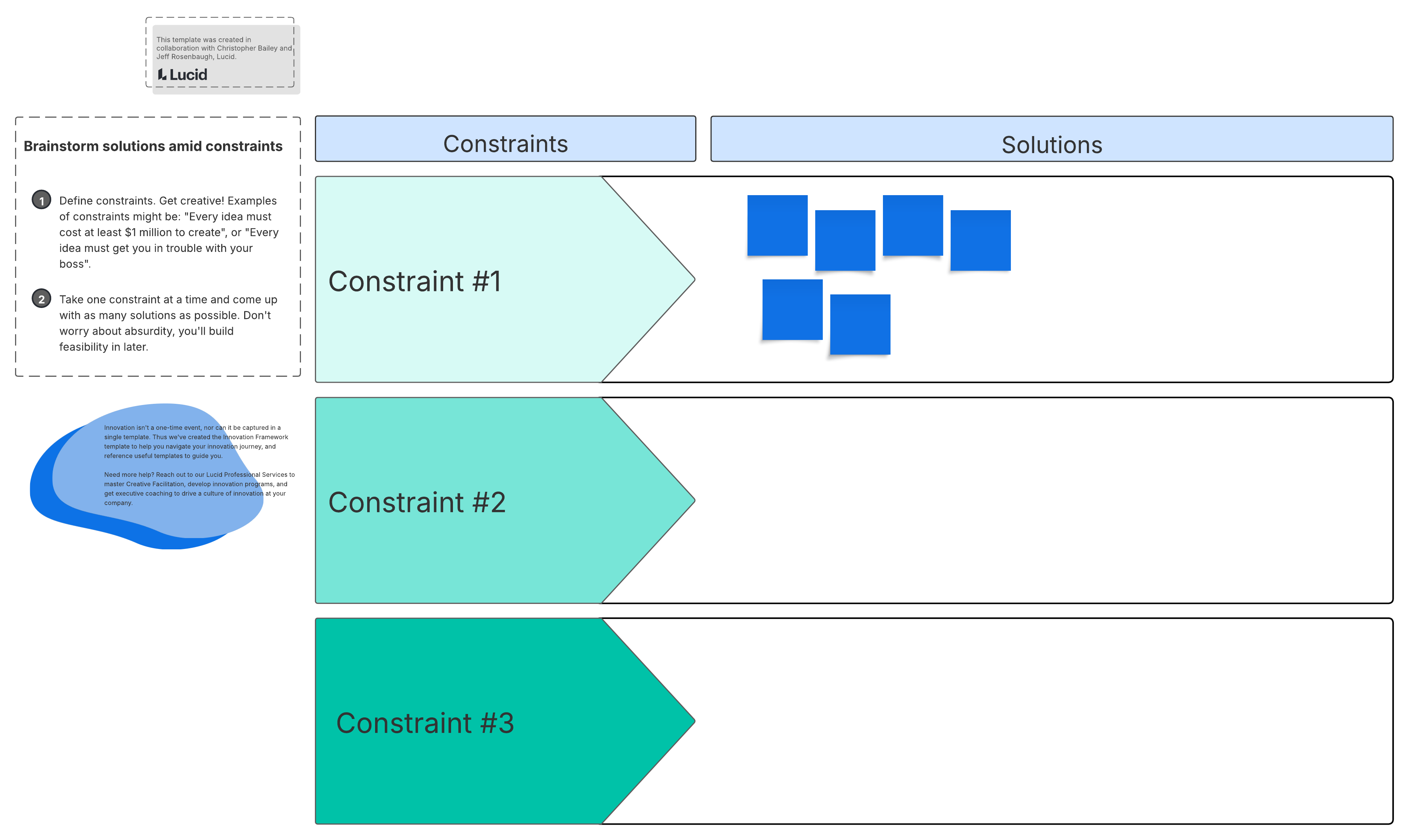
Since the ideation stage is meant to produce lots of ideas, your brainstorming session should be structured. Although it may feel counterintuitive, without clear structure or set constraints, it’s easy to lose focus. Add constraints to your ideation process, including deadlines, business requirements, or budget, and be strategic with your intentions.
To prompt divergent thinking and creativity, you can try some of these templates as you brainstorm:
-
The constrainer,, opens in a new tab which helps you set multiple constraints to direct focus.
-
World explorer, which provides structure for broadening your frame of reference.
-
An ideation strategy template, which clarifies what will be discussed and how long you’ll have to brainstorm.
Convergent thinking
To successfully develop your innovation skills, it’s important to pair divergent thinking with convergent thinking; rather than focusing on one or the other, true innovation requires both types. Convergent thinking helps you pinpoint a single solution out of the variety of solutions you’ve come up with, which is essential because eventually, you need to narrow your ideas down into a deliverable action plan for customers.
After a brainstorming session, you need to be able to converge your ideas, singling down which ones you will actually test out. This helps you create a clear and actionable plan to take your great ideas to the experimentation stage of innovation. If you develop both divergent and convergent thinking, you can constantly think of new and unique ways to approach opportunities or challenges while also being able to distill those ideas into actual next steps.
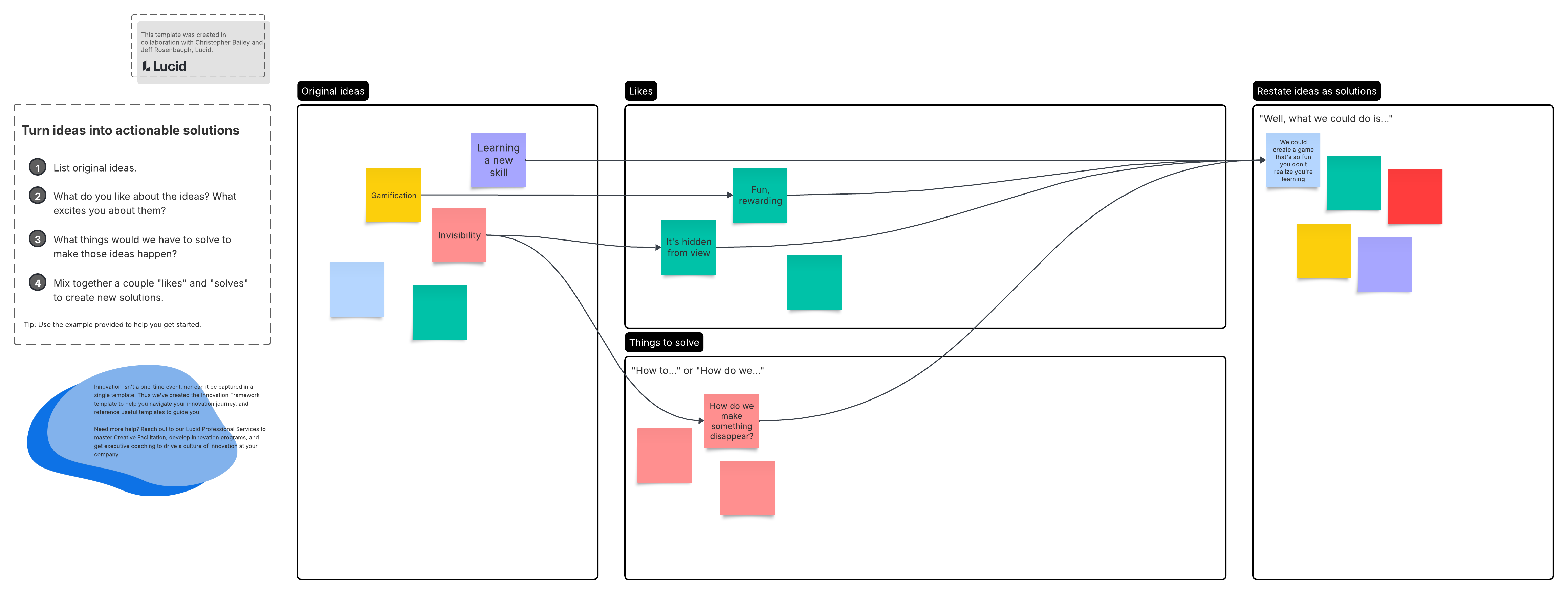
There are some strategies you can practice to hone convergent thinking. You can use an ideas to action template that helps you understand how your ideas fit together. On top of identifying next steps, you’ll come up with a hypothesis and how success will be measured for each idea. Or, you can use a building further template to help you examine your original ideas more closely to turn them into actionable solutions.
Designing experiments
So, you’ve conducted customer research and are using both divergent and convergent thinking to get to the root of the customer’s problem—but remember, innovation isn’t just the solution itself; it’s the entire process that helps you arrive at that solution.
A critical innovation skill is learning how to design successful experiments that guide you through the innovation process and help you learn and iterate on your understanding. People who are skilled at experimentation know how to embrace the concept of the MVP, write effective hypotheses, and are open to continually learning.
The MVP is the minimal viable product, which is the most basic version of your product that will satisfy customers with the least amount of effort and resources. The MVP is a great starting point for product development and innovation because it’s the smallest version of your product that you can add onto as you rapidly learn. Rather than jumping in and building the full product right away, start with your MVP to gather customer feedback and make informed decisions.
At this stage of innovation (the iteration stage), you will test out your hypotheses by building and testing prototypes of your proposed solutions. The two hypotheses you’ll need to validate are:
-
The growth hypothesis. How can sustainable growth be achieved in this product or for your business?
-
The value hypothesis. How will your product or service deliver value to customers and generate revenue?
Being able to cheaply but effectively test solutions is an essential skill to have for innovation. You’ll collect early customer data, understand your critical assumptions about your solutions, and ultimately uncover learnings. By experimenting and learning repeatedly, you can continually iterate on your product and build toward a successful solution.
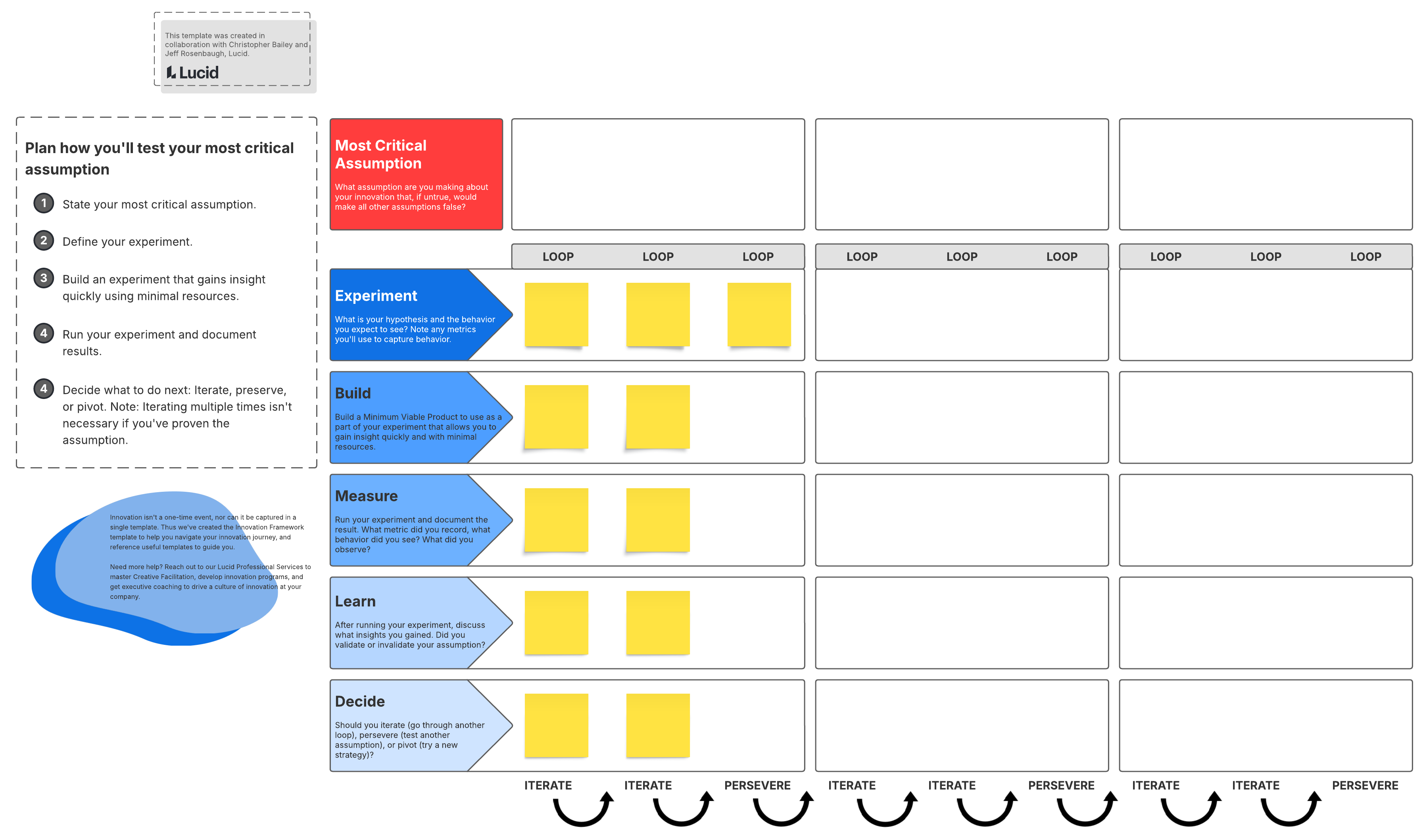
To design effective experiments, try out the experiment map and build and learn cards. You can also use wireframing templates to build prototypes of your product.
Data-driven decision-making
Another tactical innovation skill is decision-making based on data. Innovative people think like stockbrokers as they seek ways to mitigate risk, diversify their opportunities, and gather data to guide their actions.
As you conduct customer research and test prototypes of your solution, you’ll gain a lot of customer anecdotal information, which is extremely relevant data, but you’ll need actual quantitative data paired with that to guide your decisions. While qualitative data is informative and beneficial for innovation, metrics provide a more reliable way to determine how your solution will deliver value, rather than a customer simply liking the solution.
Thinking like a stockbroker can be extremely detached from emotion, but pairing it with the personal side of qualitative data helps you gather well-rounded information from different sources. With data-driven decision-making skills, you can land on solutions that support customers while having the quantitative proof to back your choices.
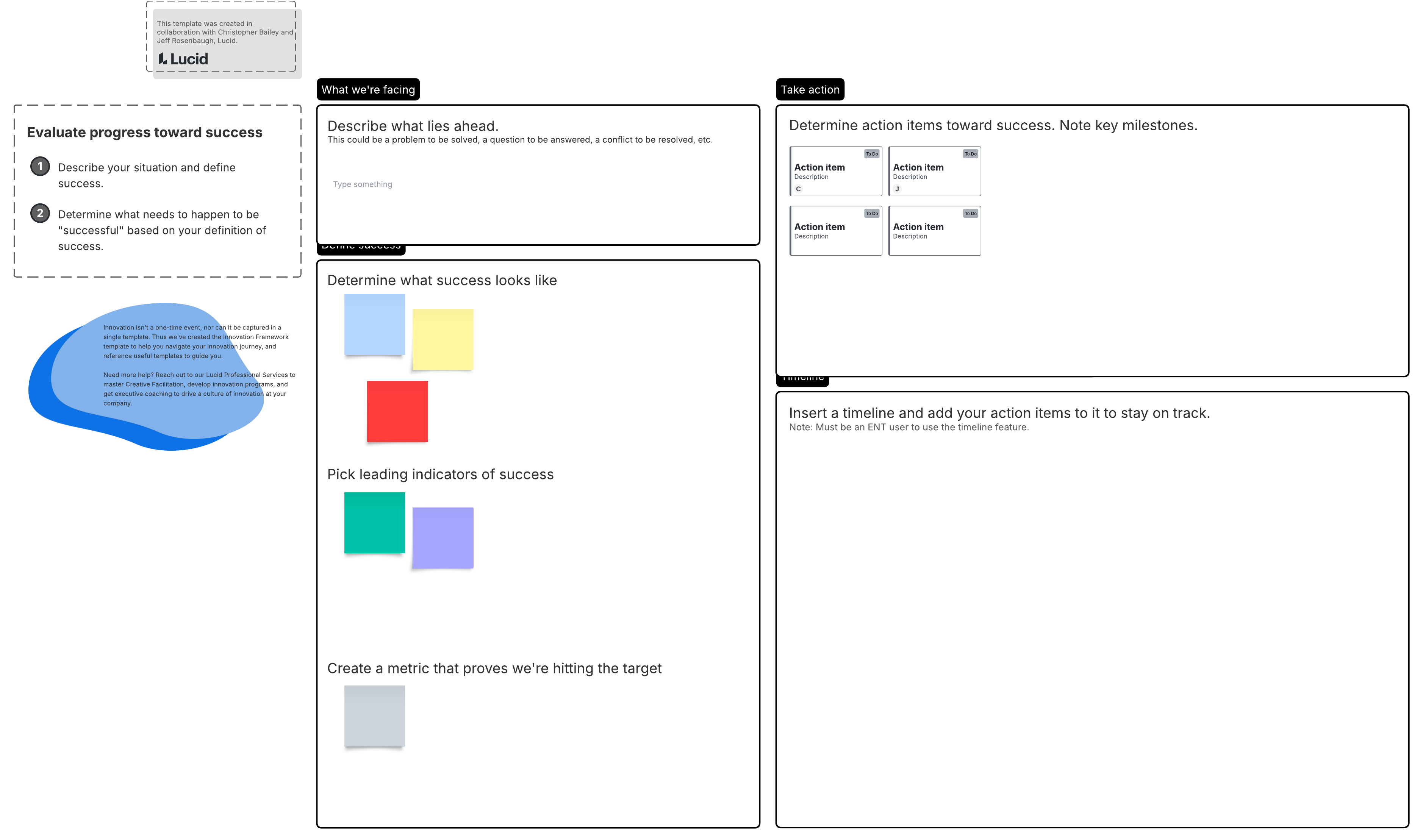
Try using the innovation accounting template to create strong metrics that inform decisions and help you determine what success will look like for your product.
Pitching ideas
Ultimately, innovation doesn’t take place in a vacuum. While you can and should practice innovation on an individual level, another important innovation skill is being able to pitch your innovative ideas and concepts to your customer—whether your “customers” are the people who actually buy your company’s product or team members of another department.
Innovation requires a lot of collaboration and articulation; innovators are able to articulate their goals, the metrics they’ve set for success, and their learnings from experiments. By successfully sharing this information in an understandable way, you can get more support from stakeholders. Coming up with an innovative idea is one thing—telling other people about it and getting their buy-in is another.
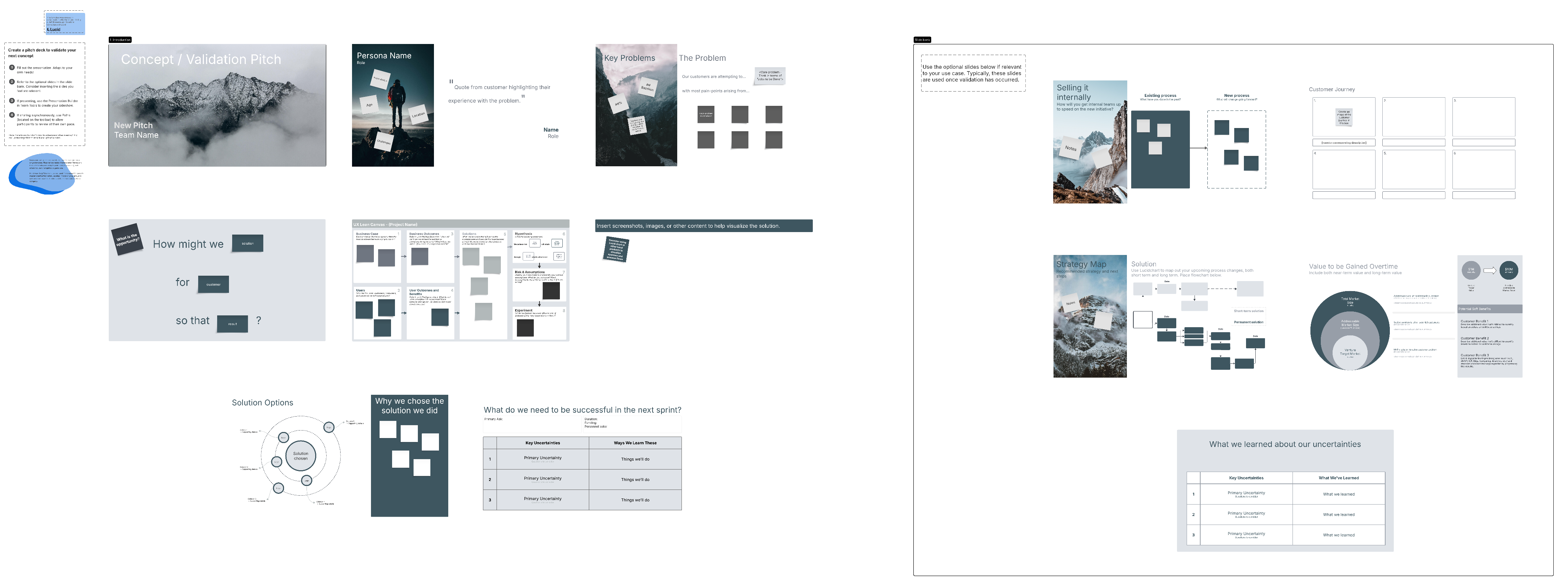
Securing that buy-in is how you take your innovative solutions from conception to validation. Once you’ve identified a problem worth solving, you can craft a concept pitch that justifies the need for your experiments and the amount of support you need (such as funding). Once you’ve conducted experiments, a validation pitch shows your findings and demonstrates market fit.
Using a visual collaboration platform to gather and present all of your information is helpful for knowledge sharing. With a visual collaboration platform, you can keep everything in one place: data from your experiments, the results of your brainstorming sessions, feedback from others, and more. You can even use templates to develop your process for pitching ideas—bringing your solutions from ideation to validation.
Becoming a more innovative person
Now that you’re familiar with the top innovation skills, how can you develop these skills and become a more innovative person? The good news is that there are plenty of options and resources for individuals to drive their innovation, including:
-
Seeking out new opportunities. Innovative people are action-oriented and they actively seek out opportunities to test their theories, try something new, or gain a new perspective. You can constantly search for new projects or chances to improve current processes. Many innovative people also network and try to expand beyond their normal circles to gain new perspectives, saying “yes” to every opportunity that arises so they can embrace new pathways and exploration.
-
Sharing your findings. As you conduct research and discover new opportunities, sharing this knowledge with your team is important so you can all learn and grow together. Knowledge sharing is an important aspect to developing innovation as again, innovation doesn’t occur in a vacuum. Whether your experiments were successful or not, sharing your experience helps inform innovation strategy.
-
Being unafraid of failure. Having a safe-to-fail mindset is important for innovation. You can learn from your shortcomings and try again, viewing your failure as an opportunity to learn. As you test your ideas, some of your experiments will show that the idea you had wasn’t quite right or didn’t provide enough value for customers. Keep track of your learnings so you have a basis for future improvement.
-
Measuring your innovation. To become more innovative, you can measure your experiments and projects to determine progress. A key way to measure innovation, especially on the individual level, is to focus on rates and percentages instead of count metrics (such as “how many” new ideas you’ve come up with). Count metrics measure activity, but percentages measure actual progress toward your established goals.
-
Using structure to foster creativity. Many innovative people adopt some kind of framework to provide consistency and guidance for their innovation. Implementing a structure can lead to repeatability and more creativity. Once you’ve developed a framework for innovation, repeating (and iterating on) your process helps guide your innovation all the way from ideation to actual delivery.

Practice your innovation skillset
Check out Lucid’s Creative Facilitation training course to practice some of the ways you can become a more innovative person.
Go nowDevelop your innovation skills with Lucid
Innovation skills help people solve complex business problems whenever they arise. Honing a tactical skillset that includes curiosity, designing experiments, and divergent thinking goes a long way for individuals who want to practice being more innovative.
Lucid supports your innovation every step of the way, from templates that spur creative brainstorming sessions to providing a central repository for you to keep a record of all of your ideas and experiments. You can even use Lucid to create a validation pitch to share your innovative ideas with stakeholders. Learn more about how Lucid helps individuals develop and sustain their innovation skillset.

See how Lucid boosts innovation
Discover how Lucid can help you with innovation, from the ideation stage to beyond.
Learn more