Key takeaways
-
Challenges enterprise architects face during a digital transformation include supporting sustainable solution development without becoming an obstacle, controlling the cost of modernization, and getting the right stakeholders to review changes.
-
Living, visual enterprise architecture helps architects focus on the impact of proposed changes and collaborate with stakeholders effectively.
-
Lucid, a work acceleration platform, offers features for planning future enterprise architecture and collaborating visually.
Enterprise architecture is critical for digital transformation because it connects an organization’s overall business strategy with technical execution. Enterprise architecture ensures that the technological upgrades made during a digital transformation are deliberate and sustainable. Enterprise architecture is all about getting things done “right,” not just getting them done, and while enterprise architecture is often focused on governance, enterprise architects are really tech strategists who can help an organization make impactful decisions.
The problem is, there are quite a few architectural challenges that come with digital transformation, and those challenges only become more pronounced if architects aren’t using effective tools and solutions (such as solutions that aren’t visual or real-time).
In this post, I’ll dive into some of the EA challenges of digital transformation and how living, visual architecture helps solve them.
Challenges of enterprise architecture during a digital transformation
Challenge #1: Getting enterprise solutions done “right” without becoming an obstacle to transformation
During a digital transformation, there can be friction between enterprise architecture objectives and other stakeholder objectives (such as those of solutions architects and engineers) because enterprise architects are often focused on governance. When you focus on enforcing controls rather than enabling transformation, other stakeholders may begin to see EA as the “department of ‘no.’”
It's important for architects not to lose sight of the purpose of mapping enterprise architecture. The purpose shouldn't become exclusively to enforce risk and cost controls; the ultimate goal is to enable transformation sustainably. This requires a shift in mentality from enforcement to partnership. An enforcement mentality sounds like, “We can’t do that because…” whereas a partnership mentality takes the approach of “Here’s how we can do that…”
Ultimately, enterprise architects have to balance supporting the timely delivery of new business capabilities with potential tech debt incurred by moving too quickly and not enforcing architectural best practices.
Challenge #2: Cost control of modernization
Enterprise architects are tasked with the challenge of balancing the benefits of new technology with the costs to make the proposed upgrades a reality. The older a system gets, the more expensive it becomes to modernize.
For example, imagine you’re mapping out the migration for a warehouse distribution management system built in the 1970s that’s still running the business decades later (trust me, I’ve seen it happen). That would be a huge lift to translate those systems into a modern tech stack, and you, as the architect, may be tasked with identifying the tradeoffs between efficiency and cost and build those considerations into your future-state maps.
Modernizing applications is not just about the technical change; it’s also about the business decision to balance the total cost of ownership against the upside of the business capabilities that change enables. As the enterprise architect, you’re often the one people are looking to to help connect those dots.
Challenge #3: Getting the right stakeholders to review proposed architectural changes
Enterprise architecture acts as the connective tissue between strategy and technical execution, and architects pull together the right stakeholders for governance reviews. Who needs to be in those reviews may depend on data domain knowledge, security questions, compliance risks, application types, integration patterns, and business and strategic context.
“For an effective governance review, you need to be able to quickly communicate what's being said to a diverse set of stakeholders and evolve that message depending on the specifics of each review.”
If stakeholders aren’t speaking the same visual language during these reviews, progress will halt. For example, it’s common for solution architects to each use a different set of shapes in their diagrams. In this case, governance reviews can turn into an entire meeting talking about what certain shapes and colors mean instead of the impact of proposed changes.
How living, visual enterprise architecture helps solve digital transformation challenges
Living visuals, such as those created in a work acceleration platform like Lucid, help solve the challenges mentioned above in a way that static images cannot. When stakeholders share a visual language, enterprise architects can communicate the current and future state of architecture effectively, getting everyone on the same page faster. And when those visuals update in real time, improvements and changes can be made quickly and accurately without slowing down transformation.
Focus on the impact
Living visuals help you focus on the impact of proposed changes because you can visualize a transformation, add in related data (such as cost, risk, and planning variables), and compare the current state to the future state. Essentially, living visuals provide a comprehensive, multi-layered view of architecture.
By connecting diagrams, you can create interactive visualizations that help you navigate between high-level business capability views all the way down to low-level technical infrastructure views. With a solution like Lucid’s Cloud Accelerator, you can even make the low-level technical views real-time, which is helpful since they change most often.
“With static images, you have to manually maintain your enterprise architecture, particularly your lowest level, in order to understand impact. There are so many moving pieces and components to any single application that if you’re maintaining the documentation manually, you won’t understand the impact as quickly or fully, and you’ll ultimately stall transformation.”
When you have a more complete picture of the impact of your digital transformation, you can make quicker, better-informed decisions about which technological updates are worth making. If you’re using Lucid, data linking and conditional formatting can help you visualize cost and tie that cost to higher-level capabilities. You could also visualize the impact of tech debt. Being able to see cost and tech debt quickly allows you and other stakeholders to make important decisions around digital transformation faster.
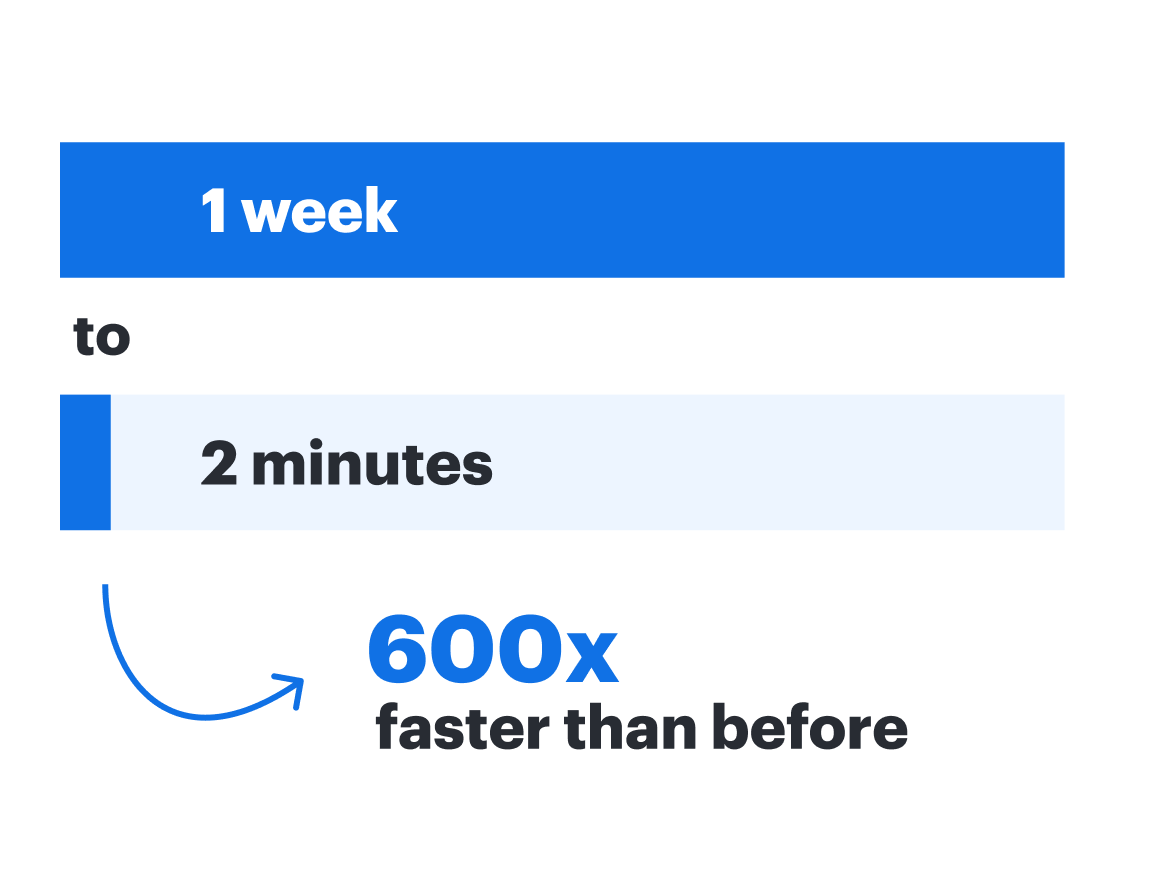
For example, enterprise architects at a global athletic brand use Lucid’s data linking capabilities to update diagrams using a data-driven approach, rather than having to manually update the same shapes across diagrams. This reduced the time it took to update a diagram from a week of work to two minutes—600x faster than before.
Collaborate effectively with the right stakeholders
Living, visual enterprise architecture allows you to collaborate with stakeholders effectively, whether asynchronously or during a governance review.
In Lucid, features such as comments and the ability to show authors make gathering stakeholder feedback much more efficient. Instead of waiting until you’re together in a room, simply add your questions and thoughts to your Lucid board and tag relevant stakeholders, and they’ll get a notification. Once stakeholders have added their feedback, you can then have Lucid’s AI summarize the key takeaways.
Taking that collaboration further, Lucid’s Process Accelerator helps manage the governance review process by providing an asset library—a repository of reusable, standardized assets, including reference architectures and patterns—that architects can use in their diagrams. If an asset is updated, it will automatically update everywhere it’s used in Lucid documents so that documentation stays as current as possible.
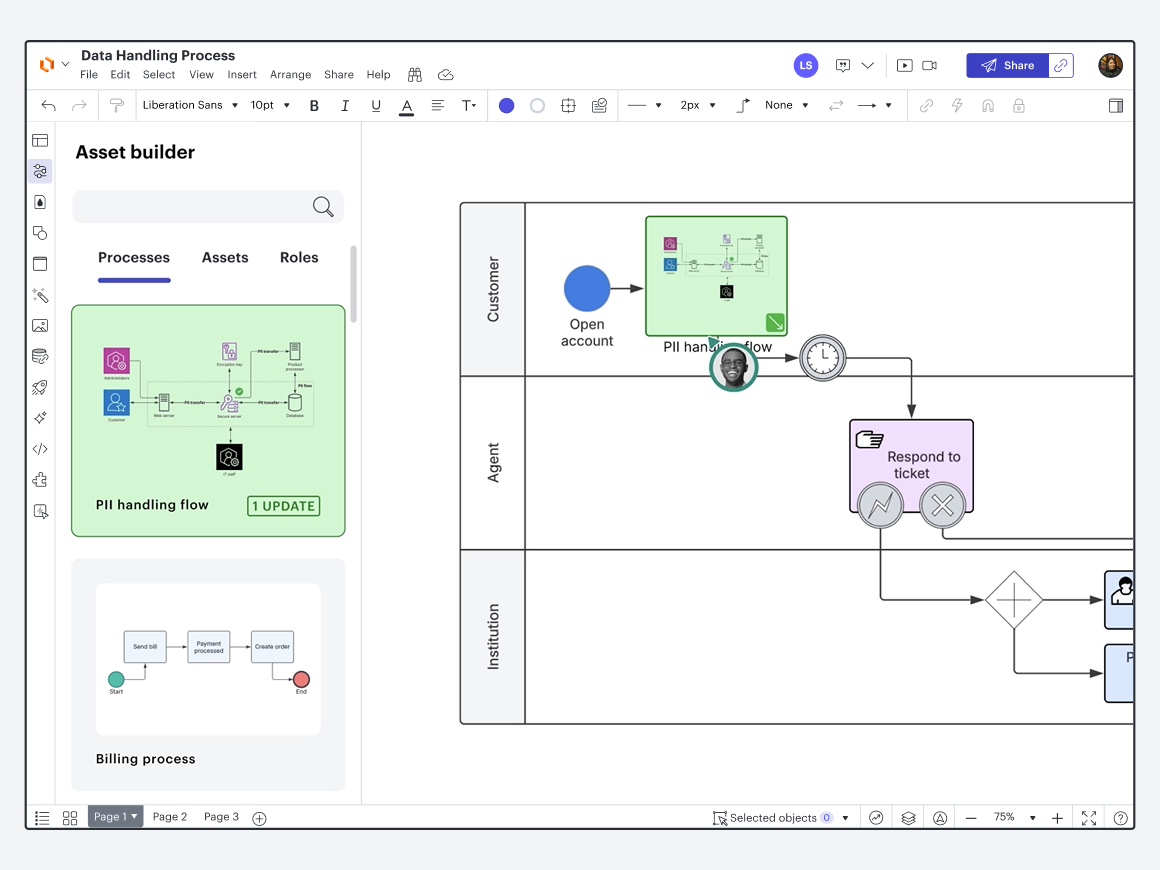
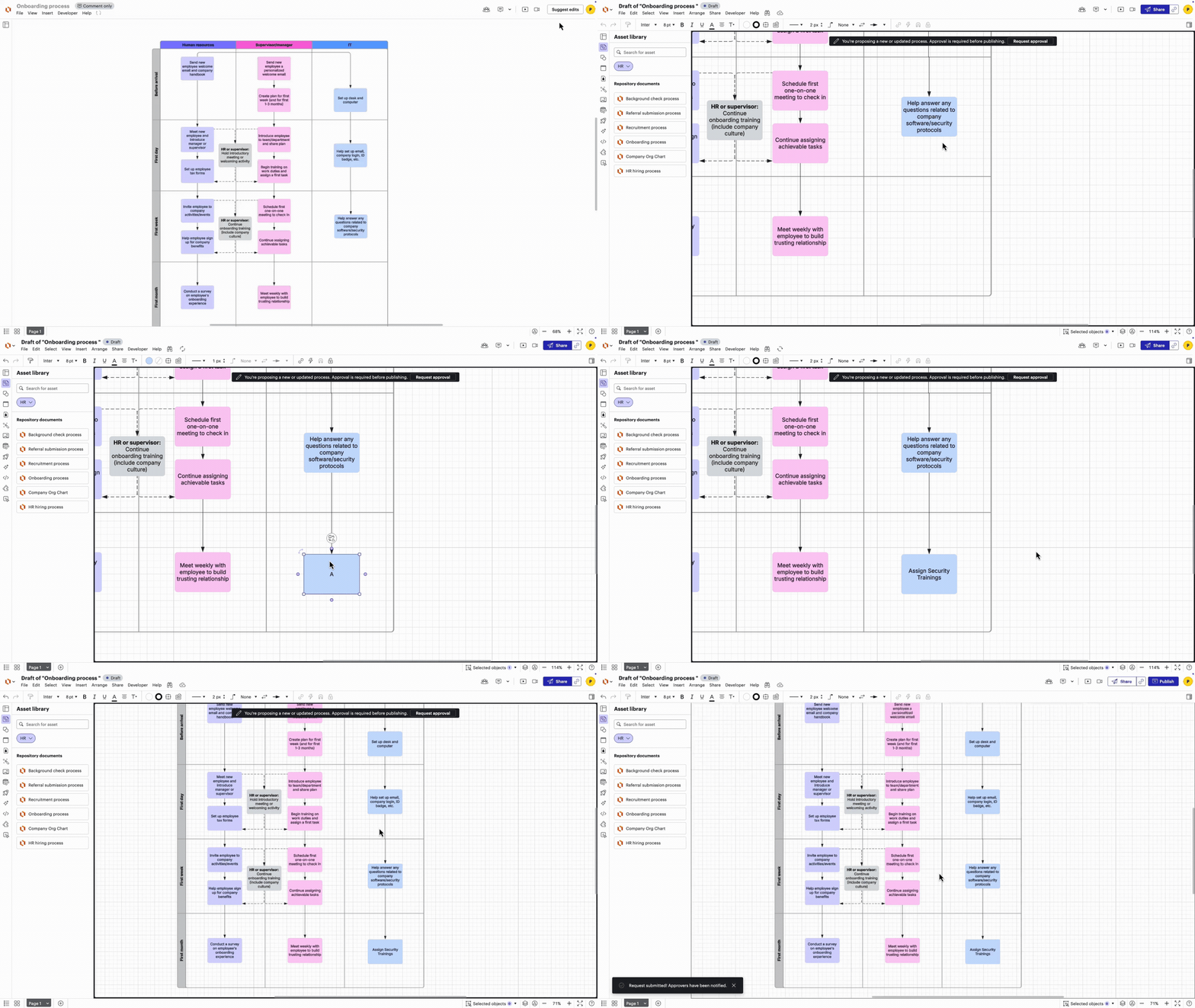
The Process Accelerator also includes approval flows so the right stakeholders get pinged for approval before process changes are made official.
There are many challenges that can arise during a digital transformation, but by using living visuals, convoluted enterprise architecture doesn’t have to be one of them. Living visuals help you focus on the impact of proposed changes and collaborate with the right people to keep transformation moving forward.

Learn how to improve architecture standardization with Lucid.
Read more