Key takeaways
-
Digital transformation is a strategic reinvention of operations, customer engagement, and value delivery, not a technology rollout.
-
Success depends on organizational alignment, clarity around business operations, data-informed decisions, change leadership, and business agility.
-
Build your strategy by setting a bold vision, assessing the current state, conducting a gap analysis, and creating an adaptable roadmap.
-
Secure broad buy-in and use iterative funding to pilot, learn, and scale what works.
-
Avoid pitfalls like resistance to change, tool chasing, skill gaps, and data architecture that does not support your chosen business outcomes.
You don’t have to look far to see the impact of digital transformation. And it’s not just shiny Silicon Valley startups that are affected. Established companies and industries are disrupted every year by ever-evolving and advancing technologies.
But not every organization sees the same level of success from its digital transformation efforts. The difference? Some view it as merely implementing new technology, while others view it as a strategic reinvention of how their organization operates, engages with customers, and delivers value. The latter approach always yields better results.
The rise of AI only underscores the need for a holistic digital transformation strategy. Recent research shows that businesses that strategically incorporate AI into their organization outperform laggards by two to six times on total shareholder return—a more significant gap in value than previous digital transformation initiatives have revealed.
Read on to learn how to develop a digital transformation strategy that will help your organization effectively harness the power of new technologies and overcome common digital transformation challenges.
Why you need a digital transformation strategy
The digital economy is marked by rapid development, evolution, innovation, and disruption. Companies that want to keep up have to be prepared to adapt to this new digital landscape.
But undergoing a digital transformation is about more than simply adopting new technology, investing in fancy gadgets, or upgrading current systems.
Those steps are important, but they aren’t the whole picture. If you want to remain competitive, you can’t just react to changes—you have to anticipate them and drive innovation yourself. To do this, companies have to plan ahead and be active designers of their own future.
That’s where a digital transformation strategy comes in.
“Digital transformation is about far more than moving systems to the cloud. It’s about building an organization that is fundamentally set up to respond to change—not just through your technology, but through your processes and culture as well.”
—Jeff Rosenbaugh, senior director of professional services, Lucid
A digital transformation strategy helps leaders answer the following questions for their business:
- Where are you now?
- Where do you want to be?
- How are you going to get there?
Most importantly, a digital transformation strategy provides your organization with a clear and compelling narrative that motivates individuals and keeps teams focused amidst ongoing digital disruption. In fact, Rosenbaugh recommends framing your strategy around a digital transformation story—that is, what you’re trying to accomplish as a business.
“When the world changes, your strategy and what you do as a business will likely need to change, but the narrative may not,” says Rosenbaugh. “It’s this clear story that will guide decision-making and help the organization adapt to shifting priorities and market dynamics.”
The world has indeed been changing drastically recently. Most organizations still have a long way to go in facilitating productive remote and hybrid collaboration, and the rapid rise of AI is throwing yet another curveball at teams. Not only does using AI effectively require centralized, organized data, but it also demands a fundamental shift in how teams work.
True digital transformation isn’t about tech alone; it’s about developing the foundational capabilities that allow your organization to evolve quickly, align deeply, and deliver value at speed. To lead through digital disruption and successfully navigate your digital transformation, businesses need to develop these core competencies:
- Organizational alignment around goals, priorities, and action plans
- Clarity into existing processes, systems, and operations
- Strategic decision-making, informed by data and documentation, to mitigate risk
- Change leadership and resiliency that equips teams to evolve with confidence
- Business agility and fast execution, embedded across teams, systems, and workflows
Without these capabilities built into the fabric of your business processes and culture, your digital transformation will stall. A strategy, compelling narrative, and digital transformation roadmap can help you develop and harness those capabilities effectively.
Here’s how to get started.
How to develop a digital transformation strategy
Use the following steps to craft winning digital transformation strategies.
1. Identify your goals and desired outcomes
The first step is to set your vision. What are your digital transformation goals? What do you hope to achieve? What experience are you trying to create for your customers and employees? What are the risks if you do nothing?
As you consider these questions, remember to focus on the long game. Digital transformation isn’t a one-and-done project; it’s about building an operating model that allows your business to easily adapt to new technology.
Be bold and ambitious in your vision. It’s your vision, after all, that will keep teams aligned and driven even as the tactics in your strategy change.
2. Assess your current state
Once you have a clear idea of your goals and desired future state, you’ll need to assess your current business state. You can’t map out where you’re going if you don’t know where you’re starting from. You’re not just looking for gaps; you’re assessing how easily the organization can evolve, adapt, and scale new ways of working.
A current state analysis will help you:
- Assess the organization’s culture.
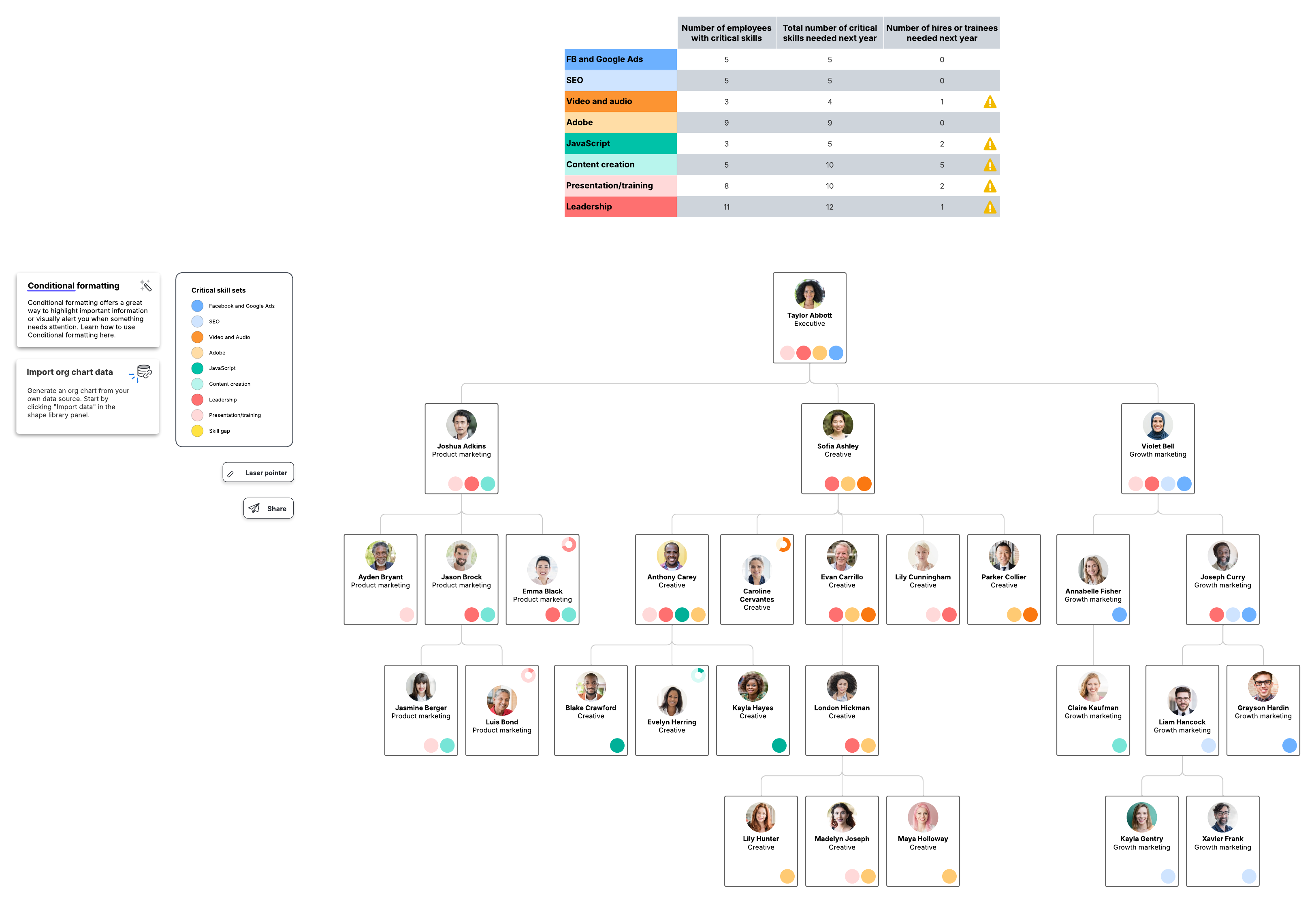
- Evaluate the workforce’s skillset.
- Map out current processes, operations, organizational structure, and roles.
- Identify opportunities and pain points that need to be addressed.
“It’s critical that you assess these components together, not in isolation,” says Rosenbaugh.“Misalignment between process, structure, and culture often blocks transformation more than any single weakness.”
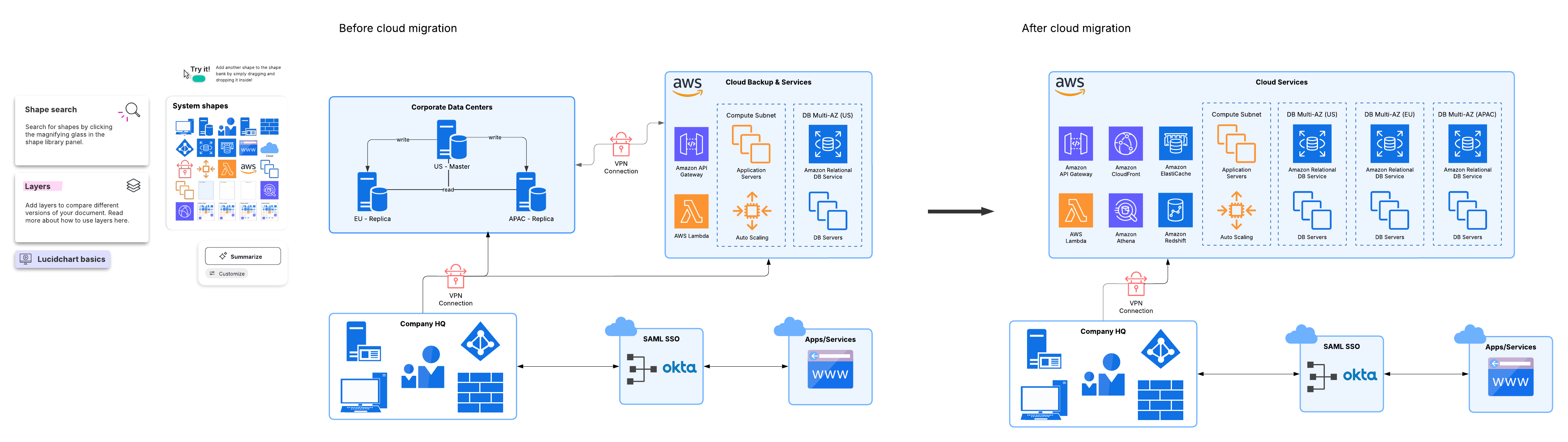
One of the biggest mistakes companies make when undergoing a digital transformation is assuming that they can simply migrate their current technology to a new platform or system (like AWS or Azure ) without considering their current processes. This assumption often leads to expensive migrations that preserve inefficiencies—or break entirely when ported to new systems. Conducting a current state assessment gives you the information you need to make strategic decisions about your digital processes and resources.
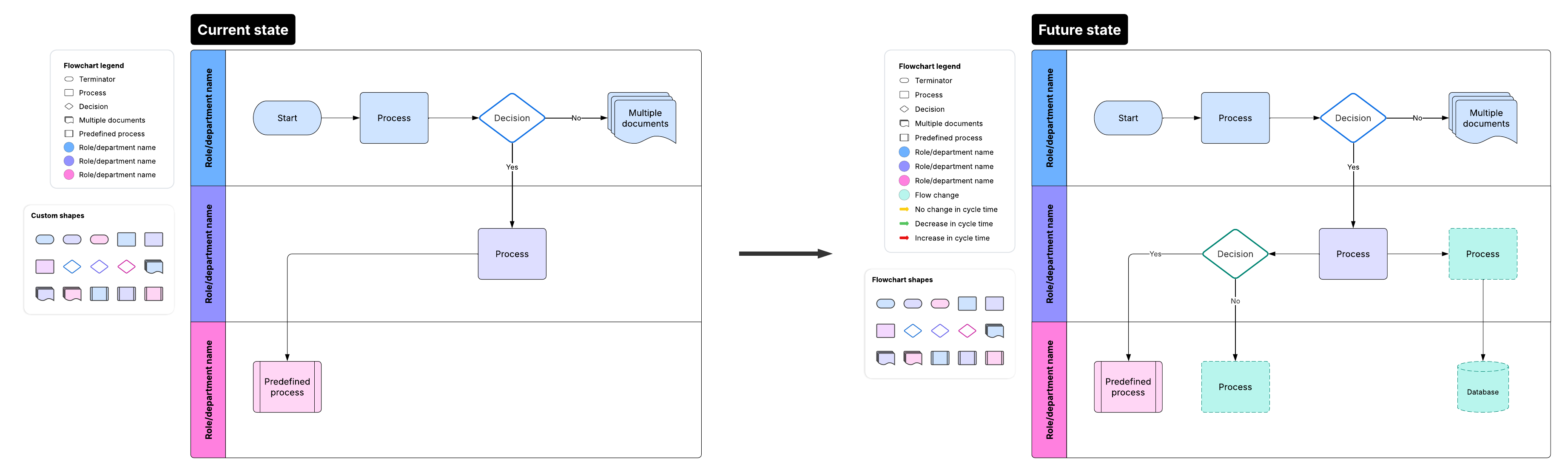
Pro tip: Lucid helps you map out the current state of your systems, opens in a new tab, processes, opens in a new tab, org structure, opens in a new tab, and more, so you can visualize where you are now and more easily identify gaps and opportunities for where you want to be.
3. Conduct a gap analysis
You’ve assessed your current state and desired future state. Now you can identify the gaps and opportunities that exist between those two states. This is the inflection point where transformation moves from aspiration to action. “By identifying the gaps between today’s reality and tomorrow’s goals, you can define what truly needs to change,” says Rosenbaugh.
Consider:
- What areas need to be bridged (e.g., processes, org design, architecture, skills, culture), and which of those are foundational to enabling change?
- What redundancies, inefficiencies, or conflicting systems are creating friction or slowing responsiveness?
- What enablers—whether skills, data, tools, or workflows—are missing or misaligned?
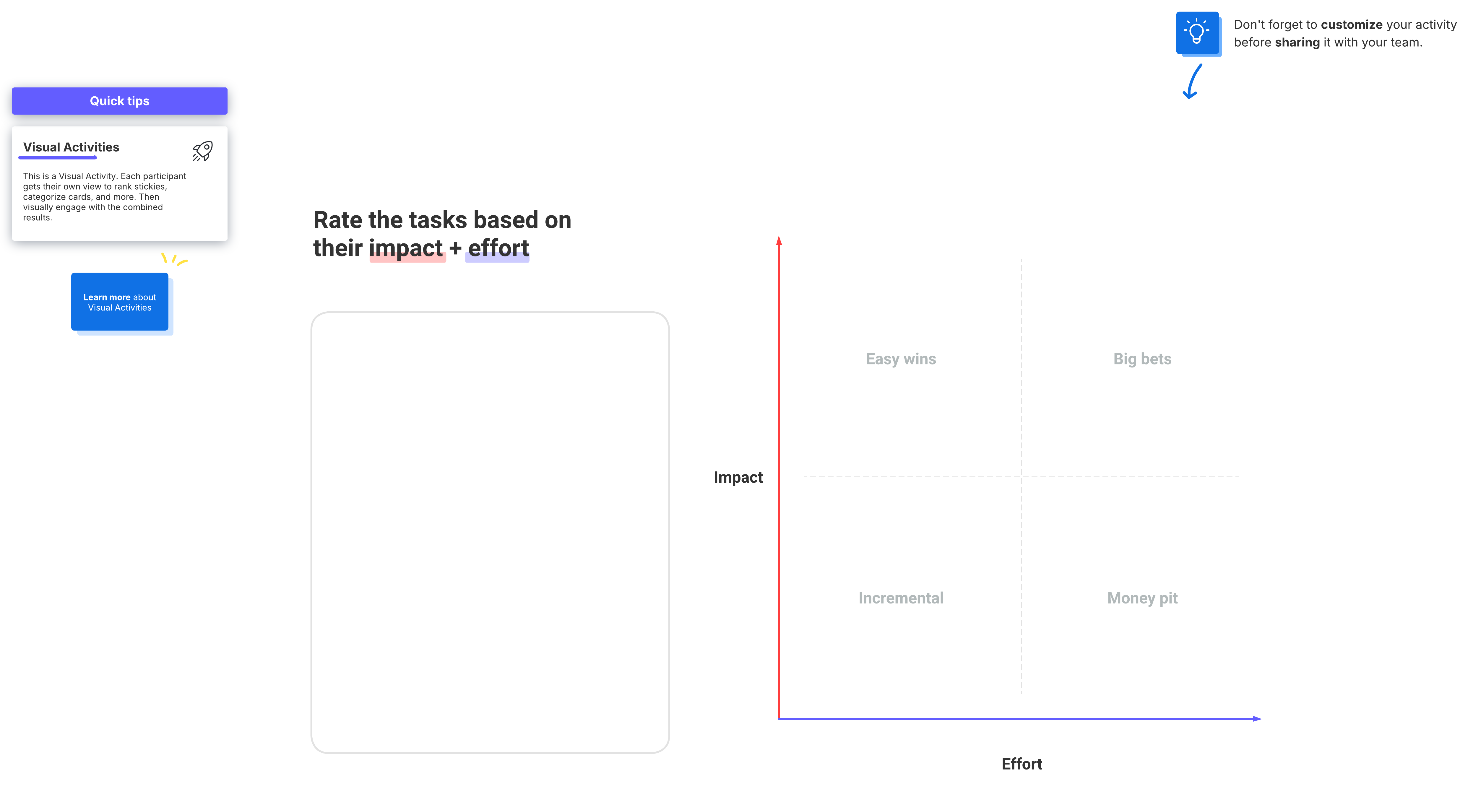
Pro tip: As you consider opportunities to prioritize, be sure to seek input from teams across the business. Set up conversations, send surveys, or even use interactive polls such as Visual Activities to collect feedback.
4. Create a digital transformation roadmap
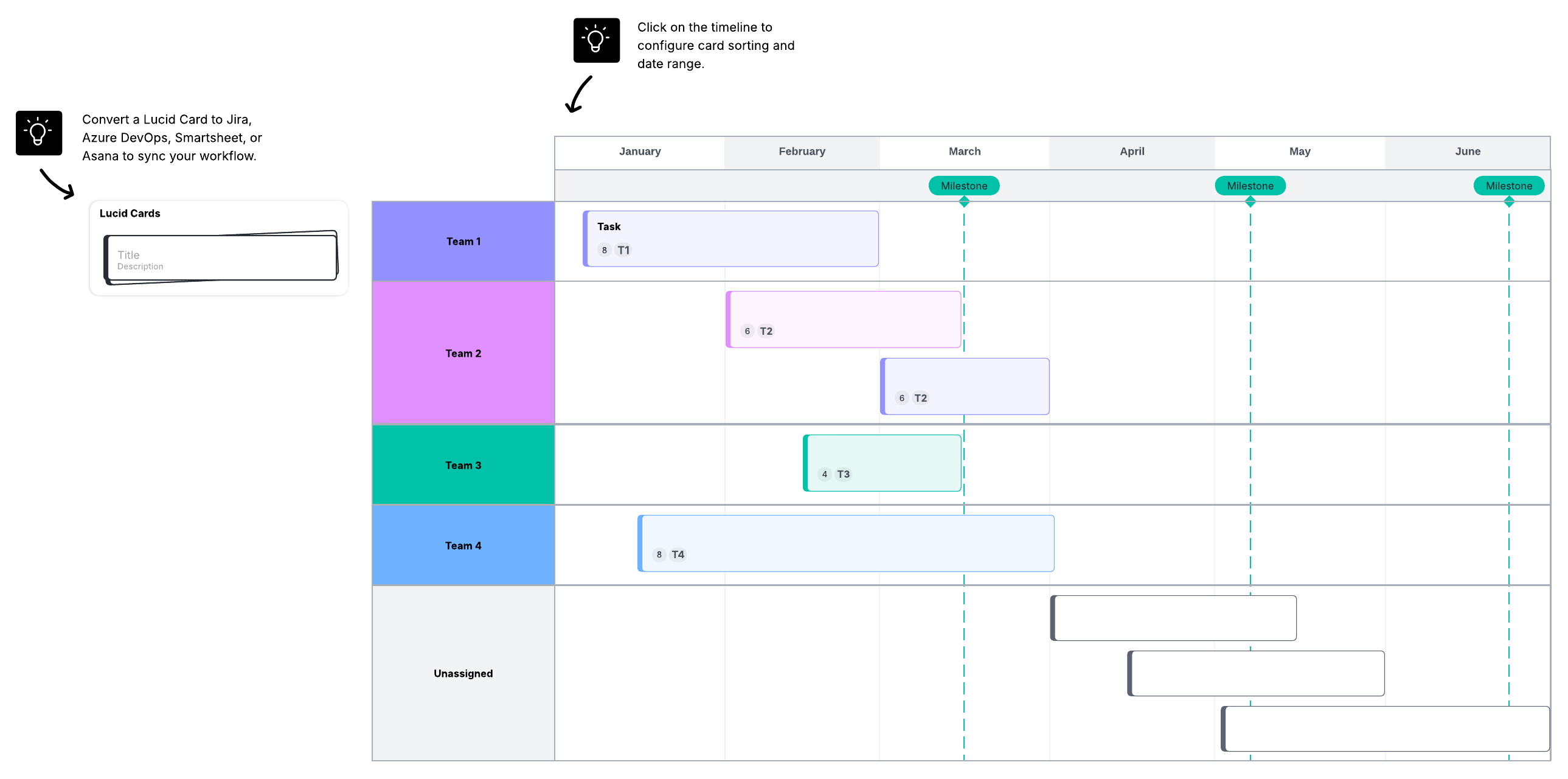
Now you’re ready to build a roadmap—that is, a shared, adaptable blueprint that aligns teams, guides investment, and accelerates the path from intention to execution.
Map out how you will get from point A to point B. This process might include reframing infrastructure, reskilling employees or recruiting new talent, modernizing your tech stack, remapping workflows, adjusting organizational structure, or transitioning to an agile development process. Your roadmap should outline the key goals and priorities, intermediate objectives, a timeline with milestones and benchmarks, and key players and roles for each area of the plan. You don’t need to fix everything at once, but you do need clarity on sequencing and dependencies.
Keep in mind that a roadmap isn’t intended to be a plan you’re locked into; it should be adaptable and evolve with your business and the changing priorities of the digital landscape. Transformation is iterative, and your roadmap should reflect that.
5. Secure buy-in and initial funding
Before you can start implementing your digital transformation strategy, you need buy-in from C-suite leaders (who are funding your plan) to frontline employees (who are implementing your plan). Actively seek feedback from stakeholders early and communicate the vision, plan, and impact frequently. True buy-in shows up in how people allocate budget, prioritize work, and engage with the strategy day to day.
“Because transformation touches every corner of the organization, buy-in isn’t just about approval. It’s about readiness,” says Rosenbaugh. “Every team must understand how their work will change and how they’ll be supported through that change.”
As you begin rolling out digital transformation efforts incrementally, you’ll want to revisit the allocated budget and make adjustments based on what you’re learning.

How to build an agile funding model
Learn how to incorporate agility into your funding model so you can easily pivot your efforts as you gather data or the market changes.
Read more6. Implement and adapt your strategy
You have a vision, a plan for meeting your vision, and the resources to get started. But the hard work isn’t done yet: Research shows that 55% of a transformation's value loss occurs during and after implementation. Putting your strategy into action involves continuous alignment, collaboration, and clarity. This stage is where complexity multiplies. Teams must stay aligned, empowered, and responsive as new challenges surface.
“At the end of the day, transitioning from strategy to execution is the greatest challenge in nearly every business transformation, opens in a new tab.”
—Jeff Rosenbaugh, senior director of professional services, Lucid
There are a lot of unknowns when you first start rolling out your strategy, so start small. Rather than rolling out a large-scale strategy all at once, identify one or two ideas to test and learn from (you can think of these as pilot programs). Since your strategy is built largely on assumptions, your goal is to experiment, collect data, and validate which assumptions are worth scaling and investing in further.
Common pitfalls when implementing digital transformation
Even the best-laid plans can encounter roadblocks. When developing and implementing your digital transformation strategy, watch out for these common pitfalls.
Resistance to change
Change is hard, which can make it difficult for you to win over hearts and minds for buy-in to your bold new plans. Whether it comes from the leadership, staff, or customers, resistance to change can quickly derail your digital transformation.
“Digital transformation breaks down silos, reveals inefficiencies, and questions traditional ways of doing things,” says Rosenbaugh. “It’s natural and expected for digital transformation to be met with intense emotion, often stemming from fear of loss—of control, of status, of influence.”
Rosenbaugh recommends not only acknowledging this complicated nature of change, but embracing it. That means building intentional strategies to create transparency, communicate clearly, and offer ongoing support.
Sometimes, resistance isn’t dysfunction. It’s a signal that people don’t understand the ‘why,’ don’t trust the process, or don’t see themselves in the future state. Leaders often over-index on communication volume and under-index on contextual relevance. The message isn’t just ‘what’s changing’—it’s ‘why now’ and ‘what’s in it for me.’
—Jeff Rosenbaugh, senior director of professional services, Lucid
Work with stakeholders early on in the process to get buy-in and collaborate on ways to make the transitions (and ultimate transformation) easier.

Modern-day change management guide
Get expert tips on overcoming change fatigue and guiding your organization through transformation.
Get the guideConfusing tool adoption with transformation
This may seem obvious, but as AI captivates a wider audience, it’s worth the reminder: No one tool is going to transform your organization on its own.
When organizations are constantly jumping to the next shiny tool, it’s hard to make any progress toward goals (plus, you’ll give teams whiplash and intensify change fatigue). Remember that the objective isn’t merely to adopt new technology; it’s to build an adaptable business.
Before adopting any new technology, consider if it supports your vision and how it maps back to your processes and culture.
Lack of expertise
Digital transformation is a huge initiative, and few individuals have both the technical fluency and deep organizational knowledge needed to steer transformation alone.
“Most organizations have people with great depth of expertise in what the business does—be that pharmaceutical knowledge, manufacturing, or anything else,” says Rosenbaugh. “These people can’t simply be replaced by a tech-savvy individual.”
Instead, leaders should intentionally consider how to uplevel these experts’ skills. Part of this process may also involve unlearning antiquated ways of working. For example, many habits and KPIs that teams were comfortable with for years may completely shift, and teams will have to intentionally develop new patterns and work toward new metrics.
"While external experts can help accelerate change, transformation fails when accountability isn’t internalized. Your people must be equipped, not just advised."
—Jeff Rosenbaugh, senior director of professional services, Lucid
Keep in mind that digital transformation isn’t a one-person job. It should be a cross-functional endeavor involving multiple departments, so you should ensure that these teams are staffed accordingly and looped into the transformation strategy.

Enhance your AI skills
Get resources to bolster your AI skillset—no previous technical experience needed.
Data architecture fails to support business outcomes
Organizations often collect vast amounts of data but fail to translate insights into timely decisions. Teams get buried in dashboards, delay action while waiting for perfect certainty, or lack clarity on who owns data-driven decisions.
Transformation efforts frequently stall because the data architecture wasn’t designed to support the desired business outcomes.
To overcome this, organizations should design their data architecture backward, starting with the key decisions they need to accelerate or improve. Rather than asking, “What data do we have?” the better question is, “What decisions matter most to our transformation, and what data, structure, and access do those decisions require?”
This approach ensures that your architecture prioritizes usable insight over exhaustiveness, and that ownership of data is aligned to outcomes—not just systems.

Get more tips for making timely, data-driven decisions.
Get the guideTry these templates to drive your strategy for digital transformation
Building a digital transformation strategy involves a lot of moving parts and coordinating a wide range of people. Having the right tools in place can help you at every stage of your strategy development. Lucid’s visual collaboration applications make it easy to brainstorm and share ideas, visualize data, and map your plans.
Choose from a variety of digital transformation strategy templates to customize your plans from start to finish.
Current and future state diagram
Gap analysis
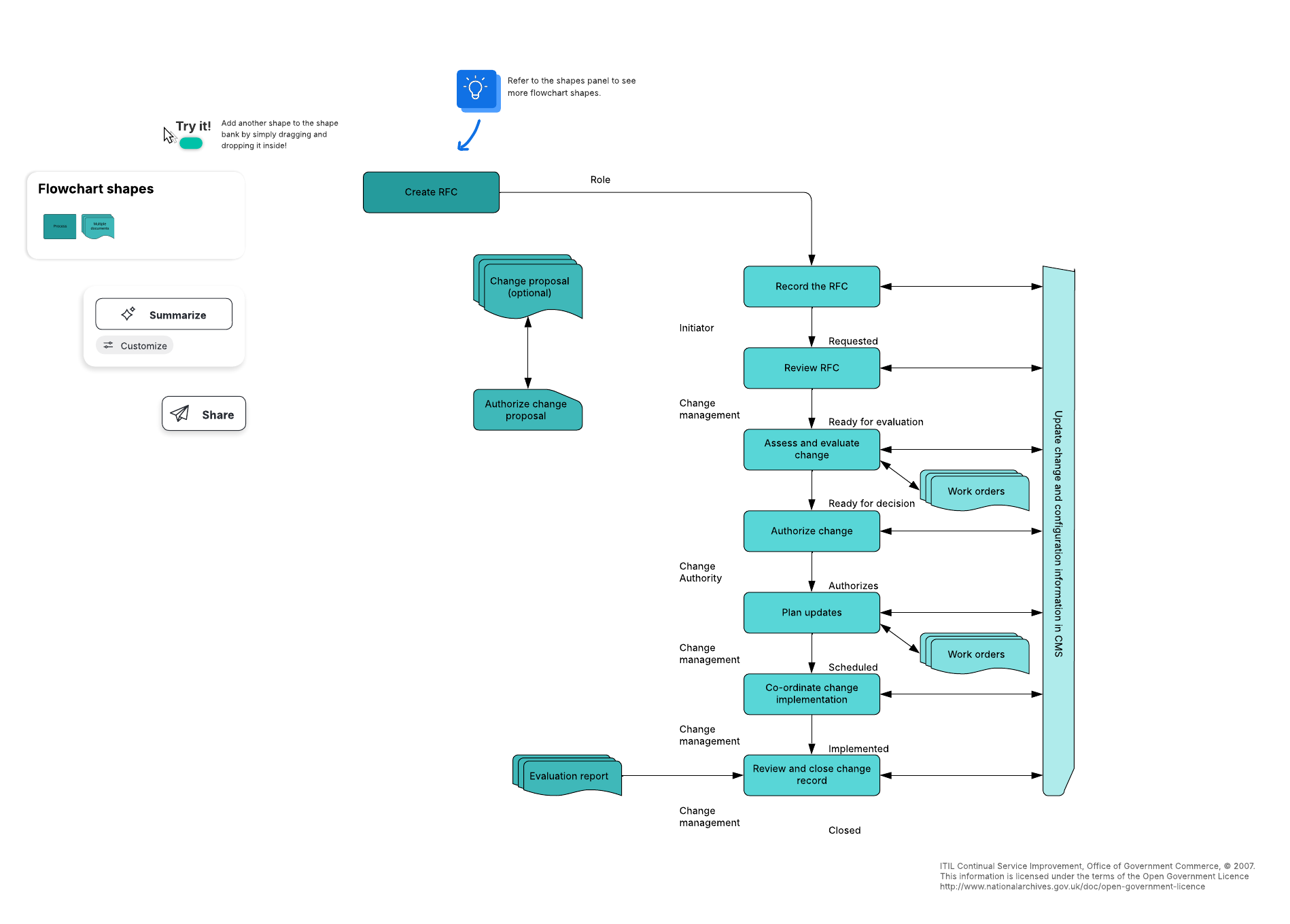
Change management process flow
Skills gap analysis org chart example
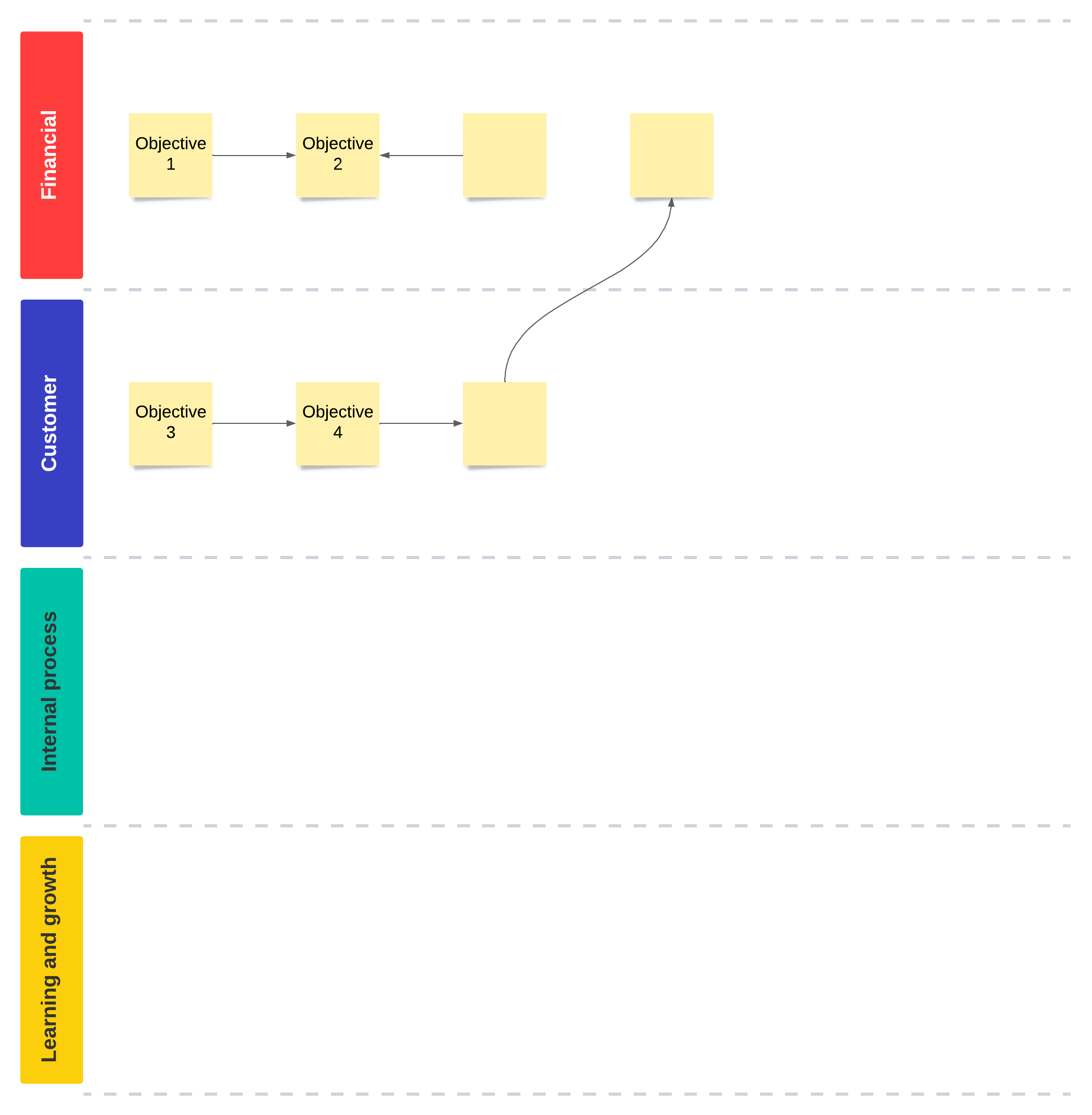
Strategy map
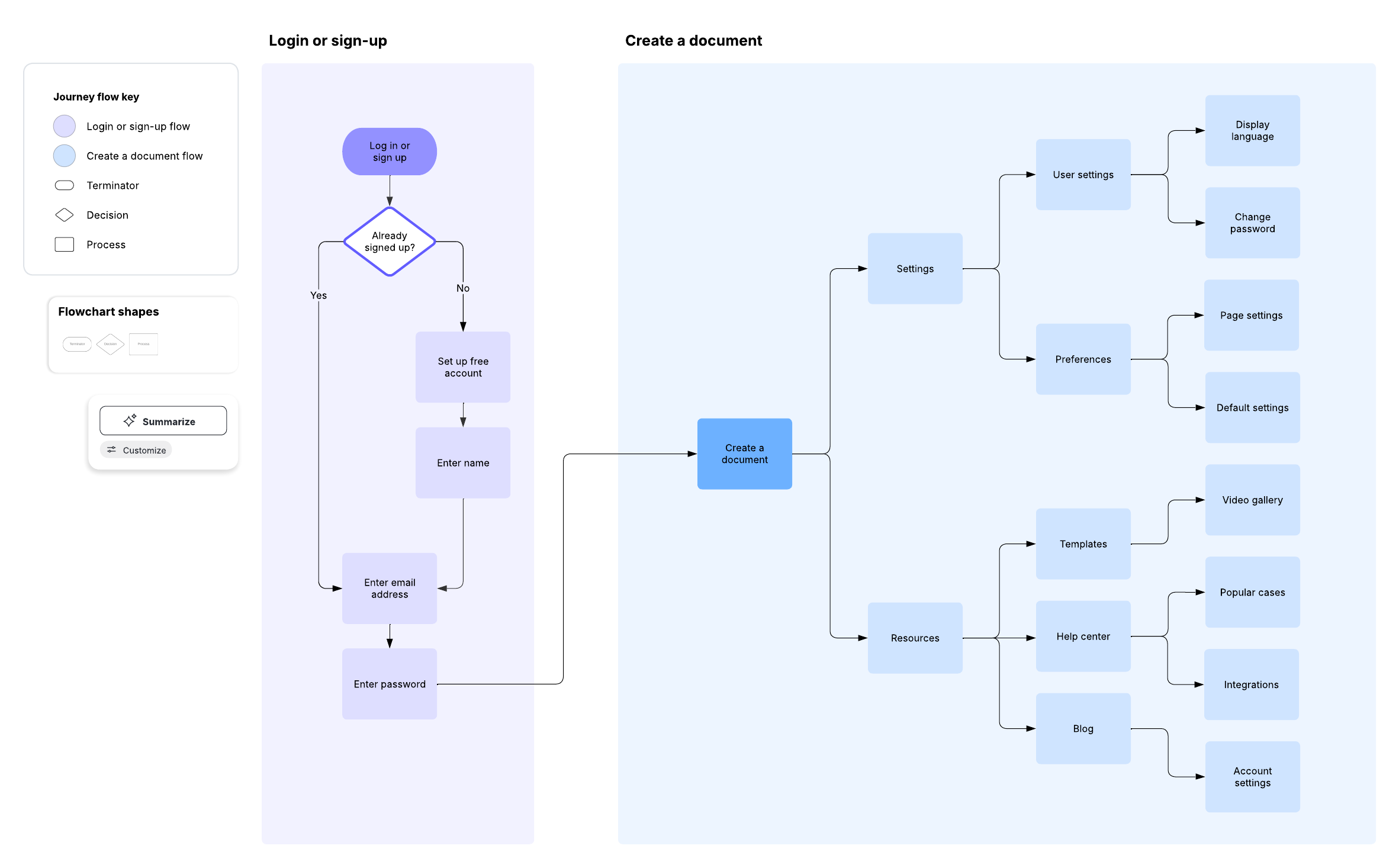
User journey flow
Accelerate digital transformation with Lucid
Not only does Lucid provide templates to help teams visualize and collaborate on complex processes, systems, and workflows, Lucid also helps teams standardize and scale practices to accelerate transformation with three powerful add-ons: the Agile Accelerator, Cloud Accelerator, and Process Accelerator.
No matter where you are in your digital transformation journey, Lucid provides the clarity and alignment needed to navigate change.
Frequently asked questions
What is a digital transformation strategy?
A digital transformation strategy is a comprehensive plan that helps organizations strategically reinvent how they operate, engage with customers, and deliver value—going beyond simply implementing new technology to build an adaptable business that can respond to ongoing digital disruption.
Why do I need a digital transformation strategy instead of just adopting new technology?
Digital transformation is about building an organization fundamentally set up to respond to change through your technology, processes, and culture. A strategy provides a clear narrative that guides decision-making and helps your organization adapt to shifting priorities and market dynamics, rather than just reacting to changes.
What are the key steps to develop a digital transformation strategy?
Start by identifying your goals and desired outcomes, assess your current state across culture, processes, and systems, conduct a gap analysis, create an adaptable roadmap with milestones, secure buy-in and funding, then implement and continuously adapt your strategy based on learnings.
How should I start implementing my digital transformation strategy?
Start small with one or two pilot programs to test and learn from, rather than rolling out a large-scale strategy all at once. Research shows that 55% of a transformation's value loss occurs during and after implementation, so continuous alignment, collaboration, and clarity are critical.
What common mistakes should I avoid during digital transformation?
Avoid confusing tool adoption with transformation, underestimating resistance to change, lacking necessary expertise across teams, and designing data architecture that doesn't support your desired business outcomes. Remember that no single tool will transform your organization on its own.
How do I overcome resistance to change during digital transformation?
Build intentional strategies to create transparency, communicate clearly, and offer ongoing support. Work with stakeholders early to get buy-in, and ensure your messaging explains not just what's changing, but why now and what's in it for each team member.
What capabilities does my organization need for successful digital transformation?
You need organizational alignment around goals, clarity into existing processes and operations, strategic data-driven decision-making, change leadership and resiliency, and business agility embedded across teams, systems, and workflows.
How do I measure progress on my digital transformation roadmap?
Your roadmap should outline key goals and priorities, intermediate objectives, a timeline with milestones and benchmarks, and key players and roles for each area. Remember that a roadmap should be adaptable and evolve with your business and changing digital landscape priorities.