Key takeaways
- Business transformation is most often driven by changes in the competitive landscape, the rise of new technologies (such as agentic AI), and macroeconomic pressures.
- When business transformations fail, it’s typically not because of poor strategy but instead a consequence of missing operating loops needed to execute the strategy, including a lack of governance, incentives, and performance tracking.
- The most successful business transformation approach involves making small changes at a time, validating ideas through pilots, and scaling successful ideas through standardization and effective change management.
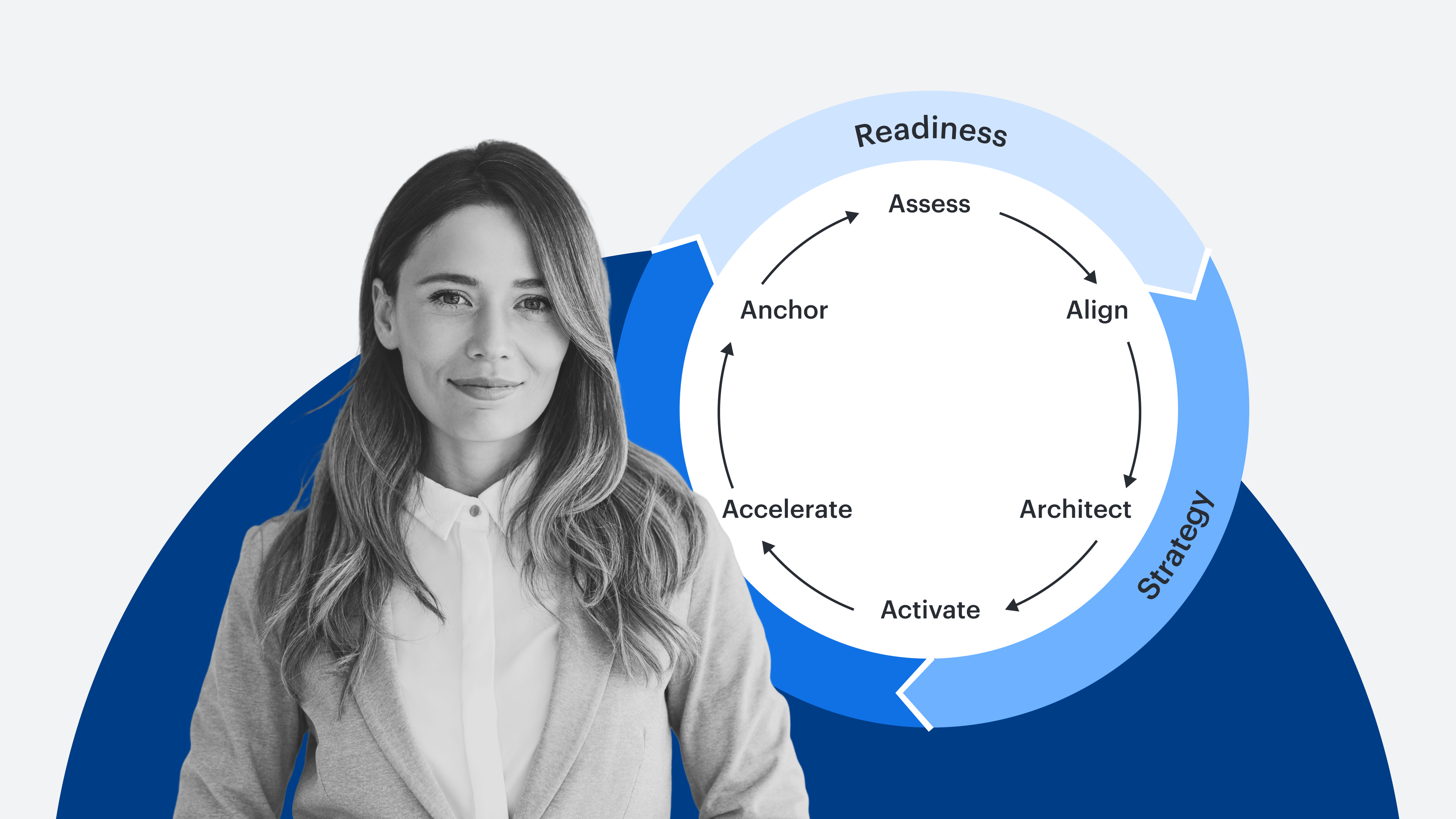
- Lucid's business transformation framework is a loop that consists of six stages to guide organizations through readiness, strategy, and execution from one transformation to the next.
- As the pace of change increases, a work acceleration platform like Lucid becomes critical for keeping teams aligned, streamlining decision-making with data and automation, and standardizing key workflows.
Organizations simply don’t have the luxury to implement change slowly anymore.
90% of C-Suite leaders say the pace of change has accelerated since January 2025, according to Accenture’s latest Pulse of Change report. 84% are expecting the pace to increase further, yet only 42% feel very prepared to meet that disruption.
But just because the pace of change demands quick transformation doesn’t mean leaders should sacrifice structure. Think of it this way: Speed without structure creates rework. But structure without speed stalls progress. Neither outcome leads to sustainable change.
The best way to get both speed and structure? A flexible business transformation framework.
Built on my 15+ years of experience in guiding organizations through large-scale change, Lucid’s business transformation framework provides the right balance of structure and flexibility to navigate any disruption.
What is business transformation?
Business transformation is the strategic evolution of a business’s operating model, processes, technology, or culture. Transformations can be triggered by internal factors, such as revenue drops, high costs, or other performance issues; however, they are more commonly triggered by external forces, with the competitive landscape, rise of new technologies (such as Cloud or AI), and macroeconomic pressures being the primary drivers (Monitor Deloitte’s 2025 Chief Transformation Officer Study).
A few of the most prevalent business transformation examples I see today include:
- AI transformation: As generative AI gains popularity and businesses prepare for agentic AI, organizations are considering how to fully integrate AI into their operations, products, and services.
- Digital transformation and IT modernization: Some organizations are looking to upgrade their data and integration backbone—moving from siloed apps to a unified data plane and API architecture—to enable critical end-to-end workflows, ship faster, reduce errors, and ensure real-time decision-making.
- Changes to an operating model, such as Agile transformation: More organizations are looking to enhance organizational agility in hopes of boosting employee engagement, efficiency, adaptability to change, and customer satisfaction.
- Business model transformation: This type of transformation, which focuses on how a company operates, grows, and generates revenue, is commonplace today as organizations shift to subscription-based or platform-based business models.
Regardless of what drives business transformation, there’s a common trend I’ve noticed across the board: Large, monolithic change efforts tend to underdeliver. They drag on, overrun capacity, and often get recast under a new name long before outcomes land. This approach is incredibly risky and is not only ineffective at driving change, but it’s also costly.
I’ve seen the most success come from a business transformation approach that scopes thin slices at a time, validates ideas with pilot programs, and scales successful experiments deliberately.
The business transformation framework and templates that follow are designed to help you take an incremental approach to accelerate your change initiatives.
Why use Lucid’s business transformation framework
There are a ton of business transformation frameworks to choose from, and I’ve used many of them myself. I’m not trying to reinvent the wheel here; rather, I’d like to distill the best practices into a tactical framework that doesn’t just tell you what needs to be done—it shows you how to put those recommendations into action.
Lucid’s business transformation framework is divided into three main phases:
- Readiness: This phase is about setting up the foundation for your transformation. It involves assessing the current state of your business and the market in which you operate, so you have the information needed to inform your strategy.
- Strategy: Building a business transformation strategy involves aligning on a vision and scope, defining your target operating model, and making a plan to transition to your ideal state.
- Execution: Traditionally one of the most challenging parts of business transformation, executing on your strategy involves testing ideas in pilot programs, scaling successful pilots, and integrating the new way of working into the business through change management.
To better guide you through your transformation, we’ve broken down each phase into stages with distinct goals and guidance to help you reach each goal. For instance, while both designing pilot programs and systematizing new operations are part of the execution phase, these two stages have different objectives (quick learning vs. standardization) and therefore require different sets of capabilities. Lucid’s business transformation framework accounts for this complexity, providing clear templates and tips to help you progress through the stages.

It’s important to note that, while some frameworks treat transformation as a linear process, Lucid’s business transformation framework is deliberately cyclical. After you anchor changes, you stabilize and verify the benefits, then revisit the first stage on a planned cadence (e.g., quarterly or when new signals emerge) to target the next, highest-value slice. Effective transformation is not a one-and-done organizational effort, but rather a continuous, bite-sized process focused on specific outcomes.
The six stages of Lucid’s business transformation framework
One of my favorite analogies to use when discussing the stages of business transformation is a sea voyage. Long voyages, much like business transformation, require continuous planning, coordination, and adaptation as conditions change. Follow the stages below, trying out the templates and tips in Lucid to navigate your transformation journey.
Stage 1: Assess the business
Goal: Capture the current state of your business processes, systems, data, people, and market conditions to lay the groundwork for your transformation, scoped to what’s needed to unblock the first thin-slice pilot (not a boil-the-ocean inventory).
Before you can hoist the sails, you must assess the conditions of the water ahead and the readiness of your ship and crew to face those conditions—in other words, you need to understand your current state. Confirm constraints (e.g., budget, capacity, compliance) and the systems of record you’ll use for measurement so that all future decisions use one source of truth.
Documenting your current state is foundational work for preparing for any transformation. After all, you can’t change what you don’t understand.
As part of your assessment, you’ll want to look at both external and internal factors, including:
- Competitors, market conditions, and the economic landscape: Consider evolving customer expectations, assess barriers to entry in your market, identify disruptive technologies, and understand potential political or economic factors that could affect your business. Capture two to three value pools you’ll explore in later stages.
- Your primary processes and value streams: Map end-to-end processes from initial customer trigger to value delivery (e.g., order to cash or idea to launch), evaluating effectiveness, efficiency, variability, and areas of waste.
- The systems and technology that support those processes: Inventory all critical systems, identify data silos and integrations, document technical debt, and assess data quality and data lineage.
- Your organizational structure and culture: Document how teams are aligned to your processes, identify decision rights, understand your current incentive structure and appetite for change, and assess skills and competencies.
Here’s how to assess your business using Lucid:
You can complete your entire assessment in Lucid, working on a shared canvas so inputs, decisions, and owners are visible.
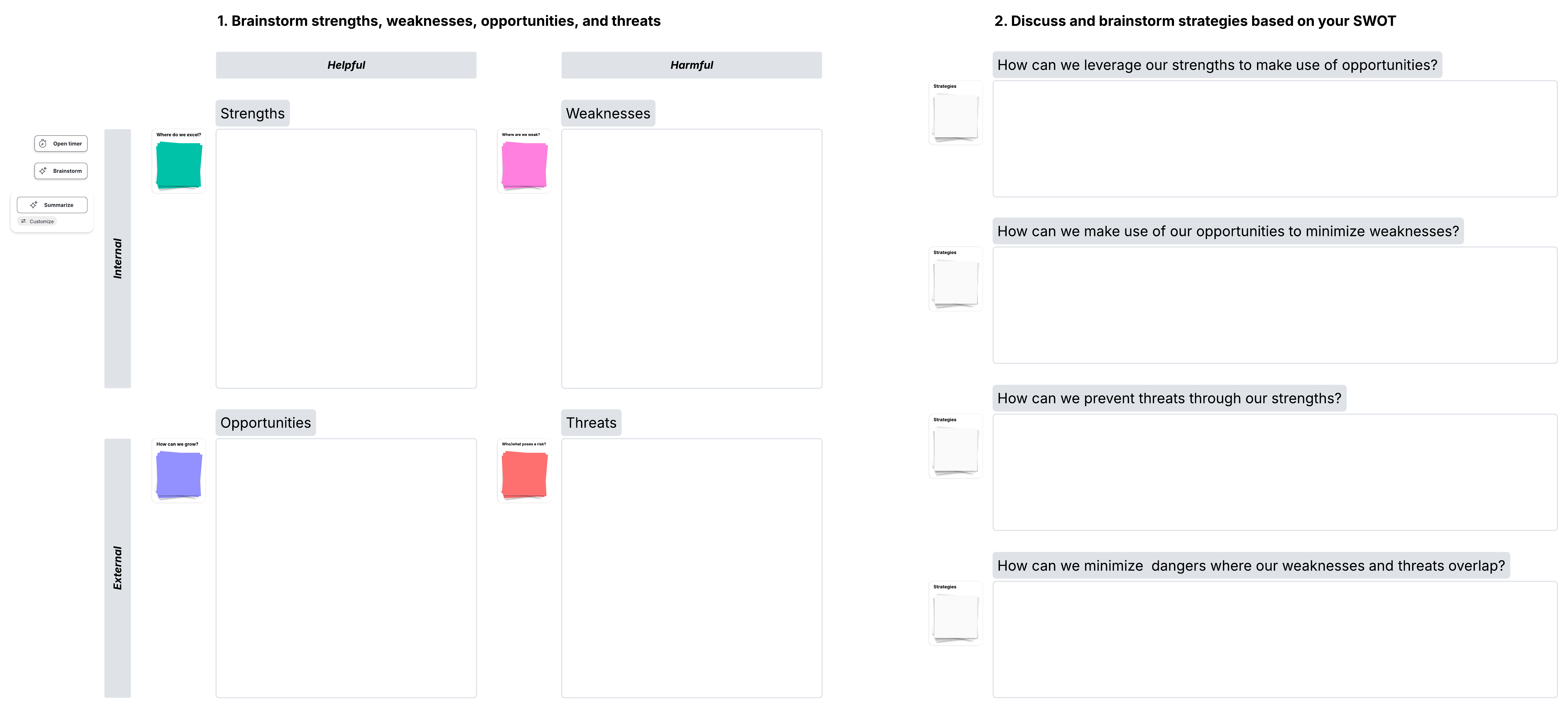
Conduct a SWOT analysis or PESTEL analysis, use a strategy map, or fill out the business model canvas to evaluate your position in the market, inviting stakeholders across the organization to contribute strategic input.
Easily document your current processes, technical systems, and organizational structure to identify inefficiencies, interdependencies, complexity, or opportunities for change. I suggest using conditional formatting or layering data onto your visuals for deeper insight.
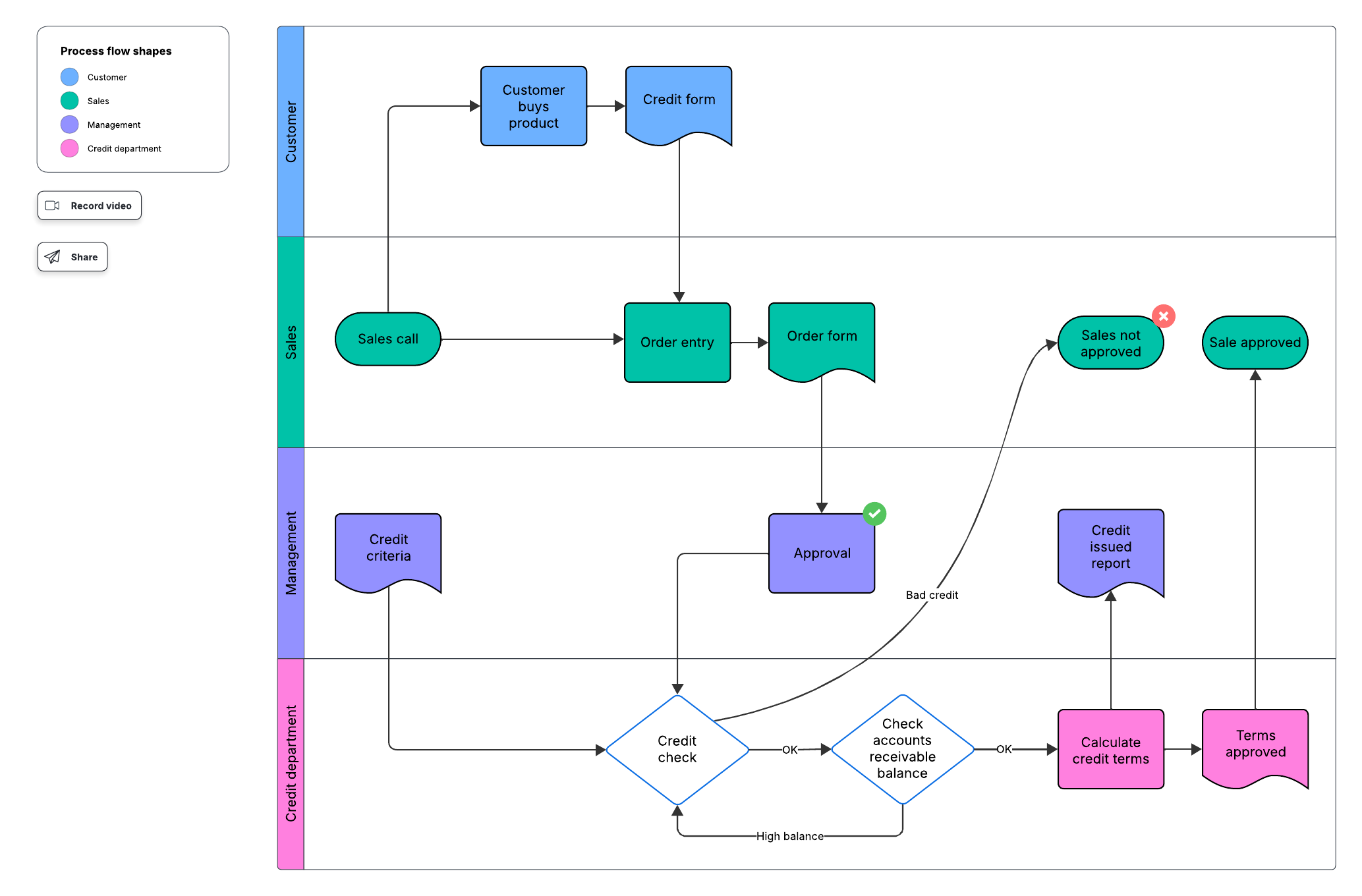
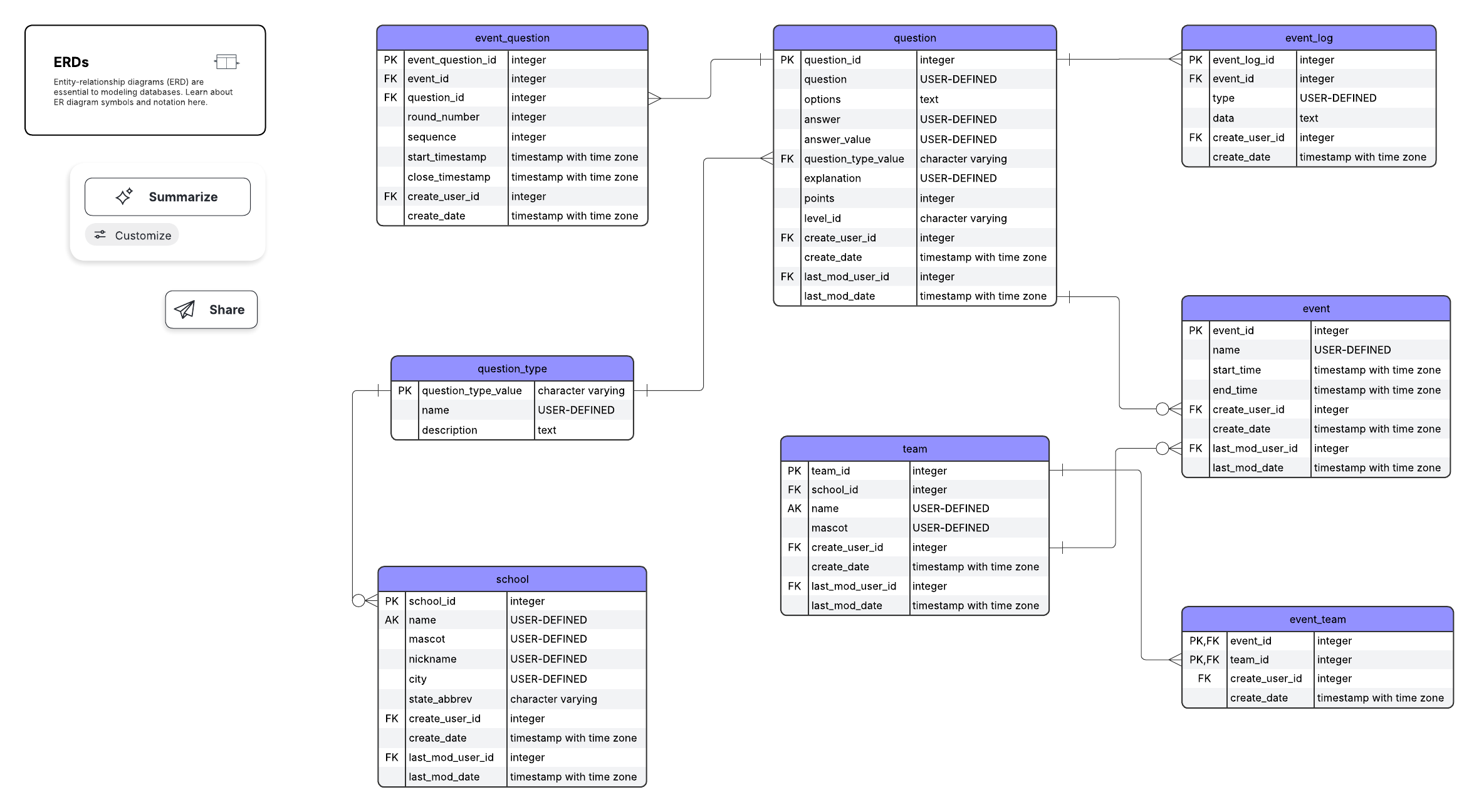
Speed up your current state documentation by automatically generating visuals of org charts, ERDs, or UML diagrams by connecting to outside data sources, including spreadsheets, a SQL database, your HRIS, or another system of record.
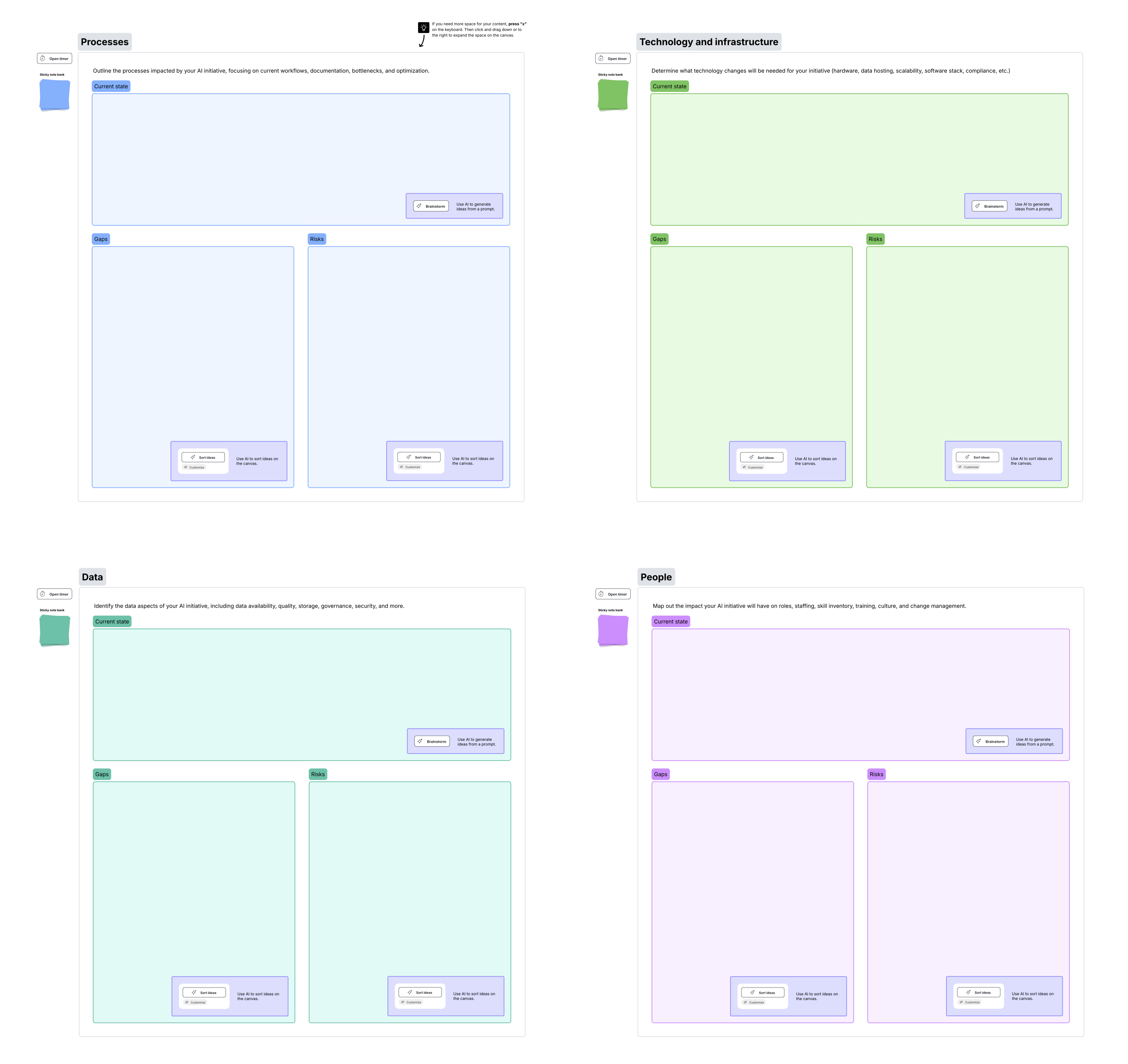
If you’re preparing for AI transformation, you can check out our newly added AI initiative templates specifically designed to help you assess AI readiness and document workflows for AI agents.
Stage 2: Align the business around a vision
Goal: Decide which outcomes you’ll pursue, over what time period, who owns each outcome, and what initiatives are out of scope for this transformation.
With a current understanding of your current state, you can better see where you need to go and why you need to take the journey. You can think of this as your North Star, a guiding vision that the entire crew (or organization) can set their sights on.
Be explicit about why now and where value lives. Are you losing share to faster entrants, under cost pressure, or chasing new customer expectations?
At this stage, you’ll need to align on:
-
A problem or opportunity statement: Consider whether the transformation is the result of a problem you’re trying to address (such as process inefficiencies) or a new opportunity you want to explore (such as agentic AI).
-
Time-boxed, measurable outcomes with owners: Identify clear outcomes by examining performance metrics you want to improve (e.g., revenue, customer retention rate, or process cycle time), evaluating product-customer fit, or analyzing win/loss data. Set clear KPIs and owners to increase accountability and clarify how to track progress.
-
Opportunities not part of this transformation’s scope: You can increase alignment by explicitly clarifying what change opportunities you will not pursue in your initial transformation. Document these trade-offs so that you can revisit them after you’ve reached your objective and decide if they make sense to act on later.
Here’s how to align the business using Lucid:
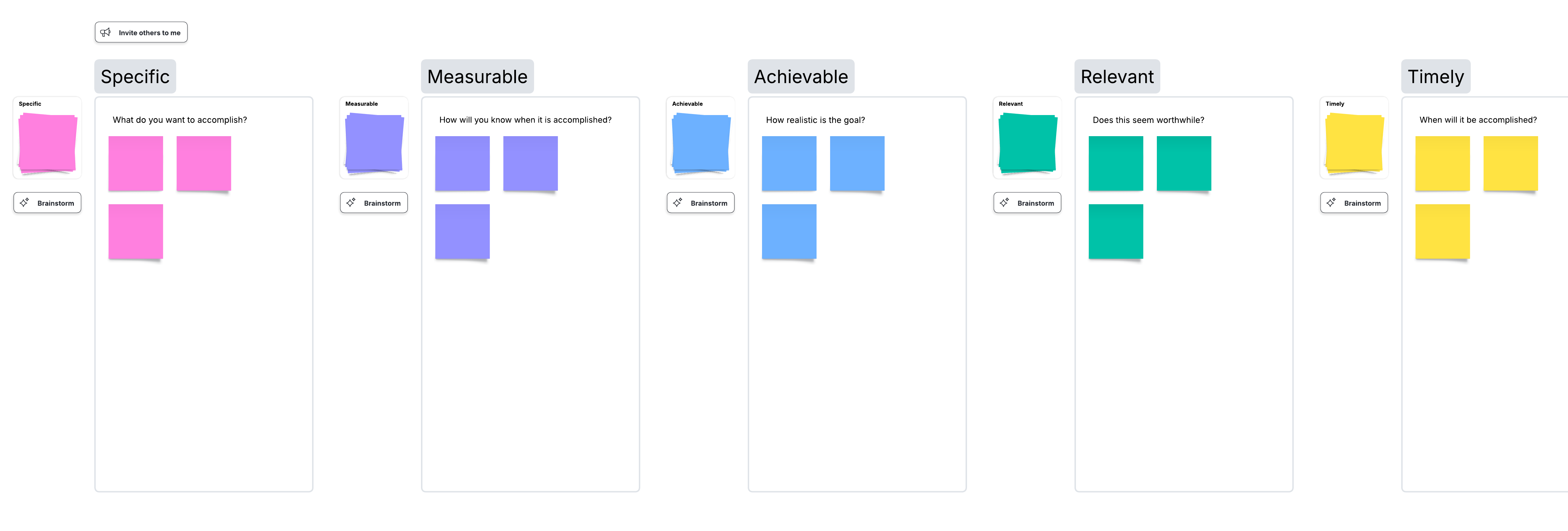
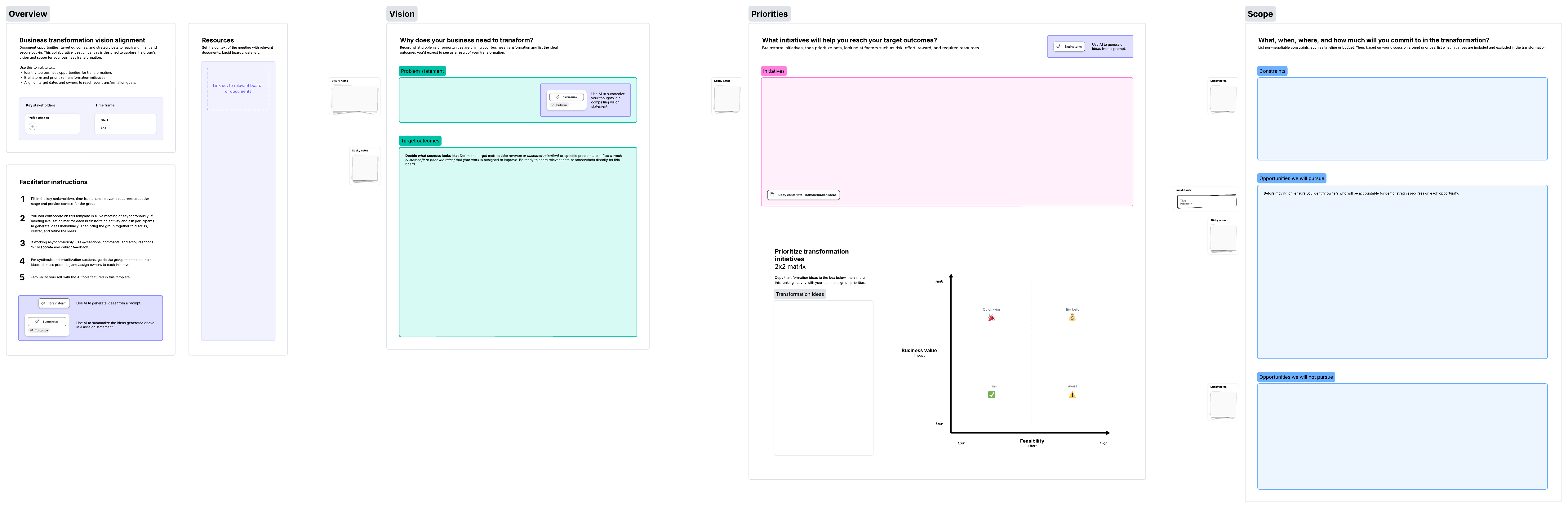
Bring stakeholders together—asynchronously or in real time—to brainstorm transformation goals that are specific, measurable, attainable, relevant, and timely. You can use AI in Lucid to generate more ideas or sort and summarize all ideas so you can clearly see trends.
It’s simply not feasible to pursue all potential outcomes, so you’ll need to prioritize bets for this wave of transformation. Use Visual Activities, or interactive surveys in Lucid, to collectively prioritize ideas, looking at factors such as risk, urgency, impact, or effort. Visual Activities makes it easy to see areas of agreement or misalignment that may need further discussion.
A cursor clicks "view results" of an impact/effort matrix visual activity in Lucid
Document your vision, target outcomes, and strategic bets to get stakeholder buy-in and create alignment with the teams doing the work. At this point, you’ll want to narrow the scope of your transformation by recording the opportunities you will and will not pursue during this wave of transformation.
Stage 3: Architect your future state and strategy
Goal: Translate outcomes into a target operating model (TOM) and a time-based plan with named owners and decision gates.
Now that you’ve aligned your crew around where you’re going and why, it’s time to chart your course, or figure out how you’ll get there. For instance, if your goal is to be 30% more efficient, specify where in the business that efficiency will come from (e.g., reduce time to first value by 30%) and how you’ll achieve those efficiency gains, such as through capability changes, a redesigned value stream, clearer decision rights, or system integration changes.
In our ship and crew analogy, this stage entails identifying the necessary equipment, training, and navigation systems required to reach your destination. In business transformation, you need to consider:
- The capability set you need and how you’ll achieve it (e.g., will you build, buy, improve, or sunset legacy capabilities)
- The target value stream with defined control points and SLAs
- The organizational structure and decision rights to run the new processes
- An integration/data blueprint that details the contracts, owners, and lineage to make the future state operable
As you develop your business transformation strategy, you’ll also begin to outline your plan for achieving your ideal state. As McKinsey & Company explains, “The most successful transformations turn ideas into detailed business plans with trackable, time-bound metrics to measure outcomes.”
In practice, you need two deliverables: a defined target operating model and a time-based transition plan. Build the plan around a rollout decision milestone, clearly spelling out the metrics, thresholds, owner, and decision gate that will transition you from pilot to rollout.
Here’s how to architect your future state and strategy using Lucid:
Design your ideal operating model, using ready-made templates or Lucid AI to kick-start your diagramming. Value stream mapping is a great way to identify the steps, teams, time, and costs associated with creating value. Compare your future state diagrams to your current state, using layers to view the differences between your as-is and to-be states.
As you evaluate, consider: What gaps exist (e.g., processes, org design, architecture, skills, culture), and which of those must be closed to reach our goal?
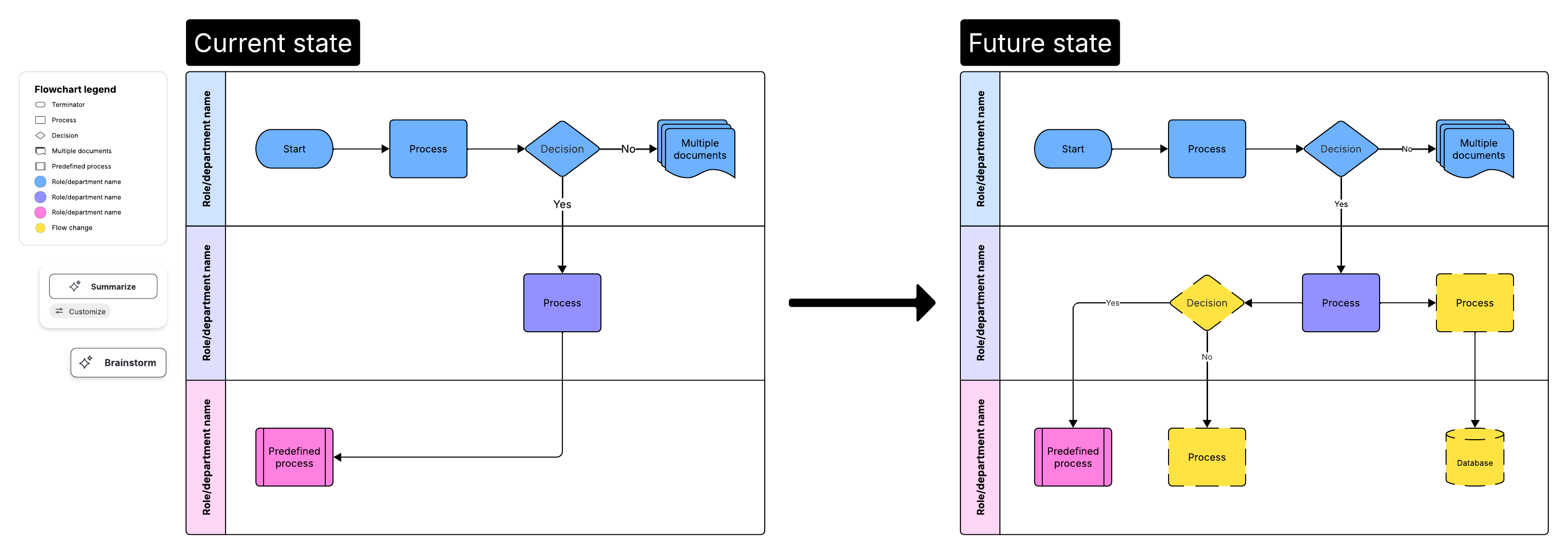
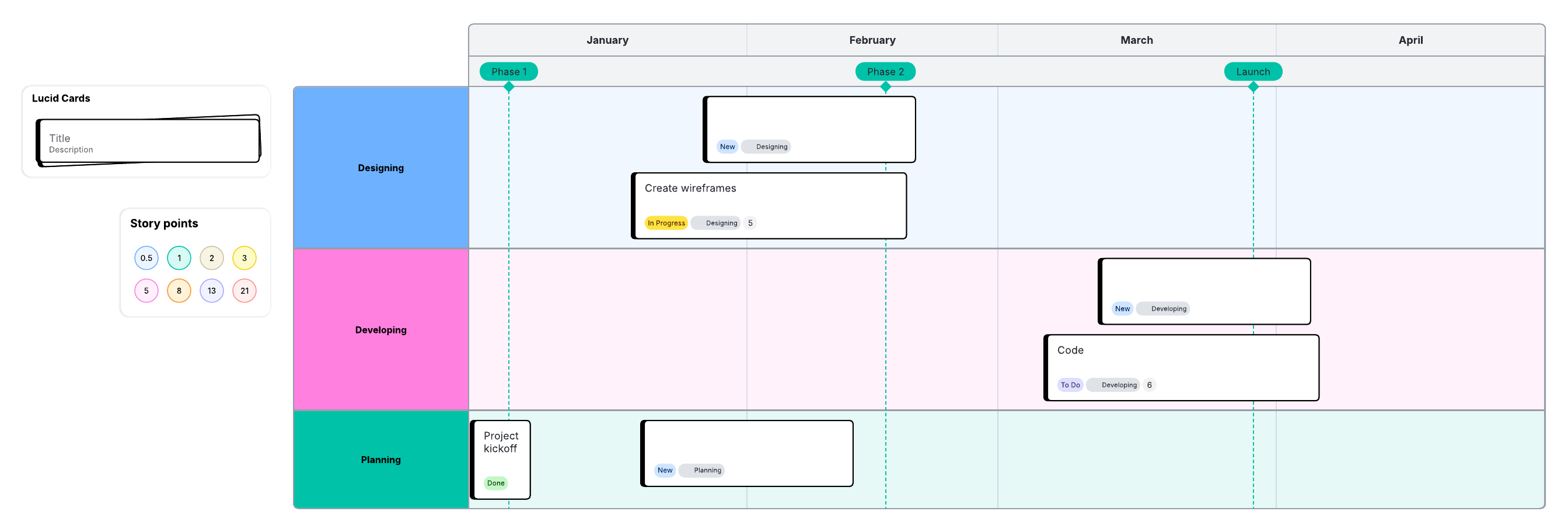
Brainstorm what capabilities you need to reach your desired state. Then, identify what changes you’ll implement first by plotting a high-level plan on a timeline. Clarify the key milestones and owners for leading out the initiatives.
Stage 4: Activate your plan
Goal: Validate the design with pilots that drive behavior change, produce decision-grade evidence, and set up a rollout decision milestone.
With your strategy in place, it’s time to start your voyage. But instead of sailing the whole ocean at once, you break your trip into shorter legs, updating your maps and navigation system as you learn more about your route. Similarly, you want to activate your transformation incrementally through pilot programs.
If you set forth at full speed, you risk running into obstacles that you don't even know exist. As you begin piloting, you might think you're 80% accurate on what needs to be done, but you'll quickly discover you only have about 20% of the plan. Early plans are hypotheses. Pilots turn your hypotheses into evidence as you surface unknown constraints, validate what actually moves the metric, and build confidence to scale or change direction without the drag of sunk costs.
Keep your pilot thin and instrumented. For each pilot, define:
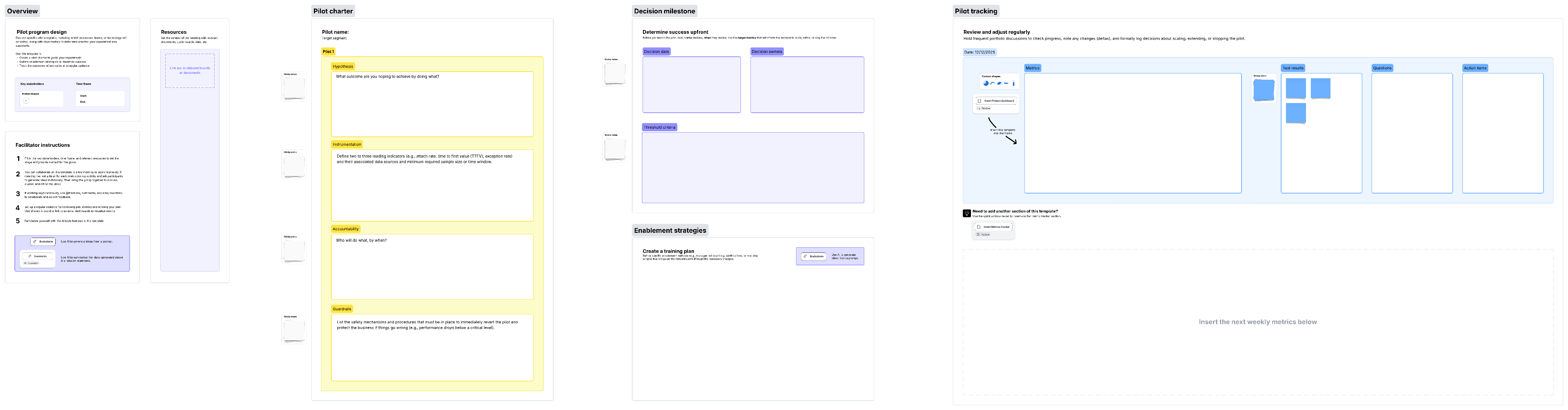
- The pilot charter: Outline your hypothesis, the cohort or segment involved, the rollout decision milestone (including metrics, thresholds, owner, and date), and any guardrails or rollback plans needed.
- Enablement: Treat adoption as a deliverable, detailing enablement strategies such as manager-led coaching, brief certifications and trainings, and role-play scripts.
- Instrumentation: Define two to three leading indicators (e.g., attach rate in pilot cohort, time to first value, or exception rate) with data sources and a minimal sample size and time window.
- Cadence: Hold weekly portfolio discussions to review deltas, decide what adjustments are needed, and log decisions (e.g., whether you will scale, extend, or stop the pilot).
Here’s how to activate your plan using Lucid:
Plan out specific pilot programs, including which processes, teams, or technology will be tested, along with clear metrics to determine whether your experiment was successful.
Use team hubs in Lucid to centralize documentation, coordinate work, and keep cross-functional teams aligned throughout the pilot programs. In your transformation team hub, you can create new Lucid documents that will automatically be shared with team members so everyone can easily access the resources they need.
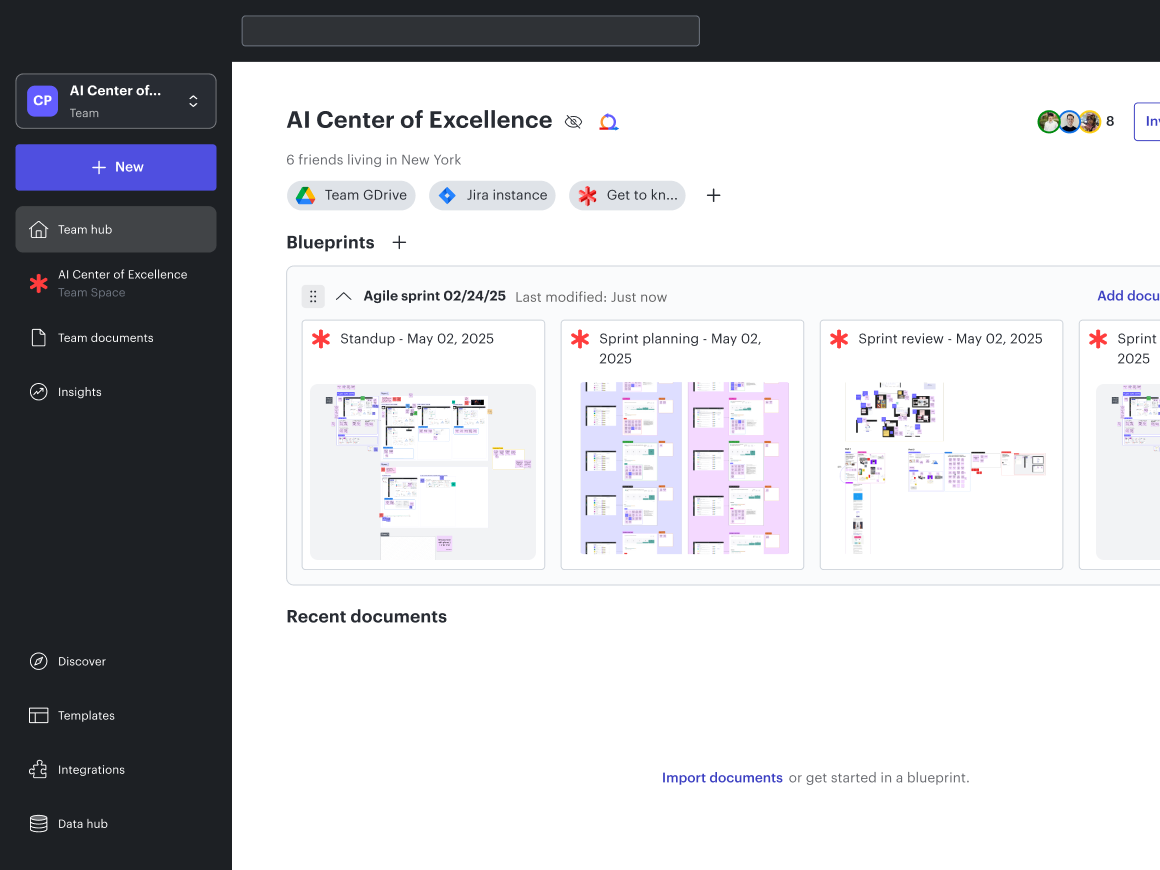
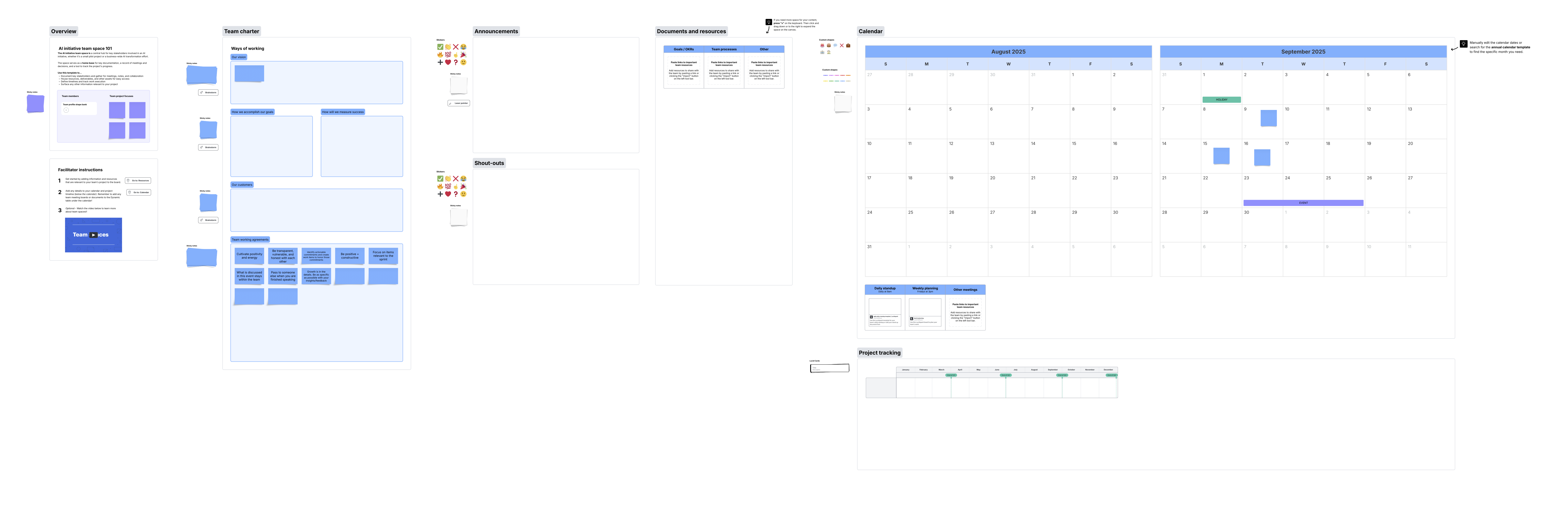
You can also pin a team space, opens in a new tab within your team hub. Your team space acts as the primary team document where team members can share resources, communicate updates and findings from the pilot programs, and coordinate progress throughout each iteration. I recommend documenting both quantitative and qualitative results here, including system limitations, behavior change friction, or other sticking points. Then, you can use the data gathered from the pilot to secure stakeholder buy-in for broader implementation.
Stage 5: Accelerate and scale
Goal: Scale successful pilots in waves with rollout decision milestones, standardize where it adds value, and prove benefits realization.
As you start to gather data about your course, you can pick up speed and move forward with more confidence. In practice, this means rolling out successful pilots in larger waves, expanding to the next segment or region only when the prior wave has cleared its decision milestone.
Here, you transition from an experimentation mindset to a "rinse and repeat" execution mode. Your goal at this stage is to standardize what works. For instance, you may begin to solidify processes, roles, and systems, removing any manual workarounds from the pilot phase to systematize operations.
You then start tracking metrics, such as value realization, to confirm whether the anticipated benefits are materializing as you roll out changes to different teams. For example, is AI usage increasing in other groups as it did with the pilot teams? Are teams showing improved throughput consistency or overall productivity? Gathering this type of data continuously allows you to course-correct as the seas change.
Operationalize how you scale with a few important assets:
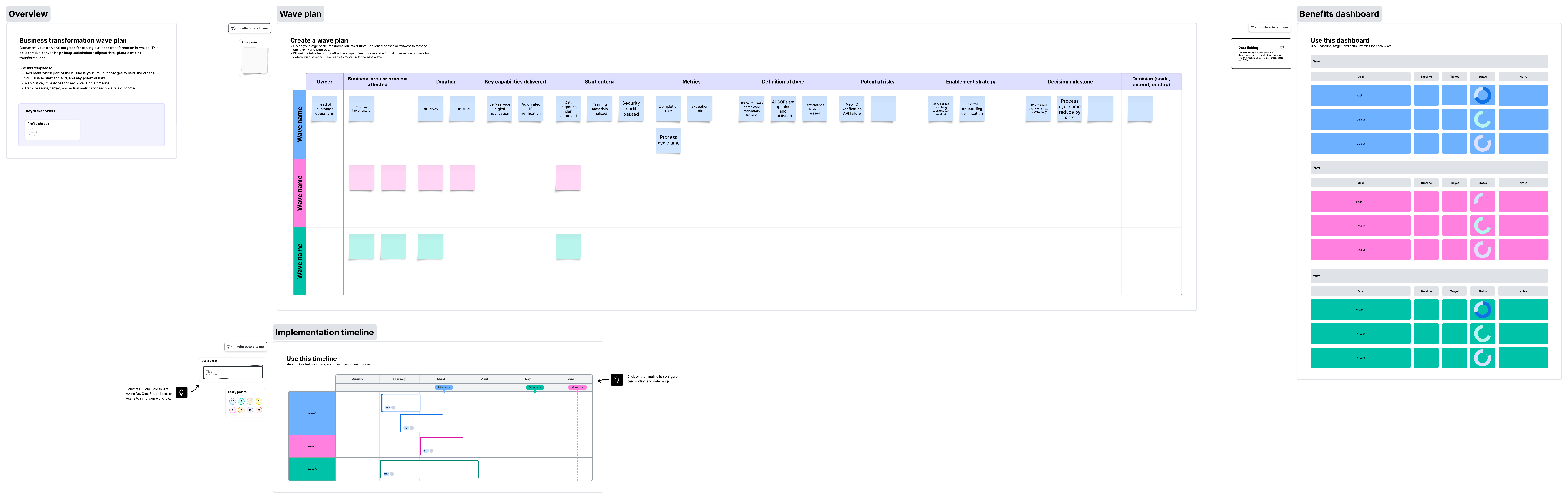
- Wave plan: Document which part of the business you’ll roll out changes to next, the criteria you’ll use to start, a definition of done, potential risks, owners, and a decision milestone between waves.
- Enablement at scale: Define where you want manager certification, build onboarding learning and development modules, standardize new processes, and develop a communication plan as you roll out changes.
- Benefits dashboard: Track baseline, target, and actual metrics for each identified outcome.
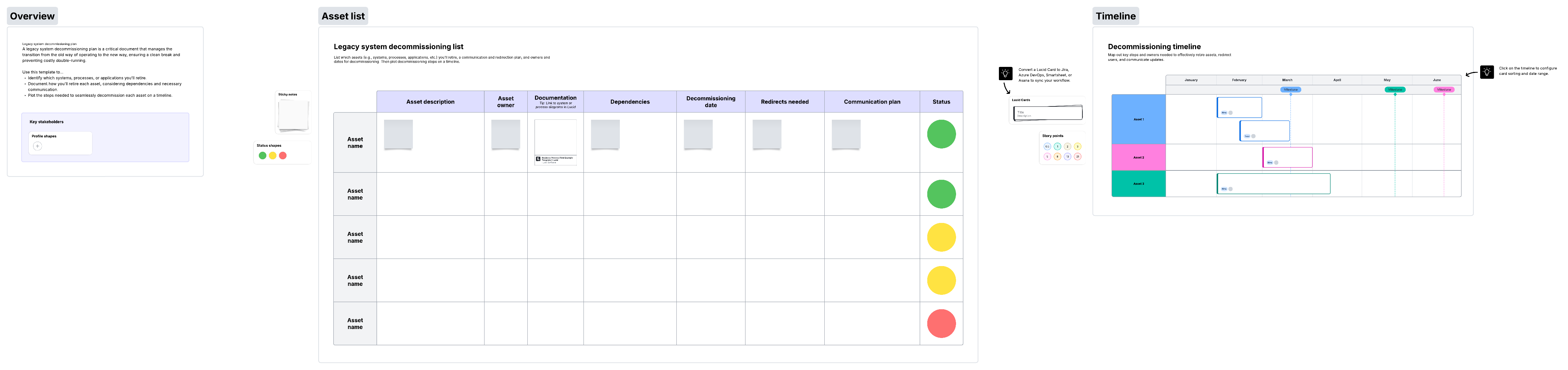
- Legacy turn-down plan: Start to list which assets (e.g., systems, processes, applications, etc.) you’ll retire, a communication and redirection plan, and owners and dates for decommissioning. You’ll put this plan into action in the next stage.
Here’s how to accelerate and scale using Lucid:
Divide your large-scale transformation into distinct, sequential waves to manage complexity and progress. Record your plan for each wave of transformation and use data-backed dashboards to visibly track progress toward your goals.
Ensure a smooth transition from pre- to post-transformation by recording a plan for decommissioning processes or systems. I recommend inviting each process or system owner to collaborate on the document so you can be confident that all dependencies and redirects are accounted for.
Create detailed implementation roadmaps, mapping out the dependencies to see the relationship between tasks. With Lucid, you can easily visualize team capacity, opens in a new tab, plan the most efficient scenarios, and automatically sync your plan back to your system of record via integrations with Jira, Azure DevOps, or airfocus.
A cursor clicks to "Create new scenario" using the capacity planning feature in Lucid.
Document your updated architecture. You can use the Cloud Accelerator to visualize your updated cloud architecture and compare it to your future-state diagrams to validate deployment. Standardize and speed up the cloud design process through blueprints, a set of templates for proven workflows.
A cursor clicks to import AWS accounts into Lucid's Cloud Accelerator
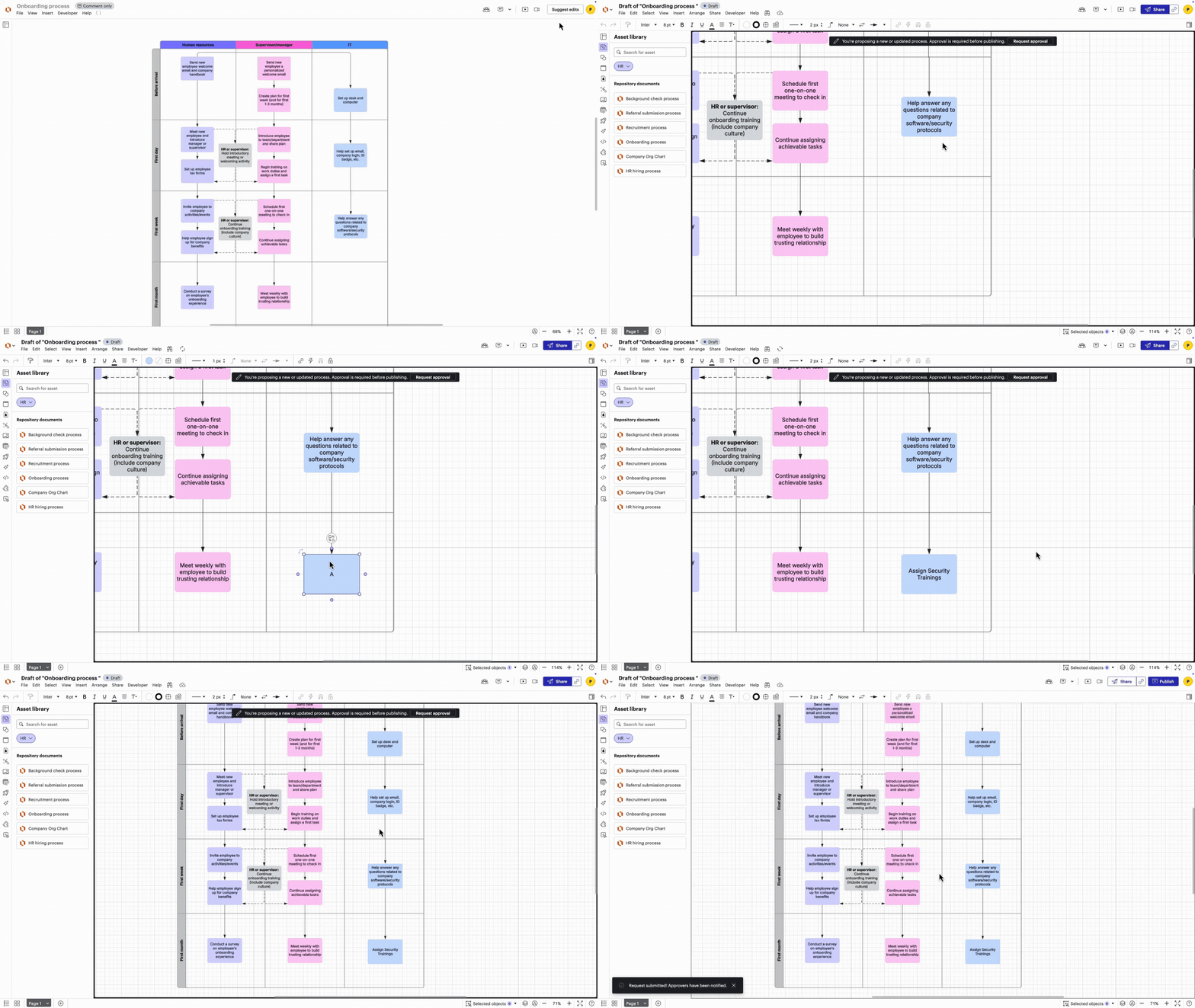
Begin standardizing processes that work using the Process Accelerator, ensuring that any changes made to process documentation are reviewed and approved through the appropriate approval flows.
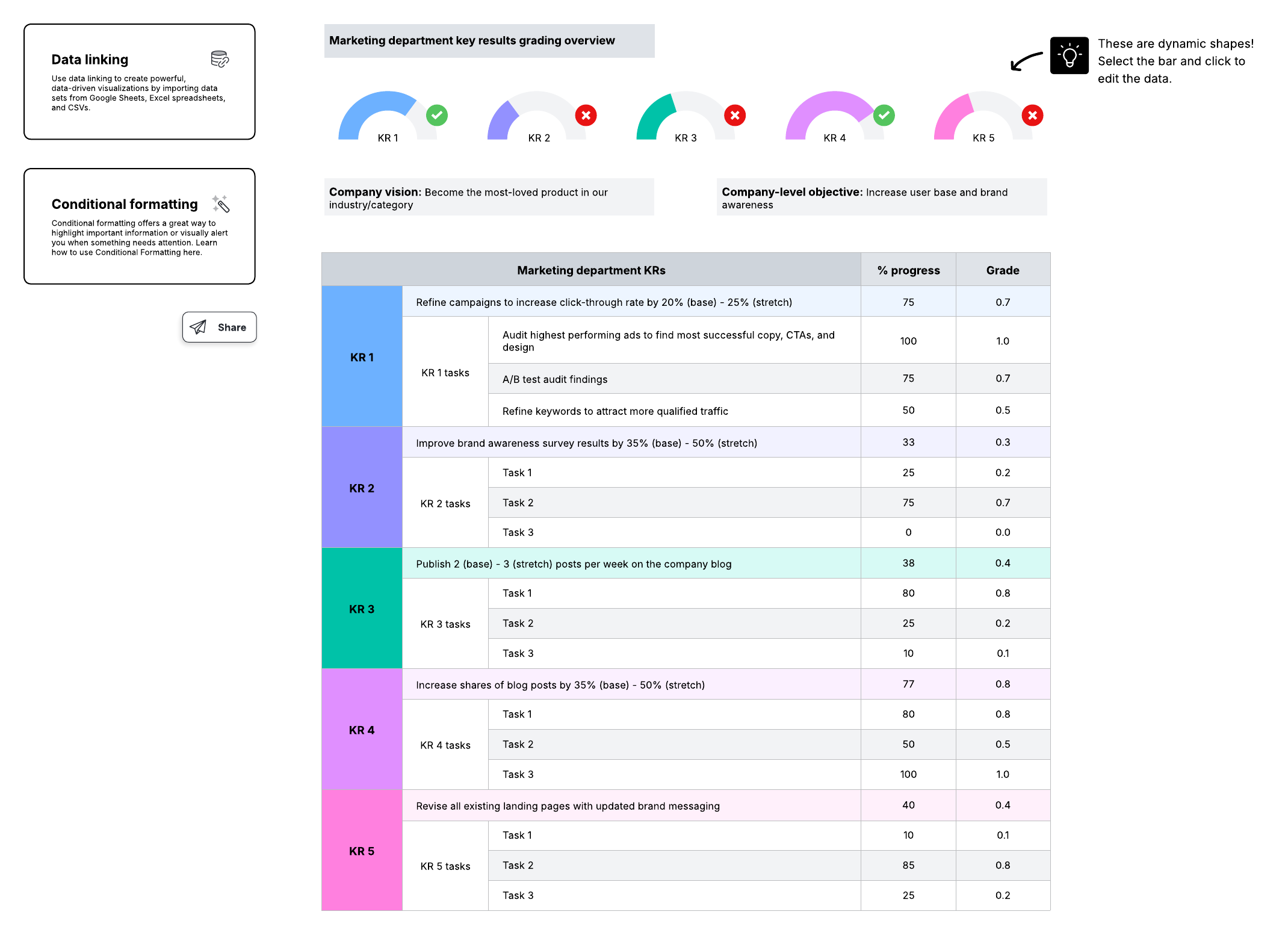
Set OKRs and use data-backed dashboards to visibly track progress toward your goals.
Stage 6: Anchor your transformation
Goal: Make the new way the default by codifying standards, wiring systems and incentives, verifying benefits, retiring the old paths, and—on a planned cadence—re-aligning for the next value slice.
The final stage is to fully integrate changes into the business. You can think of this step as dropping the anchor to make the new way the default and then looking out at the horizon for the next opportunity.
This phase is heavily focused on change management, with three main steps:
- Codify: Formalize the new ways of working by creating and publishing new standard operating procedures (SOPs), updating job descriptions, and documenting new approval paths and decision rights.
- Reinforce: Consistently support and incentivize the use of the new codified standards and behaviors through training, certifications, and updated performance metrics or compensation structures. For an operating model or people-focused transformation, for instance, you might implement certifications for new skills and fold those certifications into new-hire onboarding.
- Verify: Measure and prove that the new processes are being used correctly and are actually delivering the intended business results.
The anchoring process will also reveal new opportunities or challenges that emerged during the rollout, which may become part of the next wave of transformation. Capture new opportunities in a short decision log, re-baseline your KPIs, and put the next readiness checkpoint on the calendar.
Here’s how to anchor your transformation using Lucid:
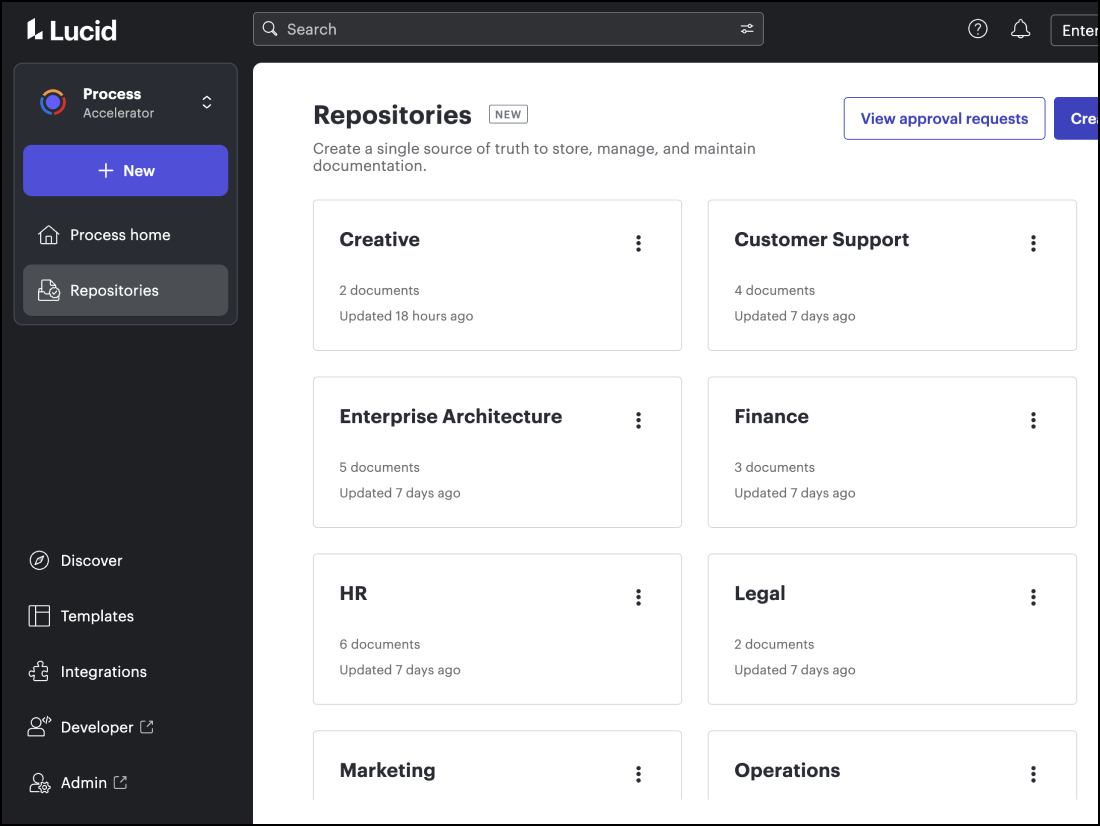
Using the Process Accelerator, store updated standard operating procedures and approved process documentation in an official repository that the entire business can easily access and search. You can also create official corporate templates, opens in a new tab for common workflows (e.g., meeting agendas, project kickoffs, and more) in Lucid, providing teams with a consistent and structured way to initiate work.
Build and document a change management plan that helps employees understand the reason for change, develop new skills as needed, and adapt to the new operating model. As McKinsey & Company states, “If people don’t understand what the transformation means for their daily work, as well as for overall business goals, their mindsets and behavior won’t change and organizational health will suffer.”
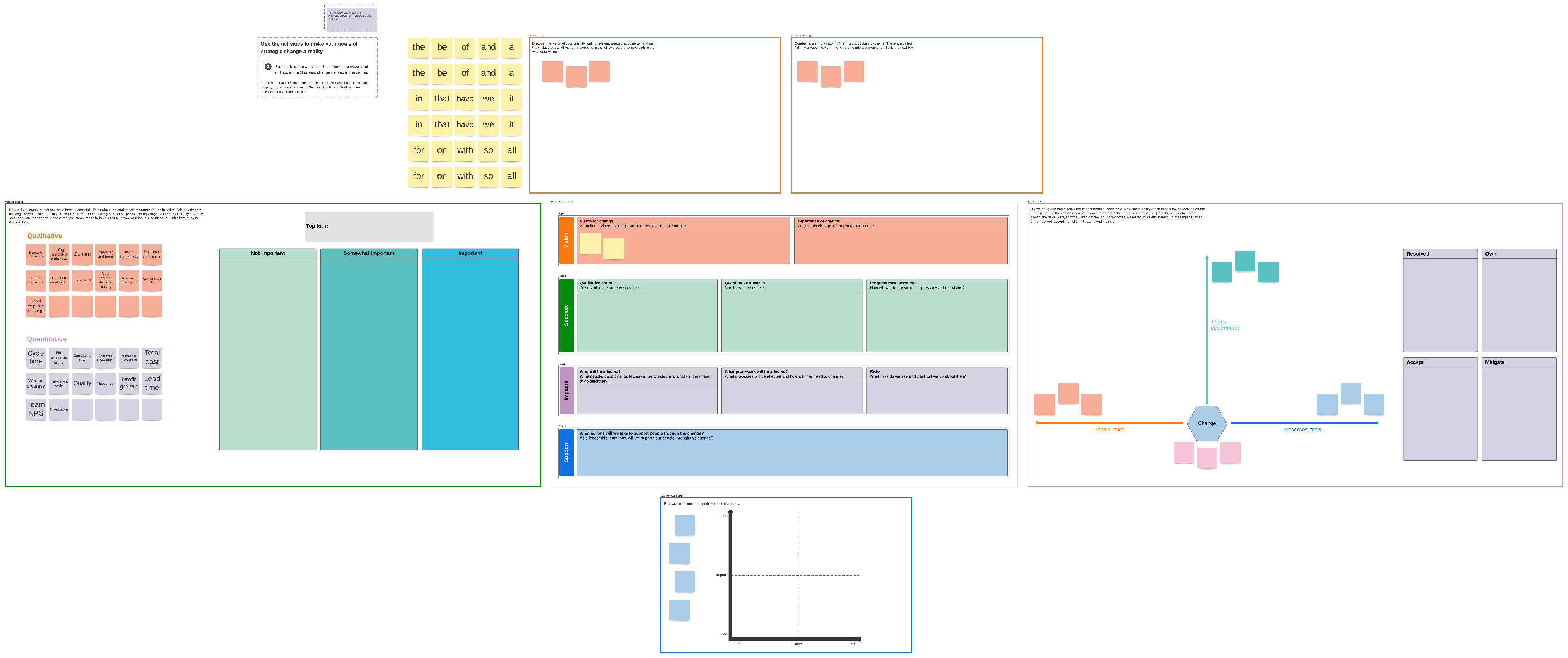
Regularly collect and document feedback through retrospectives. You can use private mode to allow team members to voice concerns anonymously.
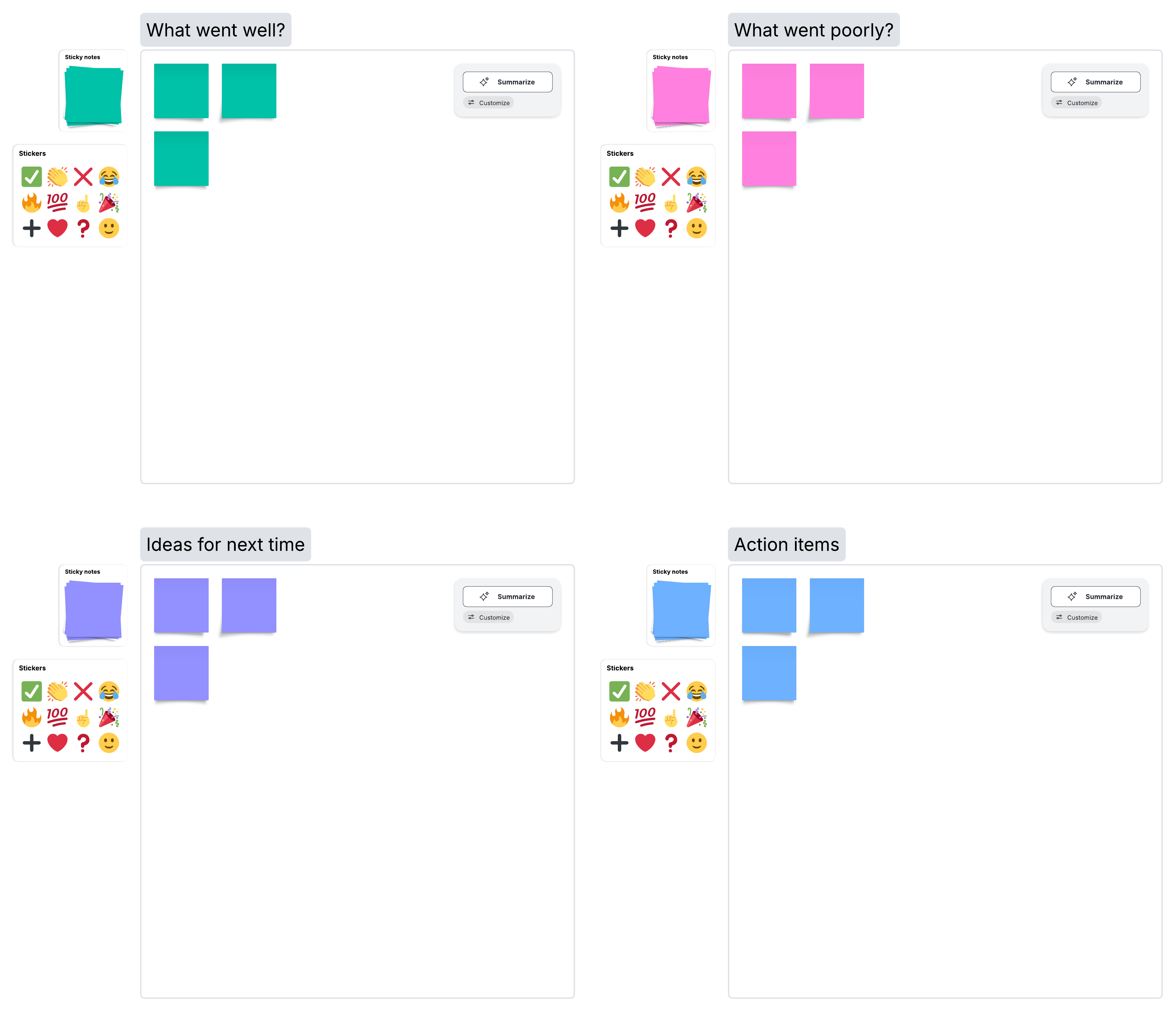
Assess the new current state of your business, beginning the cycle over again. This time, though, you don’t need to start from scratch. With Lucid, you can easily revisit the documentation you made during the first wave of transformation and update it as needed.
The power of a work acceleration platform in business transformation
Business transformation requires continuous collaboration, data-driven planning, and increased adaptability. A work acceleration platform like Lucid serves as a central hub where teams across the entire business can come together to brainstorm, plan, and execute large-scale transformations.
As the pace of change only continues to accelerate, a work acceleration platform will be necessary to adapt quickly and strategically.
Learn how work acceleration powers business transformation.
Read the blog