Successful businesses don't operate in a vacuum. They understand the context of the market environment and how those external factors can impact their strategic plans. Because many of these forces are outside your control, failing to monitor them can mean missed opportunities—or, in the worst case, serious threats to the business.
So how do you get this valuable context? Enter the PESTEL analysis.
In this introduction to PESTEL analysis, we'll break down what it is, how and when to use it, and how it compares to another common business analysis tool, the SWOT analysis.
What is a PESTEL analysis?
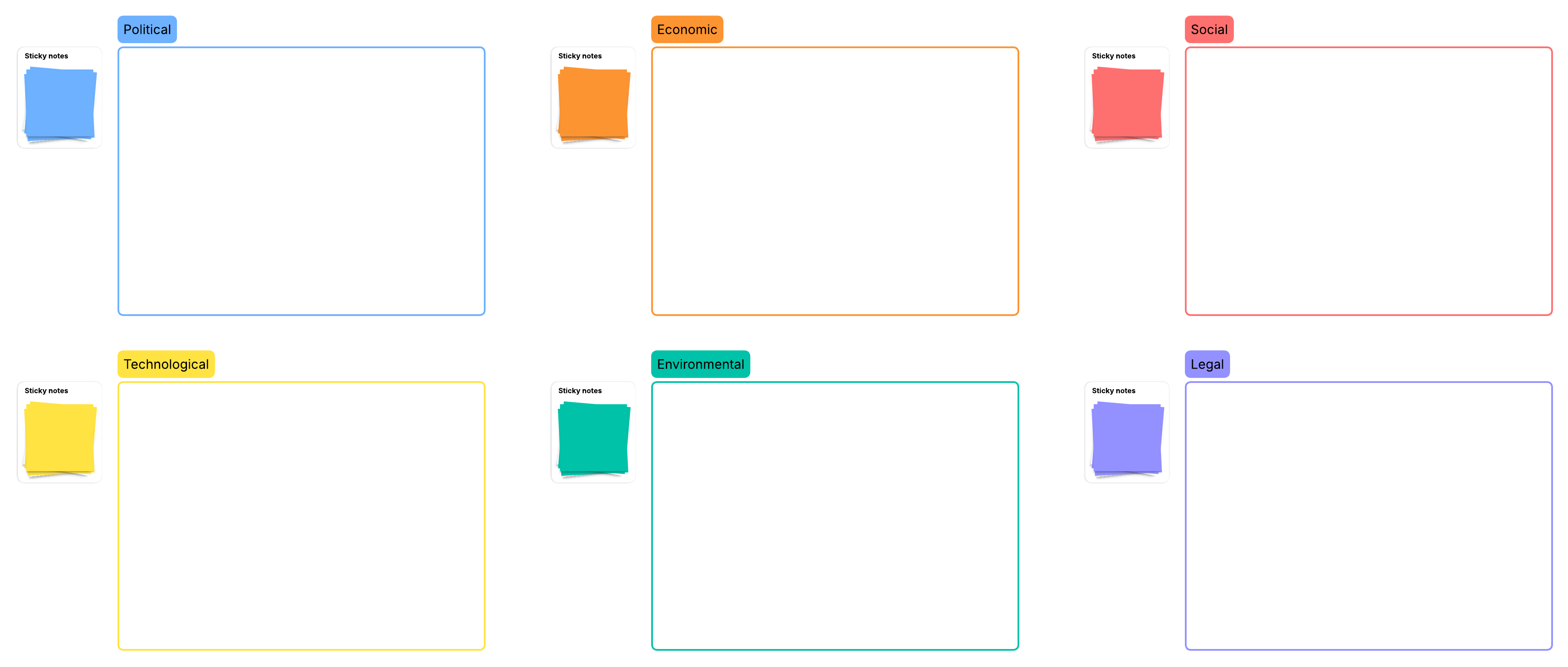
A PESTEL analysis is a strategic planning tool used to audit an organization's environment and the external forces that can influence the business. PESTEL is an acronym that stands for:
-
Political factors
-
Economic factors
-
Social factors
-
Technological factors
-
Environmental factors
-
Legal factors
PESTEL expands on the PEST analysis framework created by Harvard Professor Francis Aguilar in 1967 by adding environmental and legal considerations to the original four-factor model.
The purpose of a PESTEL analysis is to help business leaders understand the factors that may impact the business and the opportunities and risks those influences might create, enabling them to make better decisions and plan effectively for the future. In other words, a PESTEL analysis provides insight into your business environment, enabling you to make strategic decisions based on data rather than guesswork.
These six categories being evaluated are generally considered outside an organization's control (compared to internal influences that a business can change). However, by understanding these influences, businesses can more effectively position themselves to respond to change.
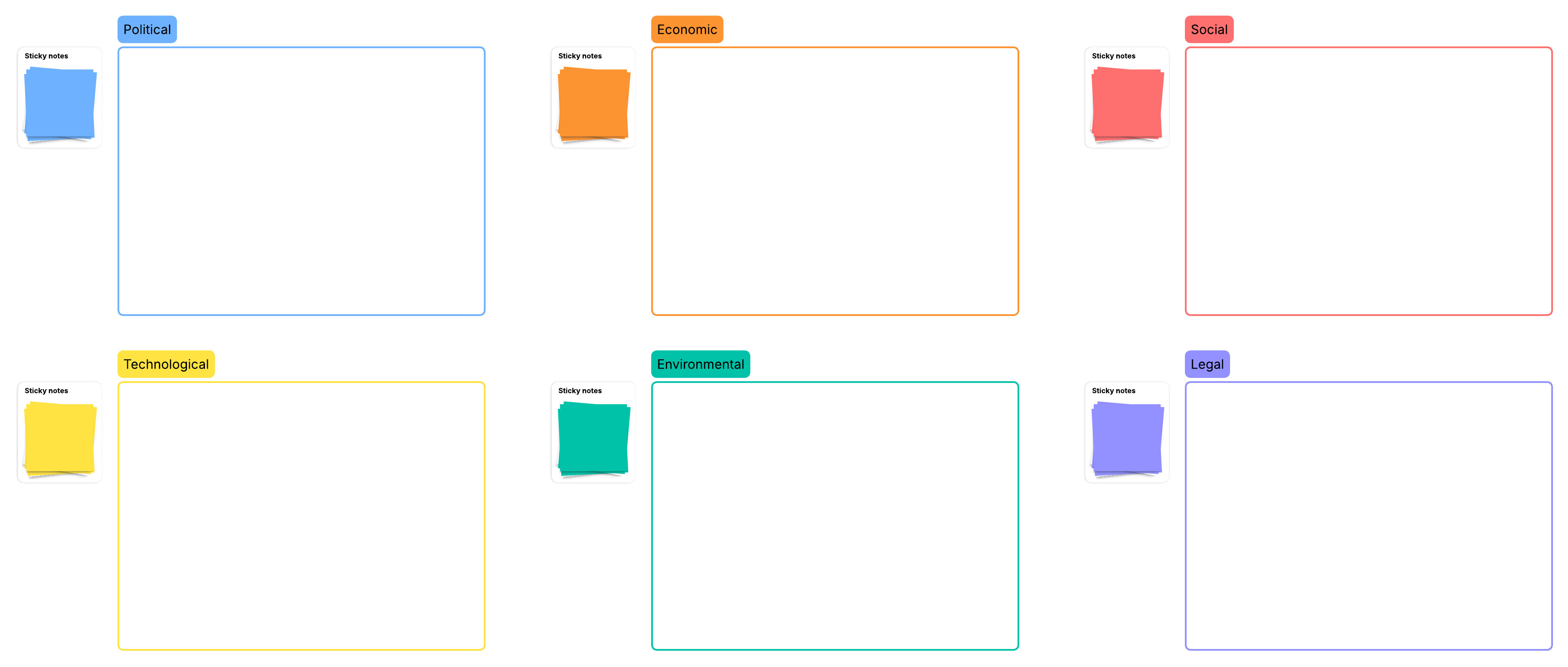
6 factors of the PESTEL model
To conduct a PESTEL analysis, you'll review six main factors of influence.
Political factors
Political factors assess how legal and governmental policies, as well as the overall political climate, can impact your business operations and profitability. This includes political influences at the local, state, and national levels.
These factors might include:
-
Upcoming elections, changing leadership, and candidates’ views on different policies
-
Government regulation of your business industry
-
Tax and labor laws
-
The stability of the government and the balance of power
-
Global alliances, diplomatic affairs, and wars
-
International regulations and industry standards
-
Trade policies (e.g., tariffs, current or prospective trade deals)
-
The level of corruption or organized crime in your region or country
-
Import restrictions
-
E-commerce policies
-
Consumer and employee protections
Questions to ask:
-
What government policies help or hurt our business?
-
Are there any tax rebates or funding grants we are eligible for?
-
How do industry regulations compare across our regions of operations?
Economic factors
This step assesses how economic trends and factors impact your business. Since the economy affects both consumers and businesses, be sure to thoroughly examine these factors to gain a complete picture of the economic environment.
These factors might include:
-
Inflation rates
-
Interest rates
-
Economic growth
-
Current and forecasted economic stability and consumer habits
-
Fiscal policies
-
Stock market trends
-
Access to credit (personal and business)
-
Unemployment rate and competition for jobs
Questions to ask:
-
Are interest rates expected to change significantly? How will that affect business investments and financial commitments?
-
Does our target market have disposable income? Can they afford our product or services?
-
How might changing tax rates or minimum wage standards impact profit and the ability to make payroll?
Social factors
Social factors assess the socio-cultural influences of consumers and your target demographics. Understanding the general makeup of the population and your target market, as well as the trends impacting them, will give you the insight you need to position your business strategically.
These factors might include:
-
Population growth
-
Demographics like age, race, family size, and structure
-
Cultural trends
-
Labor market trends
-
Immigration rates
-
Generational shifts
-
Consumer habits and values (e.g., focus on product quality or eco-friendliness)
-
Attitudes toward work
Questions to ask:
-
What is our target demographic?
-
Is there consumer confidence in our industry?
-
How does the market view our competitors and similar organizations?
Technological factors
Technology and innovation can have far-reaching impacts on business, including how organizations produce and distribute goods and services, how they communicate with employees and consumers, and how they operate day to day.
For instance, the increase in remote work in recent years is largely tied to and enabled by technological innovation from virtual collaboration tools to improved internet speed and access. This not only impacts the labor market and employment practices but also introduces new opportunities for work and productivity. Now, the rise of AI is certainly a factor to watch.
As you evaluate these influences, consider the following factors:
-
Rate of technological change and development
-
Innovation in digital and mobile technologies
-
The organization's access to technology
-
Cybercrime trends and cybersecurity tools
-
Trends in automation
-
Evolution of infrastructure
-
Cutting-edge research and development
-
Competitors’ access to technology
Questions to ask:
-
Is our IT set up to handle new security threats?
-
How will new technology like AI impact our business ability?
-
How well is our technology protected? How easy would it be to copy our technology?
-
Do we have the internet access and connectivity needed to support business and employee performance?
Environmental factors
The local and global environment have an intrinsic impact on everything we do, including business. From climate change and pollution to the growing focus on corporate sustainability responsibility (CSR), environmental factors play a big role in how businesses operate today.
Consider the following environmental factors:
-
Climate change
-
Sustainability, including recycling processes and operational efficiency
-
Waste disposal
-
Carbon footprint targets
-
Weather and natural disasters
Questions to ask:
-
How efficient are our processes and operations?
-
How will climate change impact our business?
-
What opportunities are there to reduce or offset carbon emissions?
-
Will resource scarcity impact our business?
Legal factors
Legal factors can be closely tied to political factors and include any proposed legislation that could impact the business directly or indirectly.
These factors might include:
-
Privacy laws
-
Trade and commerce policies
-
Labor law
-
Industry regulation (or deregulation)
-
Infrastructure and public health legislation
Questions to ask:
-
How might new legislation impact our business processes or ability to operate in a certain region or location?
-
What changes would we need to make to our policies or operations to ensure compliance with regulations?
-
What consumer protections do we need to put in place?
PESTEL analysis benefits and use cases
A PESTEL analysis provides the foundation you need to make informed, strategic decisions about your business. Because it is a macro-level evaluation, it's particularly useful when you need a broad read on the market before committing to a direction.
Use a PESTEL analysis to:
-
Evaluate your business decisions and how they may affect your organization.
-
Uncover new opportunities to move your business forward.
-
Get the big picture of your business environment so you aren't making decisions based on assumptions.
-
Strengthen long-term planning by anticipating how external conditions may evolve.
-
Focus time and resources on initiatives that are more likely to succeed in the current market environment.
-
Mitigate risks and take advantage of opportunities to remain competitive.
-
Forecast changes so you can grow with the market rather than work against it.
When to do a PESTEL analysis
A PESTEL analysis is best used when you need a big-picture understanding of your business.
Some of the best times to do a PESTEL analysis include when you:
-
Start a new business or enter a new market.
-
Uncover a major problem.
-
Pivot your business.
-
Recognize impending changes in one area (e.g., politics) and want to re-evaluate the market.
-
Reassess risk.
How to do a PESTEL analysis
Once you understand the six categories, the next step is turning the framework into an actionable workflow. A PESTEL analysis is straightforward, but it can be time-consuming, so plan enough time to do a thorough evaluation.
1. Consider all six PESTEL categories that could impact your business
The first step is to research and gather as much information about your organization's external influences as possible. Enlist the help of other leaders or managers in the business to ensure you have a comprehensive data set.
2. Identify opportunities
Once you've researched the various ways your organization is influenced and affected by external conditions, start identifying opportunities these changes could provide, such as new technology that improves efficiency or demographic changes that open new markets. Seek out as many opportunities as possible to develop the best strategic response for your business.
3. Identify threats
Unfortunately, change also comes with risks. Capture anything that could raise costs, reduce demand, slow operations, or strengthen competitors. The sooner you recognize threats, the more likely you are to avoid them or reduce their impact.
4. Act on your findings
With all your data collected and your opportunities and threats outlined, it's time to take action. Incorporate these findings into your business plan to take advantage of opportunities and manage threats as soon as possible.
PESTEL analysis vs. SWOT analysis
A SWOT analysis evaluates your business to uncover its strengths, weaknesses, opportunities, and threats. Where a PESTEL analysis focuses on external factors that influence an organization, the SWOT analysis looks inward at the business itself.
By taking inventory of your business's strengths and weaknesses, a SWOT analysis helps you understand what is working well, what needs improvement, and how you might overcome potential challenges. It is often conducted at the beginning of a new project or to evaluate a product line.
If you're planning a new initiative or outlining your business strategy, start with a PESTEL analysis first, followed by a SWOT analysis.
Combining these macro- and micro-level analyses of your business will help you understand a complete picture of your market and your business's unique opportunities so you can mitigate risks and effectively plan for the future.
Ready to conduct a PESTEL analysis on your own? Get started with a PESTEL analysis template in Lucidspark.

Everything you need to whiteboard online
Get the ultimate online whiteboard for teams. Brainstorm, plan projects, and collaborate virtually on Lucidspark’s infinite canvas.
Sign up free