A well-balanced portfolio of products is vital to your company’s growth and success, but deciding which products to include can be daunting. Fortunately, the GE McKinsey matrix can help you determine which products your customers are interested in—these are the ones that deserve time and resources.
In this article, we’ll discuss the GE McKinsey matrix, where it came from, its components, and how it can help you develop a product portfolio that will meet customer needs.
What is the GE McKinsey matrix?
The GE McKinsey matrix, or the GE-McKinsey nine-box matrix, is a strategic framework that lets you evaluate your company’s products, services, and strategic business units. When you know which products and services are most important to your company's growth, you better understand where to focus resources and time in your development efforts.
Where did the GE McKinsey matrix come from?
The GE McKinsey matrix was developed in 1970 when General Electric (GE) asked the management consulting firm McKinsey & Company for help managing its business unit portfolio.
McKinsey used the Boston Consulting Group (BCG) matrix as inspiration in developing the GE matrix. The BCG matrix uses a 2x2 grid (four boxes) to evaluate products and services. McKinsey developed a 3x3 matrix (nine boxes) that makes a deeper, more nuanced analysis based on market attractiveness and competitive strength.
What are the main uses of the GE McKinsey matrix?
The GE matrix is a versatile strategic planning tool to help you make better decisions concerning your company’s business units and product development. Specifically, the GE McKinsey matrix can help you:
- Analyze and prioritize your business portfolio: Use the 3x3 GE model to determine which markets might be best for your products.
- Allocate resources: The matrix can help you not only to determine where you need more resources, so you can easily reallocate to projects with higher priority.
- Strategically plan for the future: The GE McKinsey matrix can give you insight into each business unit or product's direction. This can help you make better decisions about future development within each market.
- Develop a balanced portfolio: The GE matrix encourages you to prioritize high-growth and stable components to optimize the portfolio.
- Assess potential risks: The matrix can help you assess potential risks. For example, products placed in the lower right grid box might be at higher risk because the market is unattractive and competitive strength is low.
- Align departments and teams: The GE McKinsey matrix is a visual tool that makes it easier to communicate priorities and decisions across your organization. This helps keep everybody on the same page and discourages siloed work.
Understanding market attractiveness and competitive strength
Market attractiveness and competitive strength are the two dimensions used by the GE McKinsey matrix for product analysis and evaluation.
The market attractiveness dimension is on the vertical axis to the left of the 3x3 grid. It is used to look at external factors such as market size and growth rate that might positively or negatively impact your business offerings. Each row in market attractiveness is labeled “High,” “Medium,” and “Low.” Items in the “High” section are the most likely to be profitable.
The competitive strength dimension is placed on the horizontal axis below the grid. It evaluates internal factors such as current market share, production capabilities, etc. The columns in competitive strength are labeled “High,” ‘Medium,” and “Low.” Each item in the “High” section has the potential to capture a significant market share.
Strategic implications and decision-making for managers
Each product, service, or business unit is placed into a section of the 3x3 matrix that corresponds to one of the three categories listed below. Placing components in the proper location will help you to make strategic business decisions.
- Growth strategy: Items placed in the three boxes in the upper left corner of the grid have justification for increasing budgets and resources for development, marketing, and growth so that you can increase or maintain market position.
- Hold strategy: Products and services placed in this section, which runs diagonally from the lower left corner to the upper right corner, provide average performance in an average market. There might be a chance for growth and improvement, but you shouldn’t allocate more money and resources for now.
- Harvest strategy: Products and business units in the lower left corner are in an unattractive market or perform poorly. If these components make money, you might consider investing the excess cash into other segments.
How to use the GE McKinsey matrix
GE McKinsey matrices are quite simple to set up. Just follow the steps below, or use Lucidspark’s free template to get a head start on your work.
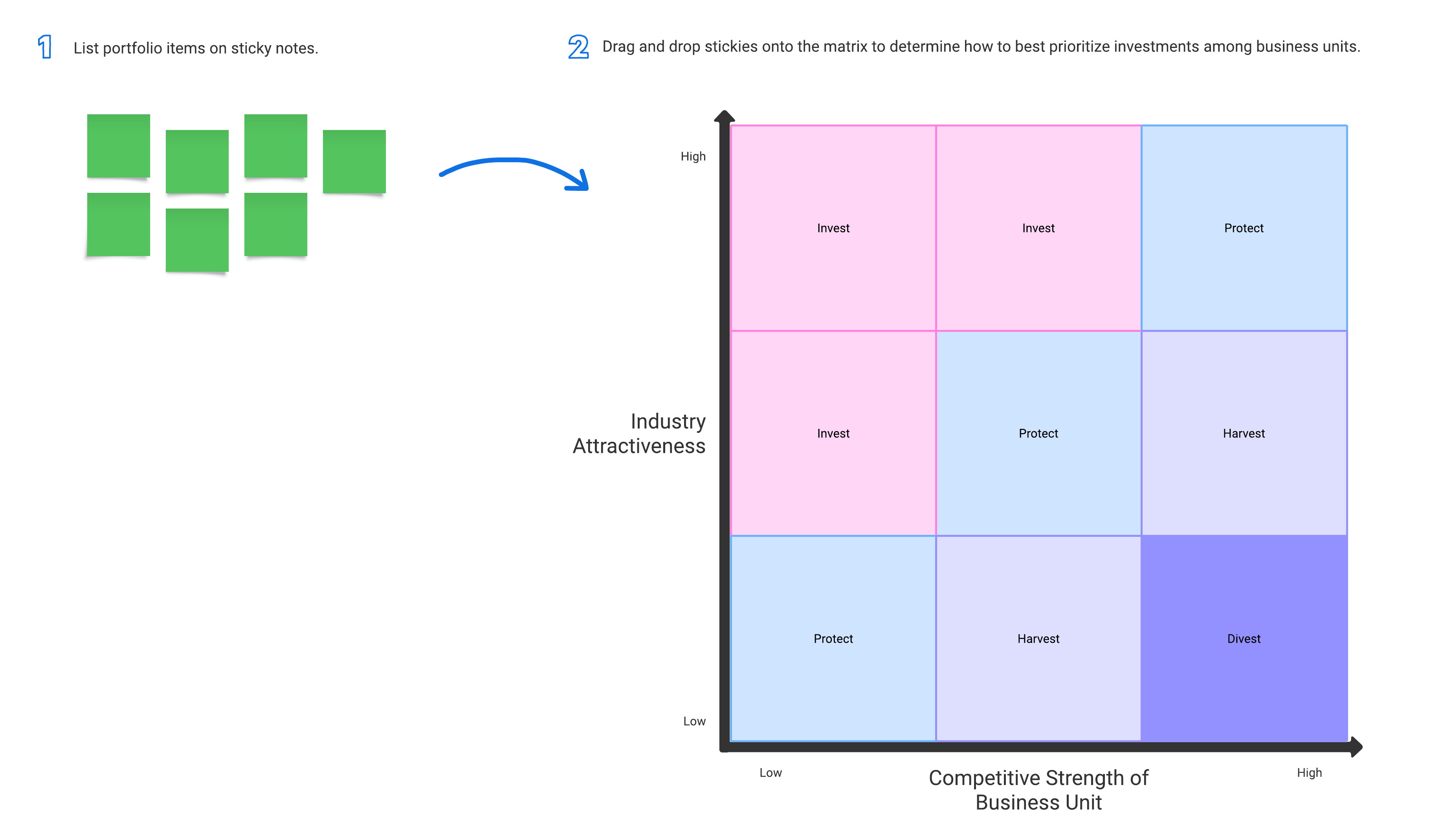
Step 1: Determine the market attractiveness and competitive strength for each product or business unit you want to evaluate
Collect data for each product or business unit. Include external factors like market size, growth rate or potential for growth, current competition, market share, brand strength, etc. Also include internal factors such as current market share, product technology and innovation, current capacity and capability, etc.
Step 2: Plot the information on the matrix
Each row and column in the McKinsey matrix is labeled “High,” “Medium,” and “Low.” Place the item with the highest market attractiveness/highest competitive strength in the “High”/”High” box, usually in the upper left corner of the matrix. Place your lowest market/weakest competitive item in the “Low”/”Low” box, usually in the lower right corner of the matrix.
Use the information you gathered to rate each item so you can place it in the appropriate grid box. For example, you might have items corresponding to “High”/”Low,” “Medium”/”High,” etc.
Step 3: Determine where to invest and what actions to take
Plotting your matrix gives you a visual representation of your product or business unit prioritizations and helps you know what action to take.
- Invest in the items in the growth strategy category. Keep these products and business units healthy in their respective markets with continuous improvement and innovation to meet customer needs.
- Decide whether to improve, hold, or divest items in the hold strategy category.
- If products or business units are performing poorly, you may want to liquidate. Or, if these items bring in surplus cash, you might want to invest just enough to keep them going as long as you don’t invest more than you bring in.
Step 4: Create a plan and allocate resources
After you’ve determined what to do with each item in the matrix, you’ll need a plan to implement your strategies for each item. Your plan should include a budget, human resources, materials, and equipment needed to complete the work.
For example, you might need to determine if you’ll hire new people, bring in temporary contractors, or move existing people and equipment around. How much will it cost to bring in new people and new equipment? How much money is needed to market your products and brand?

Learn more about other types of prioritization matrices to decide which is best for your team.
Go now