
Key takeaways
-
Scaling Agile helps large organizations improve transparency, enable enterprise-wide visibility, and align execution with business strategy.
-
Businesses can choose from various frameworks for scaling Agile, such as SAFe, Scrum of Scrums, or LeSS, to create a shared language and cadence.
-
To determine if you are ready to scale Agile, evaluate factors like team distribution, organizational readiness, and whether you have clear pain points to address.
-
Leading practices for implementing Agile at scale include maintaining consistent processes and enabling shared visibility across different delivery tools and systems of record.
Once companies experience the benefits of Agile, they often seek ways to expand those benefits across the organization.
Maybe you have several teams that are already working according to Agile principles, and you’d like more teams to experience better delivery and alignment. Or, you want to bring multiple teams together to work at the same cadence as they support shared business goals.
Whatever the situation, you’re wondering whether it’s time to take Agile to the next level. But how do you know if you’re ready? Expanding Agile successfully requires leadership buy-in, change management, and cross-functional alignment.
This blog post will introduce you to common frameworks for scaling Agile and provide practical strategies for implementing Agile throughout a large organization.
Why scale Agile?
Scaling Agile allows businesses to adapt to changing market conditions and customer needs, maintaining a culture of flexibility by implementing agile ways of working. When companies have multiple teams that need to align on a shared goal, it’s essential to create a unified front across the business. But without a framework or plan to follow, large companies often end up with a fragmented approach to agility.
Scaling Agile frameworks help companies deliver value and adapt quickly across their entire organization, ensuring that multiple teams create a shared cadence and language. Scaling Agile is a long-term transformation, but the benefits are worth it, as it improves transparency, enables enterprise-wide visibility, enhances employee engagement, and aligns execution with strategy.
Factors to evaluate before scaling Agile
Scaling Agile before your organization is ready is one of the most common—and costly—mistakes large businesses make. Before committing to a scaling effort, honestly evaluate the following factors:
-
Team size and distribution. Scaling Agile works best for large businesses that have a large amount of teams. If your initiatives involve hundreds of people, scaling helps to improve alignment and dependencies.
-
Organizational readiness. Leaders should be committed to fostering an agile culture, and you should already have strong, consistent Agile practices in place. Organizational readiness includes having the technology to scale as well, such as tools for tracking work, managing dependencies, and cross-functional collaboration.
-
Clear pain points. The problems that you aim to address by scaling Agile should be clear, such as poor coordination across fractured teams, slow feedback loops, and duplicate work.
-
Regulatory governance and compliance. As multiple teams come together, you’ll need to be ready to manage compliance and security requirements.
As you consider the above factors and evaluate your business’s Agile maturity, watch for these signals that your organization may not be ready:
-
Teams are still inconsistent in basic Agile practices such as sprint planning, retrospectives, or backlog management.
-
Leadership views Agile as a delivery methodology rather than a cultural operating model.
-
There is no clear owner for dependency management or cross-team coordination.
-
Teams can’t articulate how their work connects to broader business goals.
If any of these sound familiar, scaling now is likely to amplify the problem rather than solve it. Keep practicing Agile on a smaller scale and strengthen your culture of agility. Ask teams for feedback to ensure that Agile is working at the team level before you attempt to scale it. If teams are struggling with Agile principles, a company-wide transition won’t be successful.
Frameworks for scaling Agile
Frameworks provide lightweight guidance as you aim to become a more flexible, adaptable organization. Try one of the frameworks below, or mix elements from multiple frameworks together (similar to how teams combine Scrum and Kanban on a smaller scale).
Ultimately, your goal isn’t to adhere perfectly to any framework. It’s to help your business focus on outcome-driven scaling, resulting in increased flow, value, and visibility.
The following scaling Agile frameworks are listed in order of the most commonly used.
Scaled Agile Framework (SAFe)
Since its introduction in 2011, the Scaled Agile Framework (SAFe) is the most commonly used framework for scaling Agile, with more than 20,000 organizations using the framework worldwide. SAFe was created to provide a way to coordinate multiple teams and keep them aligned to a common mission as the practices of Scrum are elevated to the enterprise level. The goal is to retain Agile’s rapid feedback and adaptability on a larger scale while ensuring broad alignment, communication, and delivery across many teams.
Like Scrum, SAFe provides common practices and a shared language to harmonize teams, with many differences between Scrum and SAFe. These practices include creating an Agile Release Train (ART) made up of multiple Agile teams and conducting large-scale PI planning.
Since SAFe was designed to be a lightweight, flexible framework, it can be customized to an organization’s needs, which is why it’s a popular option for scaling Agile.
Scrum of Scrums (SoS)
Scrum of Scrums (SoS) focuses on aligning no more than ten Scrum teams with a Scrum of Scrums meeting (similar to Scrum’s daily standup). SoS is a lightweight coordination practice where a representative from each Scrum team meets regularly to surface and resolve cross-team dependencies and blockers.
Organizations that practice SoS implement Scrum concepts at scale rather than adding additional roles or artifacts.
Large Scale Scrum (LeSS)
The Large Scale Scrum (LeSS) framework is another framework that focuses on applying Scrum to multiple teams for large-scale development. While SAFe and LeSS share common patterns, LeSS is based on the idea that scaling Agile should be minimalistic and include fewer roles or rules. For example, there is only one product owner for all of the teams involved.
Due to this minimalistic approach, LeSS is typically limited to 8-10 teams. For organizations needing to scale beyond that number of teams, LeSS Huge extends the framework while preserving its minimalist principles.
Disciplined Agile (DA)
Disciplined Agile (DA) evolved from the original Disciplined Agile Delivery (DAD) framework and is now maintained by the Project Management Institute (PMI) as a broader toolkit.
DA combines practices from Scrum and Kanban as well as knowledge from areas such as DevOps, governance, HR, and finance. By using Disciplined Agile, companies can tailor their way of working as they scale delivery. DA is considered to be easier to scale and more flexible than other frameworks.
Scrum@Scale (SaS)
Scrum@Scale is similar to SAFe in that this framework is typically used by organizations that are already successfully implementing Scrum at the team level and are looking for ways to scale Scrum throughout the business. However, unlike SAFe, which defines its own terms, roles, and responsibilities, in SaS, each team still has a Scrum master and a product owner. Product owners come together for a MetaScrum, and Scrum masters manage coordination through a Scrum of Scrums, with a main goal to align around one shared set of goals.
Nexus
The Nexus framework involves up to nine Scrum teams using a single product backlog with a single product owner covering all teams. Nexus introduces Cross-Team Refinement and a Nexus Integration Team to coordinate work and manage dependencies. Similar to a Scrum team, a Nexus Integration Team includes a Scrum master, product owner, and developers.
Nexus tends not to be as widely used as other scaling frameworks because it is limited to three to nine Scrum teams. The framework was designed to be a more niche, minimalist solution that requires participants to already have a high level of Agile maturity.
A note on frameworks
The frameworks above offer valuable structure, but they were largely developed in the 2010s, and the most forward-thinking organizations have quietly moved on from the idea that one framework should govern everything. What's replaced it is a more pragmatic approach: Less asking, "Are we doing scaling Agile right?" and more asking, "Are teams actually delivering value faster?"
If your organization is newer to scaling Agile, starting with an established framework as a foundation makes sense. But remember, the goal is a more adaptive, aligned organization, and the framework is just scaffolding to get you there. Most organizations that have successfully scaled Agile will tell you the same thing: They didn't implement one framework, they borrowed from several and disregarded what didn't fit.
5 leading practices for implementing Agile at scale
Regardless of which framework you choose (or which mix of frameworks you pull from), the following are a few general practices that help businesses successfully scale Agile.
Support multiple ways of working without fragmentation
Large organizations that are already practicing Agile are often operating with a hybrid mix of Scrum, Kanban, and other frameworks. Exactly what agility looks like may depend on the team, and forcing everyone into uniformity will only create friction and resistance. Remember, scaling Agile requires a focus on shared understanding and alignment, not identical processes.
To successfully scale Agile, enable visibility across teams without requiring the same rituals or approaches. Allow teams to continue the Agile practices that have been working for them as the entire organization embraces alignment. The important part is that the way teams work becomes fully transparent and understandable across the business.
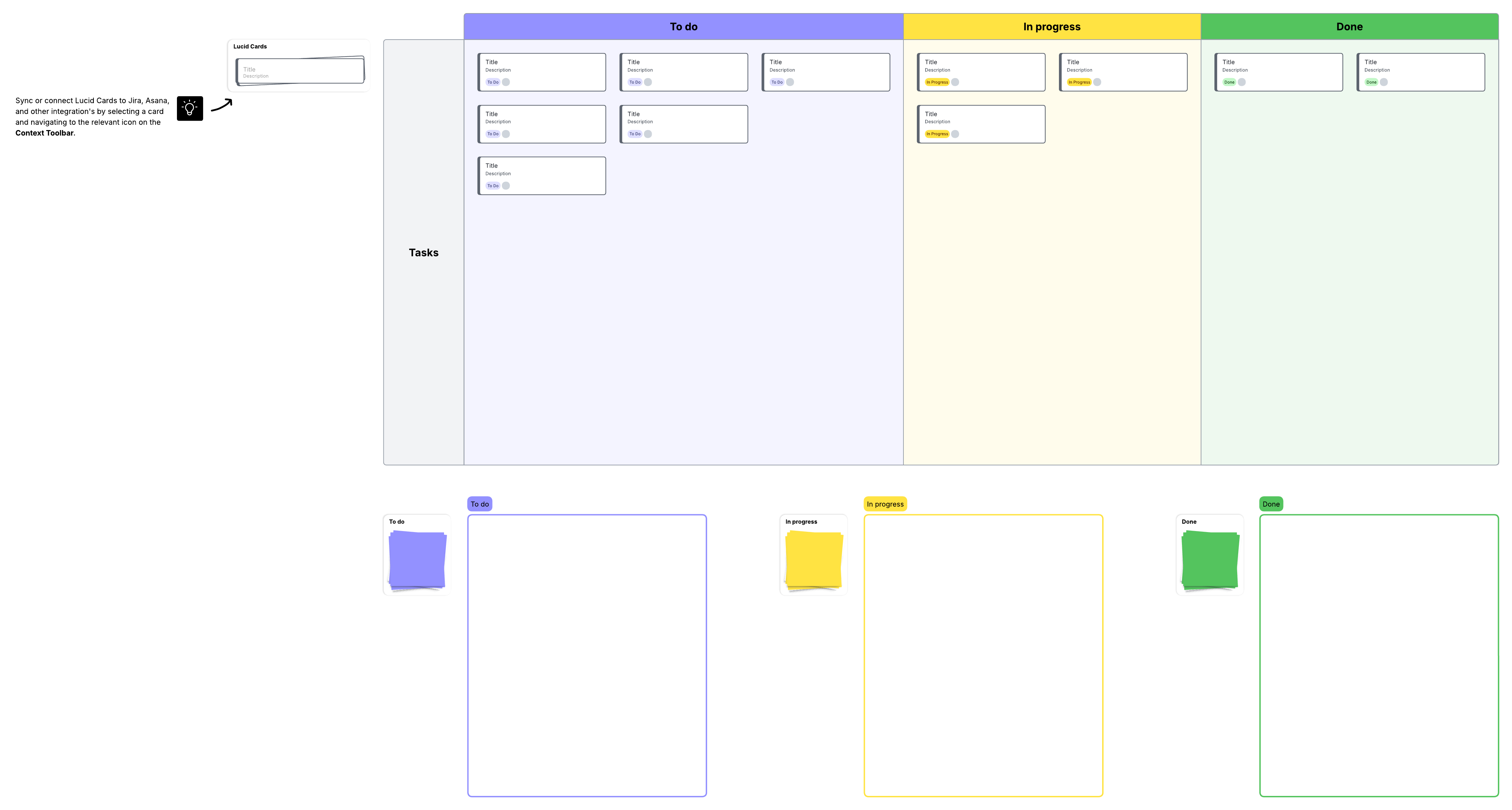
A solution like Lucid acts as a connective tissue across delivery models, supporting Scrum, Kanban, and hybrid approaches side by side. Within a single platform, you can facilitate sprint planning, use Kanban board templates, and create burndown charts, providing teams with the practices they’re familiar with so they don’t miss a beat. You can even create and organize your own corporate templates and connect your documents to real-time data, reducing the need for slide decks or out-of-date, static resources.
Establish consistent processes and practices
When you implement Agile across your entire organization, standardization is essential for scaling cross-functional workflows. This endeavor requires core artifacts, aligned cadences, and a shared language across teams, so people don’t have to waste time trying to figure out how they’re supposed to work. While processes and practices don’t have to be exactly the same, they should be consistent to enhance transparency and understanding.
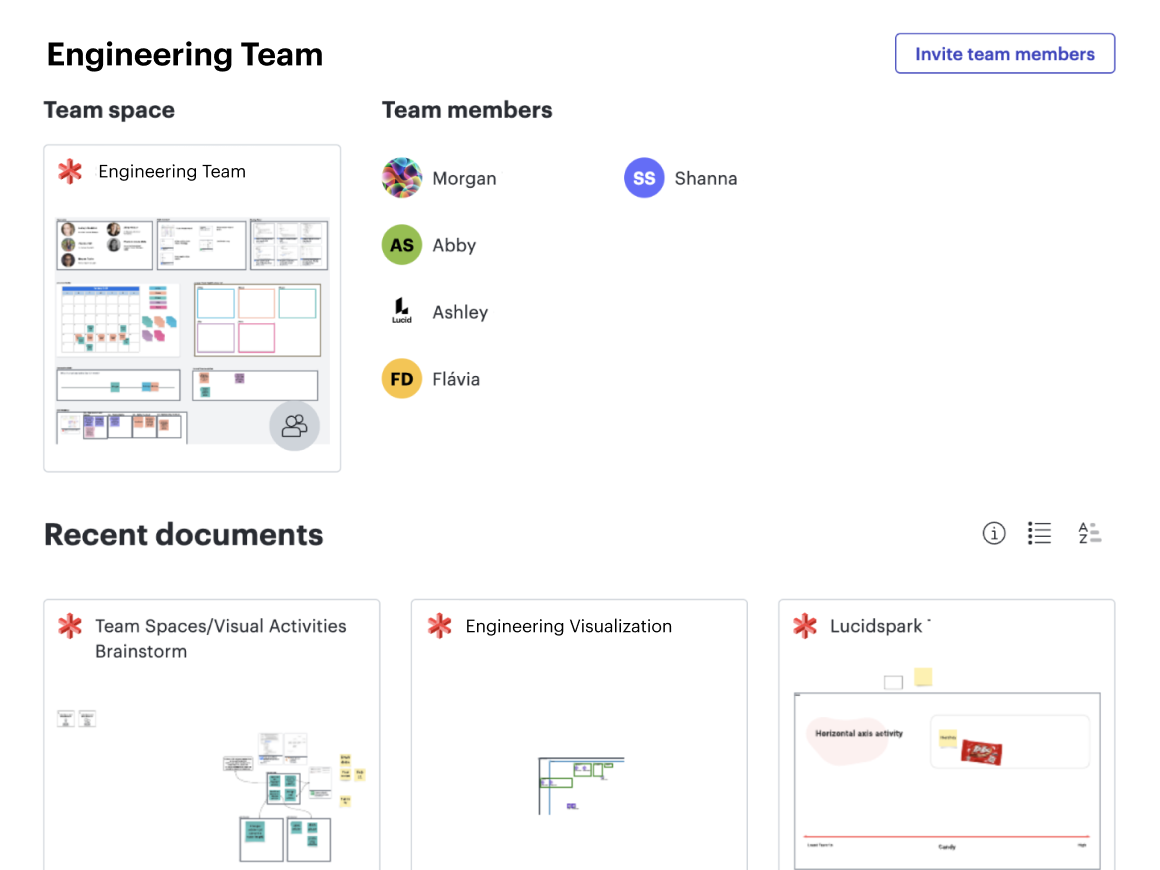
Creating a single source of truth that the whole business will use is crucial for increasing consistency and connecting cross-functional teams. By using a visual collaboration solution like Lucid, you can host documentation in one place, which also makes it easier to facilitate program-level Agile events such as PI planning when you need to bring multiple teams together.
Use team hubs in Lucid to initiate work, share progress, and centralize resources as you scale Agile practices across the business. And, with Lucid’s Process Accelerator, you can increase consistency in how your processes are stored and documented, making it easier to access and reuse assets.
Secure bottom-up and top-down buy-in
In order to successfully implement Agile org-wide, everyone must be on board, which sometimes requires a culture shift or change in management style.
Many scaling Agile frameworks operate under the assumption that teams are already practicing Scrum or other Agile methods, but ensuring those practices are universally implemented can be a challenging undertaking. You’ll need buy-in from leadership and all levels of employees, as well as a clear connection between action and strategy, in order to scale at the enterprise level.
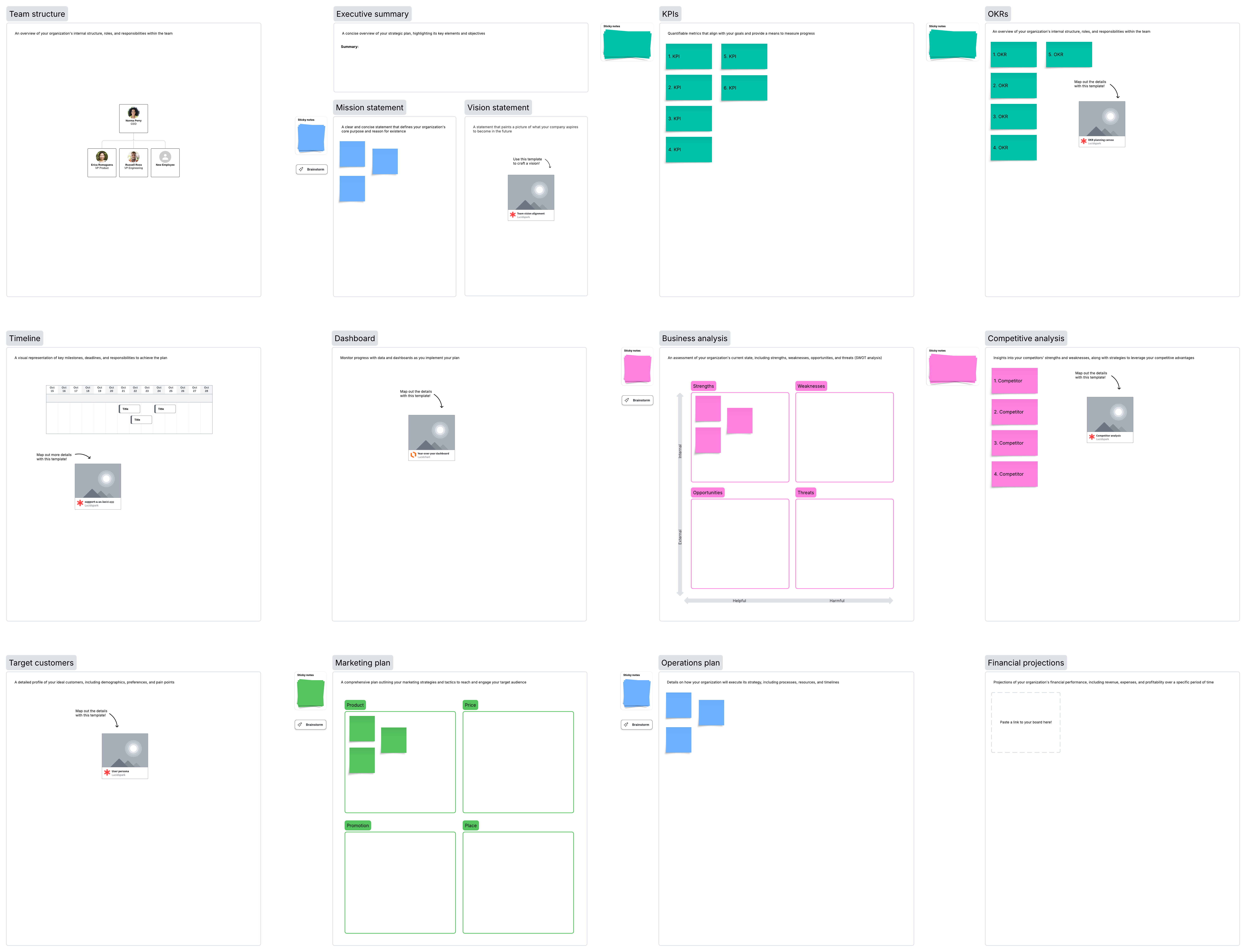
It helps to establish clear priorities that align team execution with leadership. These priorities should be visual, straightforward, and traceable to overall goals, so every team member can understand how Agile practices and cadences contribute to larger objectives.
Lucid enables teams to establish goals and delivery plans visually, supporting systems thinking across teams. By using Lucid to create high-level documentation such as roadmaps, businesses can use Lucid to connect individual work to larger goals and help leaders visualize progress.
Enable shared visibility across teams
Most businesses use a mix of delivery tools across teams and functions. For example, it’s common to use Azure DevOps (ADO) for engineering teams and Asana for marketing teams. Scaling Agile requires increasing visibility and alignment across systems of record, not necessarily replacing them. A key goal of scaling Agile is shared understanding, not identical workflows.
A work acceleration platform like Lucid acts as a visual layer that connects work happening in different systems. With Lucid, teams can come together in a shared space that automatically syncs with their existing systems of record, such as Jira, ADO, and airfocus. Any change in one platform is reflected in the other, saving teams from manual updates and supporting collaboration without abandoning existing tools or workflows.
Design for cross-team dependencies
Dependencies aren’t a failure; in large organizations, dependencies are structural and unavoidable, and the only failure is pretending they don’t exist. If you’re scaling Agile, it’s essential to make dependencies visible early on during planning stages and actively assume that managing dependencies will be part of cross-functional workflows.
A visual platform like Lucid that has dependency mapping capabilities helps you mitigate problems before they make a deeper impact. Visualizing dependencies clarifies sequencing, ownership, and handoffs across teams, helping you proactively account for work relationships rather than relying on reactive coordination when issues arise.
Using Lucid to scale Agile
Scaling Agile is less about picking the right framework and more about building an organization that can see clearly, move together, and adapt. The companies that scale Agile well aren't the ones that implemented SAFe perfectly; they're the ones that made work visible, proactively managed dependencies, and gave every team a shared language without forcing identical processes. A visual collaboration solution that was built to accelerate proven ways of working is an essential aspect for implementing Agile at scale, regardless of the approach you choose to take.
Check out the ways that businesses have used Lucid to enhance alignment and improve delivery at scale, thanks to Lucid’s team hubs, intelligent diagramming capabilities, and customizable Agile templates. With Lucid, you’ll have what you need for every stage of your Agile journey.
How Lucid supports scaling Agile
Learn how Lucid empowers businesses to improve alignment and leverage Agile practices across teams.
Read more