What is a work breakdown structure?
A work breakdown structure (WBS) is a project management tool used to define and manage a project's deliverables. The WBS is a hierarchical structure that breaks down complex activities into smaller deliverables (often called work packages, tasks, sub-tasks, or terminal elements), making the work easier to evaluate, assign, and track while also showing how the pieces relate to one another.
While most project management tools focus on planned actions, a WBS focuses on planned outcomes. A carefully organized work breakdown structure can help a project manager more effectively oversee the completion of otherwise complicated tasks within a project. A WBS with measurable, clearly defined tasks can also help project management assign accurate costs and deadlines to a project, simplifying project planning and monitoring.
Elements of a good work breakdown structure
When constructed thoughtfully, a WBS can make it easy to assign and track various elements in a project. In order to maximize its effectiveness, a work breakdown structure should exhibit the following attributes:
- Defined: Your WBS should be easily understood by project participants and stakeholders.
Easily estimated: Task durations, cost, and required resources are included to estimate the cost and time necessary to complete the project. - Manageable: To reinforce accountability, ensure each work package has a clear owner (a specific team or individual) and can be completed within a reporting period.
Measurable: A WBS should include start and completion dates and assessable milestones to accurately measure progress. - Flexible: Your structure should accommodate minor changes, such as deadline shifts or the addition of tasks. However, keep in mind that one purpose of the work breakdown structure is to give a full picture of the deliverables expected beforehand to avoid scope creep or rework.
Follow these guidelines to ensure that your work breakdown structure is an effective project management tool:
- Get granular. Break down your project deliverables to their lowest level possible, and express the task in verb form. As a practical benchmark, many teams apply the "8/80 rule," keeping each work package sized to roughly 8–80 hours of effort (or no more than about 10 days or a standard reporting period, depending on your organization).
- Check your WBS for accuracy. Ensure that all of your deliverables, deadlines, and resources are correctly recorded in your visual.
- Include supporting activities. Make sure your WBS accounts for activities such as training and testing, as well as product or service launches and implementation. Include non-IT and procedural work activities, such as documentation and reviews, in your work structure.
- Check work packages. Create your work packages so they are completely independent of other work packages. Make sure that individual tasks are not duplicated across your structure. This recommendation aligns with two widely used guardrails: the "100% rule" (your WBS captures 100% of the project scope and nothing extra) and "mutual exclusivity" (no deliverable or subtask appears twice, preventing double-counting of work, cost, or time).
- Stay outcome-focused. Keep the structure centered on deliverables and measurable milestones rather than action lists (e.g., "braking system" rather than "calibrate brake pads").
Aim for the right depth. Many WBS diagrams fall into three levels of detail overall, though some branches may need more subdivision than others to make the work truly manageable.
Types of work breakdown structures
There are two types of work breakdown structures commonly employed in project management: the process-oriented WBS and deliverable-oriented WBS. Contrary to popular belief, both structures can (and should) be used when defining your project scope. Used in tandem, they can offer unique and valuable insights into the project management process.
Process-oriented work breakdown structure
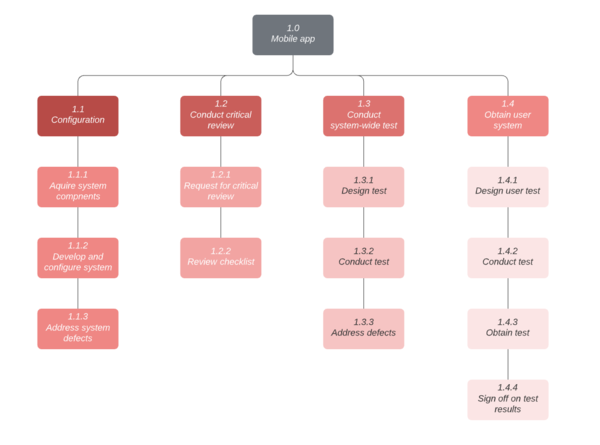
A process-oriented WBS defines a project in terms of steps, work phases, or functions. This type of WBS focuses on the steps that need to be taken within individual disciplines to complete a project and typically phrases individual elements in the verb form.
The benefit of using a process-oriented WBS in tandem with your deliverables-oriented WBS is that it provides a thorough breakdown of work from a functional perspective, creating a more coherent project scope. It can also be used to ensure high-quality processes are established throughout your project.
Deliverables-oriented work breakdown structure
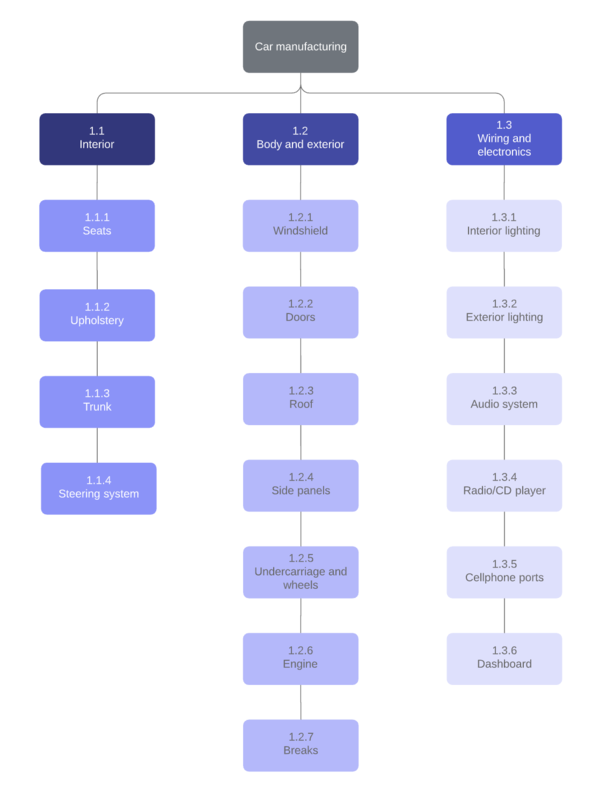
A deliverables-oriented WBS defines a project in terms of tangible deliverable components. Deliverables are typically physical components or items needed to complete the overall project.
Deliverables-oriented work breakdown structures are particularly useful in helping project managers see the total scope of a project and how each deliverable is related to the others. They can also provide a natural summary of work for various management levels, enabling more accurate cost and resource estimates.
Who uses work breakdown structures?
Work breakdown structures can be used in a variety of settings to ensure an organized and successful project. In addition to helping project managers, a work breakdown structure can benefit users in the following roles:
- Account directors: Account directors use a WBS to demonstrate to clients how a project is progressing, including highlighting project roadblocks. They can also be used to ensure that account teams and clients are on the same page concerning project deliverables.
- Event planners: With all the moving parts of events, a WBS can help efficiently track tasks and subtasks in event production. Events are typically produced on tight deadlines, making a work breakdown particularly useful.
- Software developers: Software development is often broken down into stages and phases, which makes the WBS a natural fit. A WBS can provide valuable visibility across teams as important deliverables are completed, ensuring an efficient workflow.
- Commercial project managers: Commercial projects are particularly dependent on the delivery of tangible project components. When the project involves multiple contractors, a WBS can highlight task dependencies between teams to ensure deliverables are completed on time.
More broadly, any team leading complex initiatives—such as new product launches or large-scale software rollouts—can use a WBS to turn an overwhelming objective into an organized roadmap of deliverables and ownership.
How to create a work breakdown structure
- List deliverables: List all of the major deliverables required to complete your project. Clear up any confusion about your deliverables before recording them, and have your list reviewed by different stakeholders to ensure its accuracy. At this stage, it also helps to document the overarching objective and scope in a project charter so the WBS stays anchored to an agreed-upon goal.
- Break down each deliverable into separate components: Divide the project into key phases or major deliverables, stopping short of listing every action and keeping the focus on concrete outcomes.
- Divide projects by task type or role. There's no limit to the number of components you can have, so be as thorough as possible.
- Break each component into work packages: Break down each component until you've reached a single task that can be completed by a single individual. Your work project should include its own budget, resources, milestones, and deadline. Work packages are typically the lowest level of the breakdown and should define the work, duration, and costs for each task, as well as task owners. Each work package should provide assignments that can be completed within a reporting period.
- Identify dependencies: Make sure you're clear on which tasks have dependencies. This clarity will help your team identify potential risks and manage time efficiently. As you map dependencies, you'll also be better positioned to build a realistic schedule and spot risk areas early.
- Prioritize dependencies and assign work packages: Once your dependencies are clearly identified, map your work packages by priority. Assign each work package to the correct individual, working your way up to major deliverables. As you finalize assignments, double-check that your WBS still reflects the full scope (the 100% rule) and that there is no overlap between packages (mutual exclusivity).
- A well-built WBS also supports downstream planning artifacts, such as writing a statement of work, estimating costs, developing a timeline, clarifying roles, tracking progress, and identifying risk, because it turns the project into discrete, visible chunks that are easier to evaluate than the project as a whole.
Work breakdown structure examples
Work breakdown structure template
In this basic template, each manufacturing deliverable is clearly broken down into concrete steps, making it clear what must be done to complete the final project.
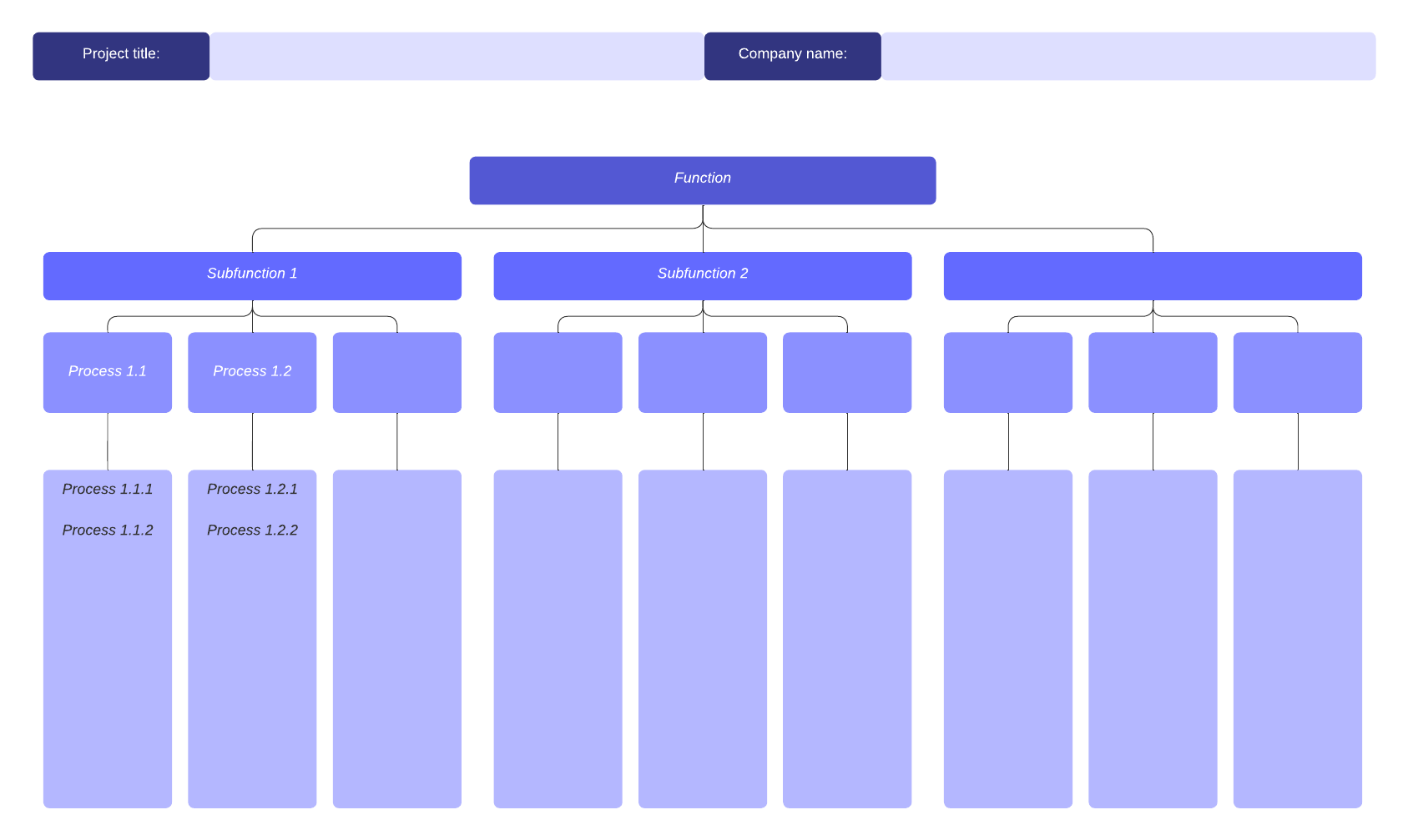
Functional decomposition template
This template depicts a top-down illustration of the overall project, with tasks divided into major categories of work and then broken down into smaller work packages.
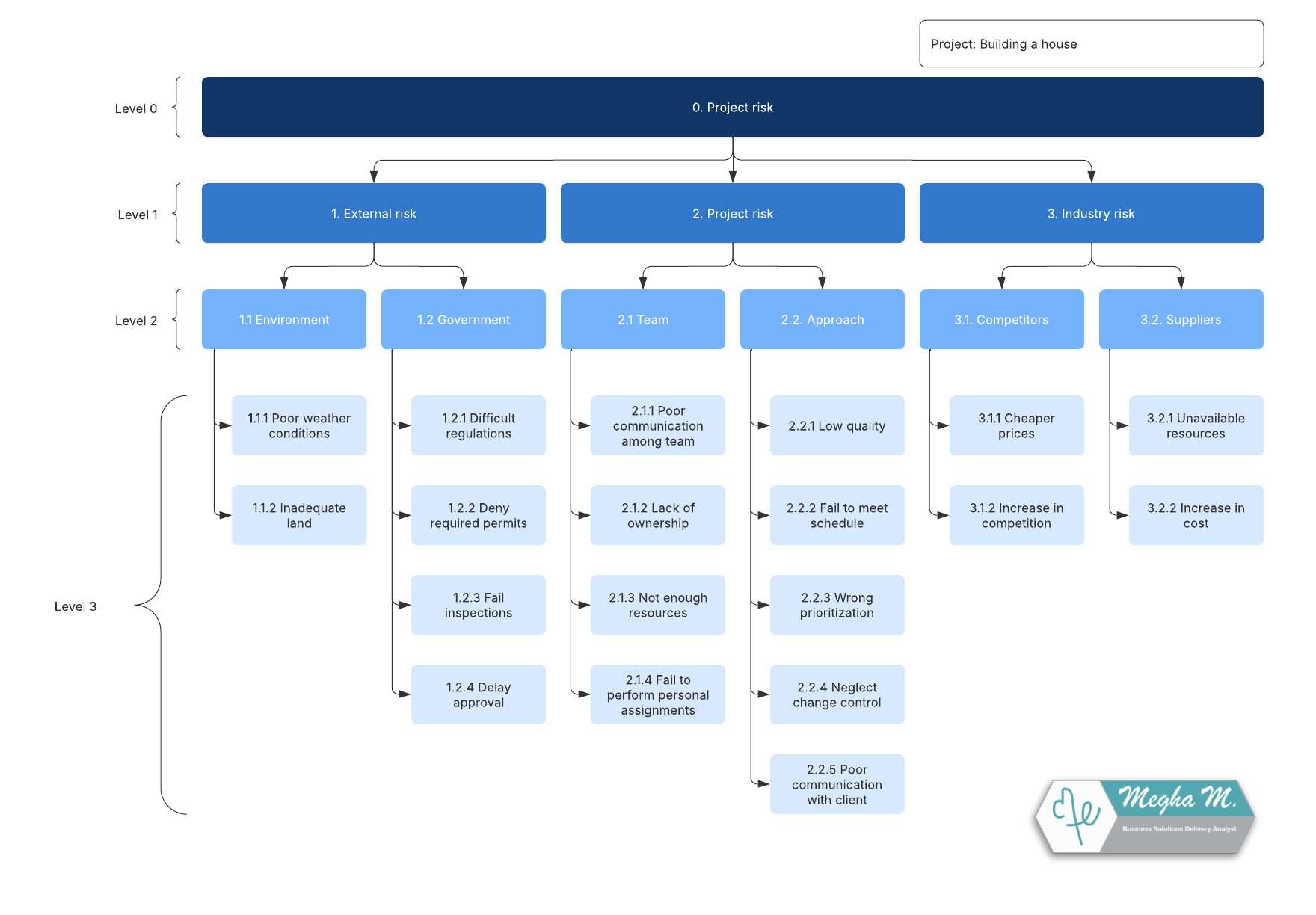
Risk breakdown structure template
This WBS identifies, categorizes, and breaks down the potential risks associated with different areas of a project.
For another common example, consider a house-building WBS: the project can be divided into major sections, such as foundation, exterior, and interior, and then subdivided into additional levels (often up to about three levels total). The complete set of work packages should add up to 100% of the effort required, with no duplicated work, and can be enhanced by adding budgets and assigning a responsible team to each package.
Work breakdown structure formats
In addition to choosing what to break down, you'll also choose how to present it. Work breakdown structures can be documented in multiple formats, such as a hierarchical table, an outline or numbered list, a tabular view, or a tree diagram.
Tree diagram
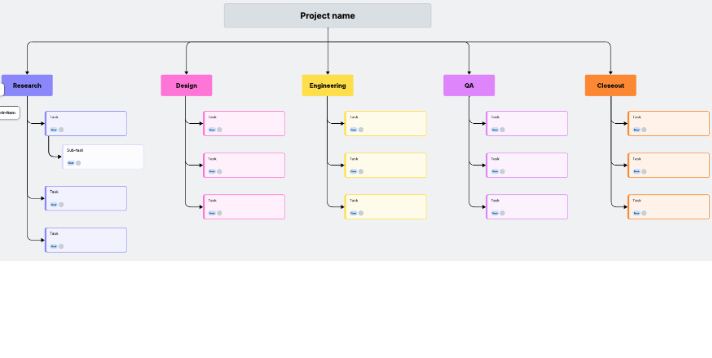
The most visual option is the tree format: It structures the WBS like an org chart and shows the hierarchy of tasks, providing space for additional information about each work package.
Outline structure
A text outline is the simplest WBS format. It is easy to put together and shows the hierarchy of tasks. However, it is difficult to add additional information about budget, duration, and assignment using this format.
Build a house
1 Foundation
1.1 Excavate
1.1.1 Dig
1.1.2 Level
1.2 Frame
1.3 Concrete
1.3.1 Pour
1.3.2 Cure
2 Exterior
3 Interior
Hierarchical structure
This format is less visually intuitive but shows the task hierarchy. Because it is a table, this format fits easily onto a page.
Tabular view
A tabular view is a more visually intuitive way to show hierarchy using a table.
WBS dictionary
A WBS dictionary is formatted like a hierarchical structure, but it includes a brief description of each work package. When documenting a project, a WBS dictionary is often included in addition to a visualization of the WBS. It helps to clarify the scope of each task so that all team members understand their responsibilities.
If you’re ready to start building out a work breakdown structure, give Lucidchart a try! You can get started with a free account and use intelligent diagramming features to break down a project’s deliverables faster than ever.

Everything you need to whiteboard online
Get the ultimate online whiteboard for teams. Brainstorm, plan projects, and collaborate virtually on Lucidspark’s infinite canvas.
Sign up free