Key takeaways
-
OKRs should help shape product priorities. When the roadmap is fixed before the objectives are written, the OKRs describe work that would have happened anyway.
-
The difference between an OKR and a delivery plan is whether completing the work is sufficient or whether the work has to demonstrably move something that matters.
-
OKR scoring should surface a signal. A model that averages all key results equally will produce numbers that satisfy no one and motivate no one.
-
OKRs become more useful when teams can see the full chain from their daily work to the goals the business is trying to achieve.
-
An OKR revisited throughout the quarter guides decisions. An OKR revisited only at the end scores history.
Every quarter, product and engineering teams invest real time in OKR planning: running discovery workshops to surface ideas, aligning stakeholders on objectives, and mapping key results to strategic goals. Then the quarter begins, and the OKRs are moved into a document that most people never open again until scoring week arrives.
“There’s a lot of time and talk dedicated to writing OKRs in the last two weeks of the quarter, but my cynical but accurate observation is that they then get put in Confluence, and rarely talked about again.”
—Zack Rowley, Technical Project Manager at Lucid Software
The pattern is familiar because it is structural. Most teams do follow an OKR process, but it’s flawed: The OKRs are delivered too late, framed too narrowly, scored too crudely, and completely ignored during actual execution. The result is a quarterly exercise that feels like overhead and delivers little value in return.
Lucid’s engineering teams worked through this problem directly, eventually shifting to a more visible, measurable, and outcome-led approach to OKR management. Their experience points to five specific places where product OKRs tend to break down, and what more useful alternatives look like.
Pitfall 1: Writing OKRs after the roadmap is already decided
In many product and engineering organizations, annual roadmapping happens before OKR planning. Teams agree on the initiatives, features, and epics they plan to ship, then write objectives around that work.
This sequence inverts the purpose of OKRs. When the plan already exists, the objective-writing process becomes a labeling exercise of work that has already been committed, rather than reasoning about what outcomes matter and which investments are most likely to create them.
Zack saw this pattern directly in Lucid’s engineering teams. When roadmapping preceded OKR planning, teams worked backward from a pre-determined delivery plan rather than forward from a desired outcome.
“A lot of OKRs just end up being work plans,” said Rowley. “You work from the item that you’re planning on delivering, instead of asking, 'We want to move this metric—what could we come up with to do that?’”
The stronger sequence starts with the outcome.
Before anything gets committed to a roadmap, teams benefit from a collaborative workshop to surface potential objectives, stress-test them against company strategy, and build alignment.
Templates in Lucid, such as the OKR planning canvas, provide the structured, visual space for exactly that kind of early-stage ideation, giving teams an infinite canvas to map objectives collaboratively before the plan takes shape. Once the outcomes are clear, the roadmap becomes the answer to the question of which work is most likely to create them.
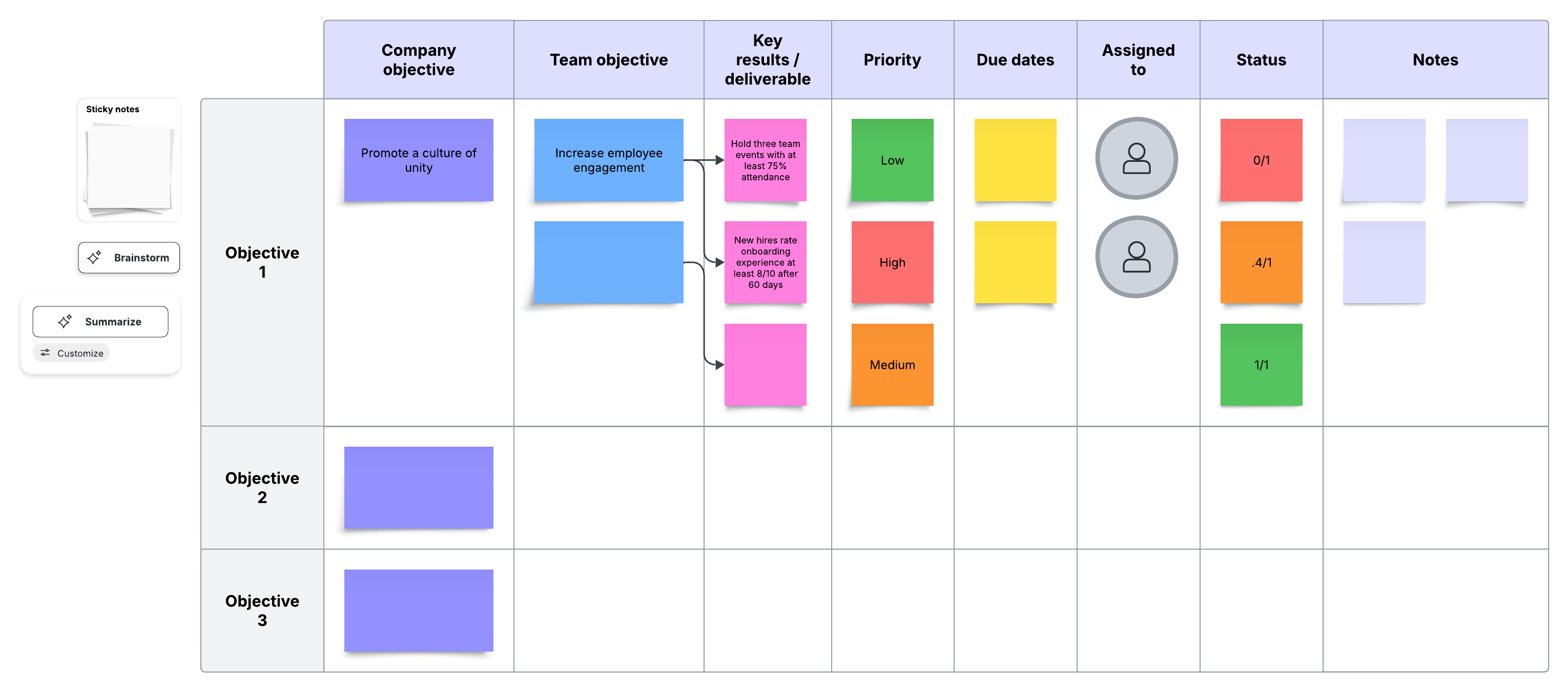
An OKR that begins with “Increase the percentage of customers completing setup and imports from 20% to 30%” gives the team something to optimize toward. An OKR that begins with “Ship the onboarding module by Q2” describes a delivery date. One of those can be adjusted when evidence suggests a better path. The other locks the team to a plan regardless of what the work reveals.
Pitfall 2: Letting OKRs become disguised work plans
Even when teams try to write outcome-led OKRs, the language often slides toward delivery. The key result ends up describing a piece of work rather than a measurable change.
Compare two key results for a team working on user retention:
-
“Launch the in-app engagement module by week 8.”
-
“Increase 30-day active user rate from 42% to 55%.”
The first is a delivery milestone. The second is an outcome. The distinction is important because it changes how the team makes decisions throughout the quarter. A team tracking against a delivery milestone will prioritize shipping the module on time. A team tracking an outcome will regularly ask whether the module is the best way to move the metric and will adjust their approach if the evidence points elsewhere.
The cultural shift Lucid’s teams worked through was exactly this: moving the conversation from “What are we planning to ship?” to “What outcome are we trying to create?” That shift requires writing key results that are genuinely measurable and tied to something that matters to the customer or the business, rather than to the completion of a task.
A useful test: If a key result can be satisfied by doing a task, regardless of the impact, it is a work plan. If it can only be satisfied by evidence that the desired outcome occurred, it is an OKR.
Pitfall 3: Using scoring systems that flatten meaningful progress
The most common OKR scoring model assigns equal weight to every key result, then averages the scores to produce an objective score. The appeal is simplicity, but equal weighting collapses meaningful information in the process.
When exceptional work in a high-priority area earns the same fractional score as middling progress on something less consequential, the scoring system stops functioning as a measure of progress and starts functioning as a source of demoralization. As Rowley put it: “This model is failure-focused. It doesn’t feel good, so teams aren’t motivated with it.”
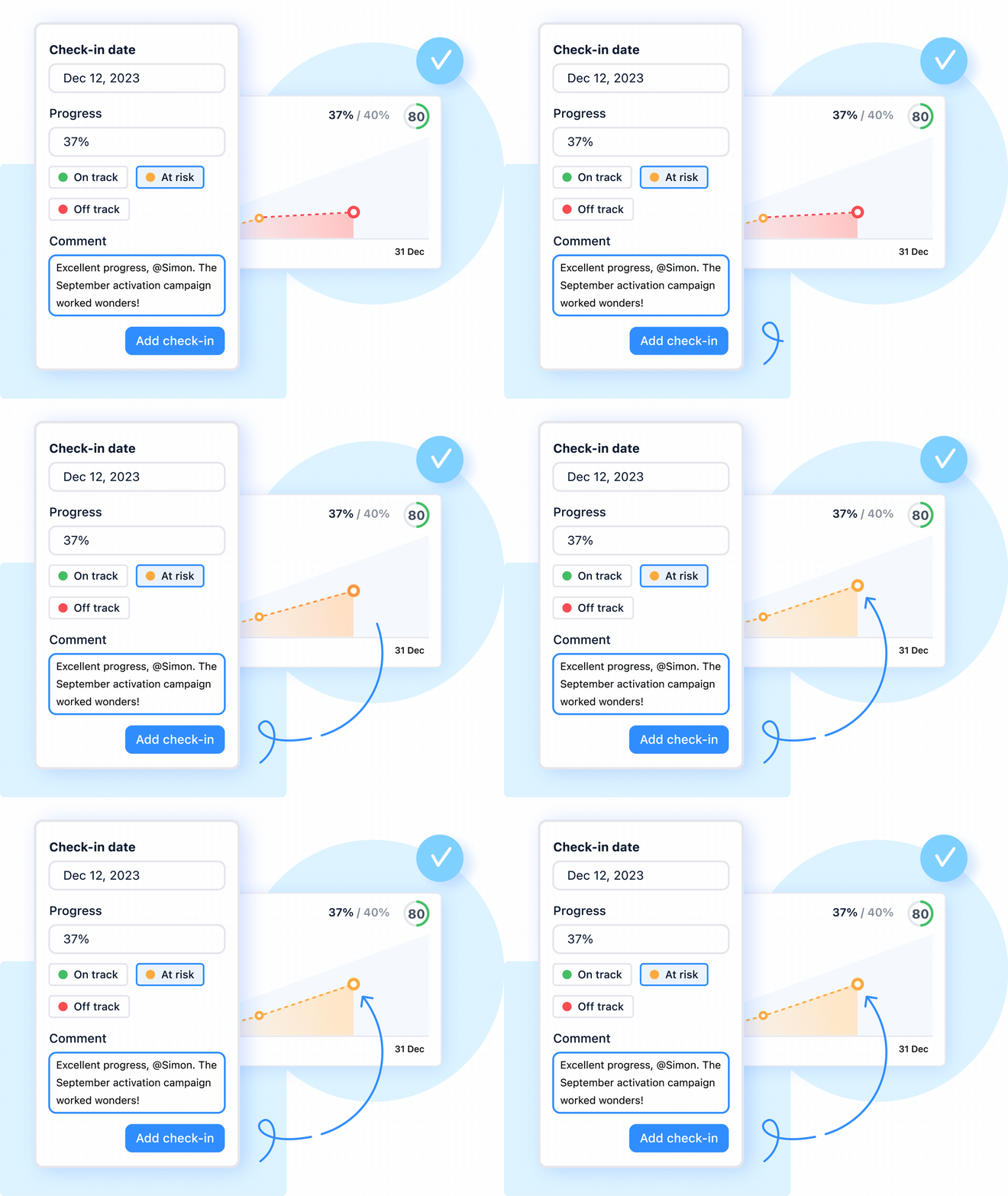
The alternative is scoring built around real targets. Rather than assigning equal fractions to every key result, airfocus lets teams set specific numerical targets, percentages, or milestones for each key result, with scores rolling upward through the objective hierarchy as check-ins are logged.
A team with a target of increasing the setup-and-import completion rate from 20% to 30% can record their current position at any point in the quarter, and the system calculates how that compares to the goal. Leaders see a consolidated view of group performance without having to chase updates from individual teams.
Pitfall 4: Disconnecting team OKRs from company strategy
One of the most consistent frustrations for product and engineering teams is uncertainty about how their work connects to broader company goals. The team delivers its objectives and still has no clear sense of whether any of it moved the metrics the business cares about.
This disconnect has a structural cause: Team OKRs live in one place, group or department OKRs in another, and company-level objectives somewhere else entirely, with the connections between them left unstated and invisible.
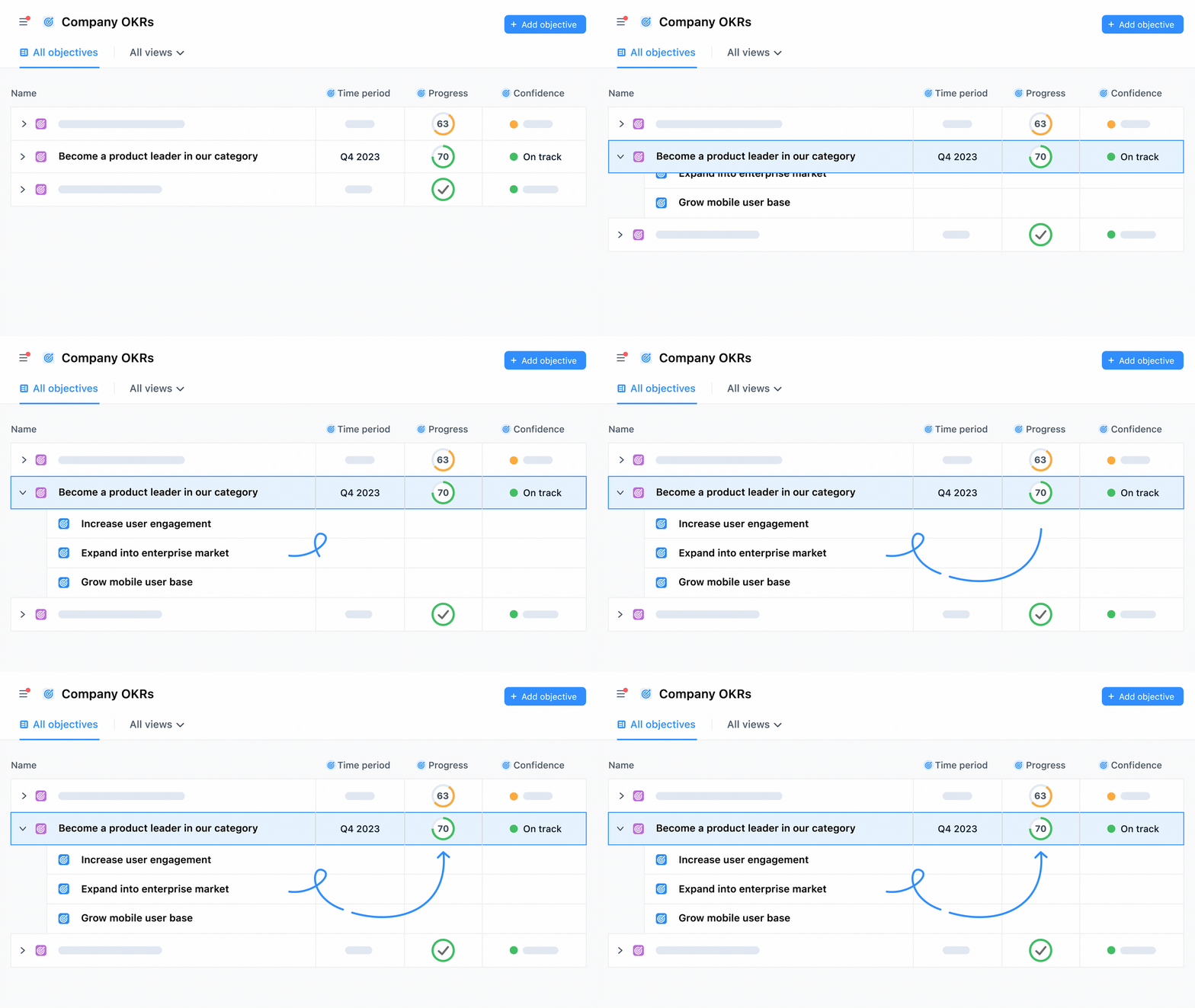
By using airfocus to house OKRs, Lucid’s engineering teams addressed this directly. Rather than keeping OKRs in separate documents at each level of the organization, the team built a connected hierarchy, with team objectives feeding into group goals, group goals feeding into department targets, and department targets tied to a concrete business outcome, in this case, an ARR target for the process accelerator product area.
The three teams working on that product area can see exactly where they sit in that chain. “Just being able to show them [airfocus], and answer how what they’re working on contributes to what the business is doing is invaluable,” said Rowley. “And it takes me just two clicks to get here.”
That visibility also changes the conversation during planning. When the relationship between team OKRs and company strategy is explicit, it becomes easier to identify gaps, surface competing priorities, and make deliberate choices about where to focus. The airfocus OKRs and Objectives page covers how a connected OKR hierarchy works in practice.
Pitfall 5: Treating OKRs as quarterly documentation instead of an operating rhythm
The planning week and the scoring week bookend the quarter. Everything in between is silence.
This pattern is what turns OKRs into overhead. When objectives are written in week one and reviewed in week twelve, the ten weeks in between pass without the OKR touching a single decision. It sits as a record of intent, waiting to be scored against an outcome it had no role in shaping.
Lucid’s teams found that monthly check-ins changed this. Rather than reconstructing progress from memory at the end of the quarter, teams log updates regularly, and those updates are visible to stakeholders without the need for a status meeting. As Rowley described it:
“A quick look at the department objective shows progress towards the ARR target, currently at 90%. That took us two minutes. It took longer to say the acronym than it did to find the information.”
The broader point, as Zack framed it, is that OKRs are worth the time when the time produces something useful. “‘We had not spent enough time talking about or using our OKRs in positive ways beforehand, and thus far, any time investment in doing this has paid off in dividends.’
The discipline is treating the OKR as a living artifact: Update progress regularly, discuss the trajectory while there is still time to adjust, and use scoring that reflects genuine assessment rather than a post-hoc reconstruction of what the team shipped.
How Lucid’s teams changed their approach to OKR planning
Lucid changed their approach to OKRs in the middle of a quarter, when an engineering manager put airfocus in front of a handful of teams and asked for their honest assessment, with an open invitation to try a new framework. The reaction was immediate. As Zack put it, within minutes, they knew it was ten times better than anything they’d used before. Every product manager reached the same conclusion, and, within a quarter, Confluence was out, and airfocus became the origin for all OKR work.
Lucid’s teams were already using Lucid for collaborative work, including strategy workshops and flexible planning, and the native integration between Lucid and airfocus made the shift even easier, connecting the visual, collaborative layer teams were familiar with to a structured system for OKR management.

For a closer look at how the two tools work together in practice, check out the guide to using airfocus and Lucid for product roadmapping.
Learn moreThe changes that followed were concrete:
-
OKRs became more outcome-led, written around metrics and customer outcomes rather than delivery milestones.
-
Key results were scored against real numerical targets rather than equal fractions of a total.
-
Objectives were connected across team, group, department, and company levels, so progress was visible throughout the hierarchy.
-
Monthly check-ins replaced end-of-quarter reconstruction.
-
Progress became visible to stakeholders at a glance, removing the need for status meetings to establish what was already true.
Practical takeaways for product and engineering teams
The common thread across all five pitfalls is the same: OKRs lose value when they function as documentation rather than as an operating tool.
Here is what that means in practice:
-
Start with the outcome, not the roadmap item. Write objectives before the plan is fixed, so the objectives can shape the plan. A collaborative ideation session within Lucid can help teams surface and align on outcomes before anything gets committed.
-
Make every key result genuinely measurable. If it can be completed regardless of impact, it is simply a task, not a key result.
-
Design scoring to reflect real progress. Score against specific targets, weight key results by importance, and use the results to surface signal rather than average it away.
-
Connect team OKRs to company strategy explicitly. Visible linkage across levels turns OKRs from a team exercise into an alignment mechanism.
-
Revisit OKRs throughout the quarter. Monthly check-ins transform OKRs from records of intent into tools for navigating toward outcomes.
-
Choose tools that make OKRs visible, connected, and actionable. The system should make it easy to update progress, see the full hierarchy, and score against real targets without a meeting to explain what the number means.
OKRs deliver the most value when they help teams make better decisions throughout the quarter. A well-designed OKR process creates the conditions for sharper decisions, clearer alignment, and more meaningful progress all the way through.

Ready to see how a connected OKR system works in practice? Explore airfocus OKRs and Objectives.
Learn more