Key takeaways
Unmanaged agentic AI deployment poses serious operational and structural risks across enterprise systems, including ineffective audit trails and data leakage due to unauthorized access.
Effective agentic AI governance relies on key pillars, including clear ownership, risk-tolerance tiers, and strict boundaries.
Before deploying agentic AI, classify agent risk and impact early, define data boundaries, and establish an incident response plan.
A visual collaboration solution helps you document ownership, map out where agents should be deployed in workflows, and monitor performance to prevent drift.
A recent report by the Capgemini Research Institute predicts that by 2028, 38% of organizations will have AI agents as team members within human teams. As organizations embrace the potential of agentic AI, it’s critical to also have a governance plan in place.
The autonomy of AI agents means there’s a greater risk than with generative AI. Agentic AI executes tasks within workflows, which requires a different kind of oversight and operational authority. This means you don’t need to just govern the outputs of agentic AI; you also need to govern its actions. According to a recent Deloitte study, 70% of business leaders cited an inability to trust and govern agents as a major factor preventing their organizations from scaling AI.
Effective governance is the key to deploying agentic AI with confidence. When ownership and boundaries are explicit, this not only reduces risk but also drives adoption and ROI. As Jeff Rosenbaugh, Senior Director of Professional Services at Lucid, explains:
“Skipping governance doesn’t just add risk, it destroys the agent’s own value case. If an agent fails, you react by putting a human back at every step, and you rebuild the manual process you were trying to automate. Governance isn’t the tax on automation—it’s what lets the automation stick.”
In this blog post, we break down agentic AI governance best practices and give practical tips on how you can execute a governance plan for your AI agent deployment.
Risks of agentic AI
Agentic AI comes with unique risks that may differ from those of other AI tools you’re using. Traditional AI governance focused on regulating the outputs of generative AI, checking whether the text was biased, offensive, or inaccurate. Agentic AI, on the other hand, executes multi-step workflows and uses APIs across live enterprise systems with minimal supervision, posing a unique operational and structural risk. If an agent operates without human intervention or oversight, it can affect the systems it runs through.
If you don’t have an effective governance plan in place, the risks of agentic AI you may experience include:
Mistakes in execution. If agents don’t have access to up-to-date, complete documentation, they will operate on inaccurate rules or invent their own to fill in the gaps. Providing agents with clear context up front can prevent severe business disruptions, wasted resources, and high costs incurred from untangling and remedying mistakes.
Irreversible actions. Consider whether agentic AI may perform actions that can’t be undone, what those are, and which actions need to involve humans. For example, irreversible actions may include deleting data or transferring funds.
Data leakage from unauthorized access. Without strict, least-privilege access controls and appropriate permissions, agents could accidentally expose confidential business data or sensitive customer information.
Ineffective audit trails, which occur when there is no clear record of actions or transactions from start to finish within a process. If there’s no record of who did what, when, and how, it's impossible to pinpoint where things went wrong.
Escalating costs. Without clear guardrails or constraints, AI may spin up multiple agents to complete one action. Not only can this cause high token fees, but it can also lead to duplicate context, as multiple agents perform the same actions repeatedly.
Given these risks and agentic AI’s role in executing workflows across enterprise systems, it makes sense that there is some fear and hesitation about implementing agentic AI. There are existing concerns about who is held accountable if agents do the wrong thing, and a lower willingness to experiment. However, effective governance can help remove that fear and provide greater emotional safety before and during agentic deployment.
Pillars of agentic AI governance
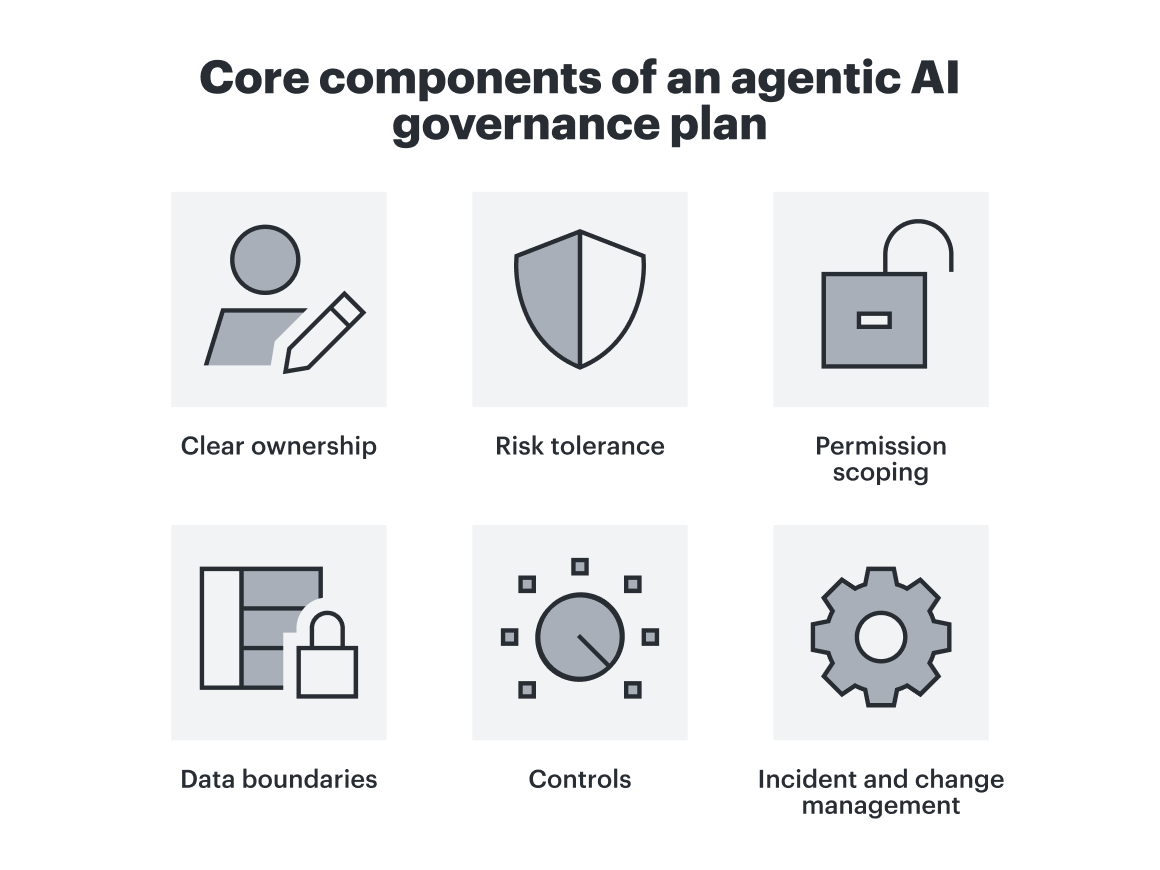
These are the core components of agentic AI governance:
Clear ownership. As Rosenbaugh says, “If nobody owns it, nobody governs it.” Both business ownership (who owns the business process) and technical ownership (who is responsible for agent development and maintenance) should be perfectly clear and understood.
Risk tolerance. Agentic actions should be classified into the following four tiers based on organizational risk tolerance:
Tier one: Auto-approve (low risk and reversible, an agent simply acts)
Tier two: Notify and proceed (medium risk, the agent acts and tells a human)
Tier three: Human-in-the-loop (high or irreversible risk, the agent needs explicit human approval first before acting)
Tier four: Prohibited (unacceptable risk, an agent is not deployed, and there is human action only)
Permission scoping and data boundaries. Restrict the data repositories and systems that an agent can access. Constraining the context agents can receive improves accuracy and security.
Controls. Establish roles and permissions, real-time monitoring, comprehensive audit logs, approvals, and emergency shutoff capabilities (a kill switch).
Incident and change management. Have an incident response plan and define explicit protocols for handling agent errors or adjusting for dependencies without breaking the overall workflow.
How to operationalize agentic governance: Steps and best practices
The following are proven steps you can take to implement the core components of an AI governance plan.
Step #1: Classify risk and impact
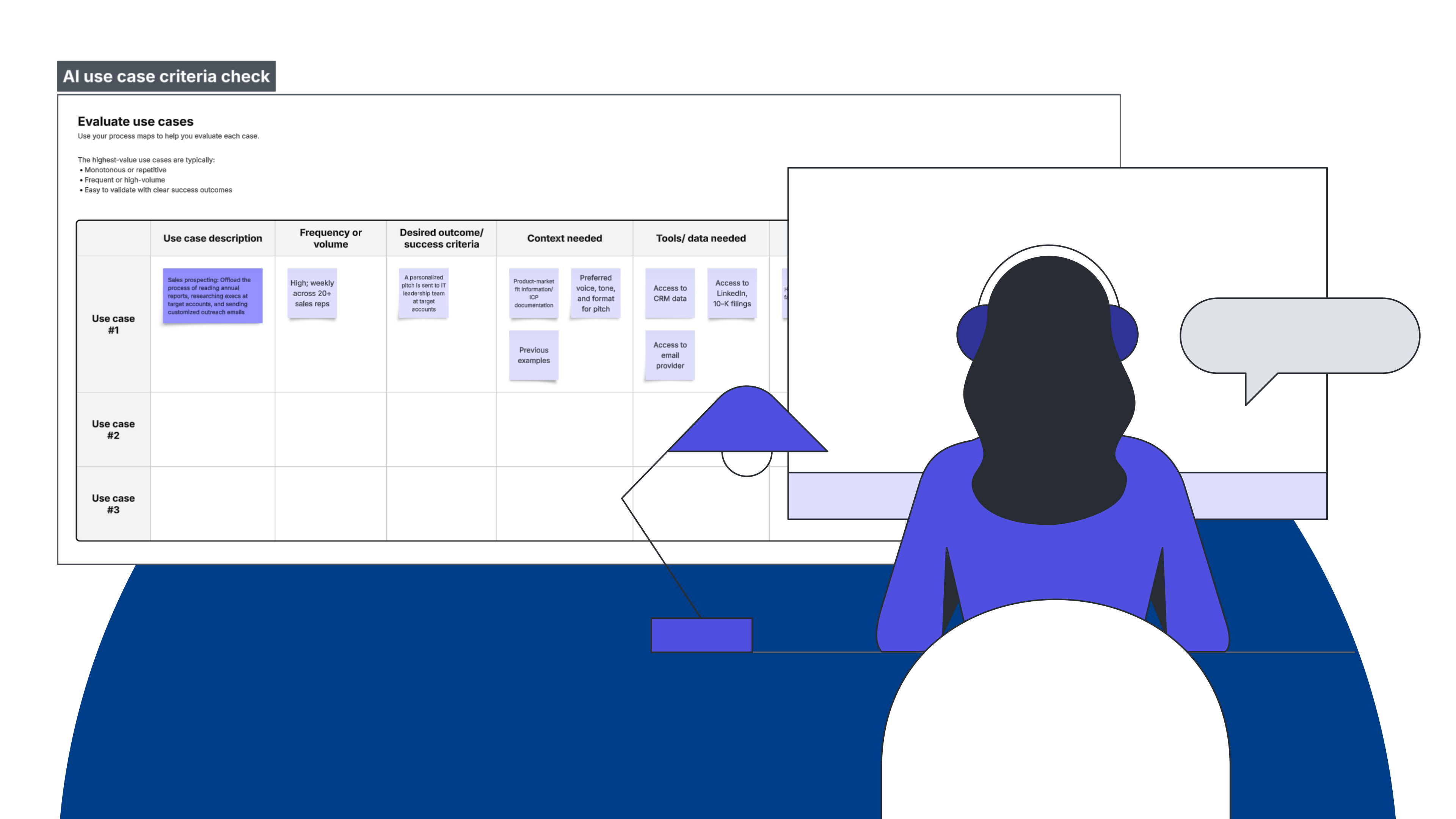
The first step to your governance plan is to conduct an inventory and classification exercise. Identify all agents to be deployed in a workflow and the actions they will perform. Classify the risk and impact of each agent and each action.
For example, pulling a standard report and other low-impact, routine tasks are typically low risk, so you’d classify this action as tier one. An action that triggers notifications to stakeholders is medium risk, so tier two, whereas a financial transaction is high risk and would fall into tier three. As an example for tier four, agentic AI should never perform actions classified as prohibited or irreversible, such as running commands that wipe files or reading private API keys.
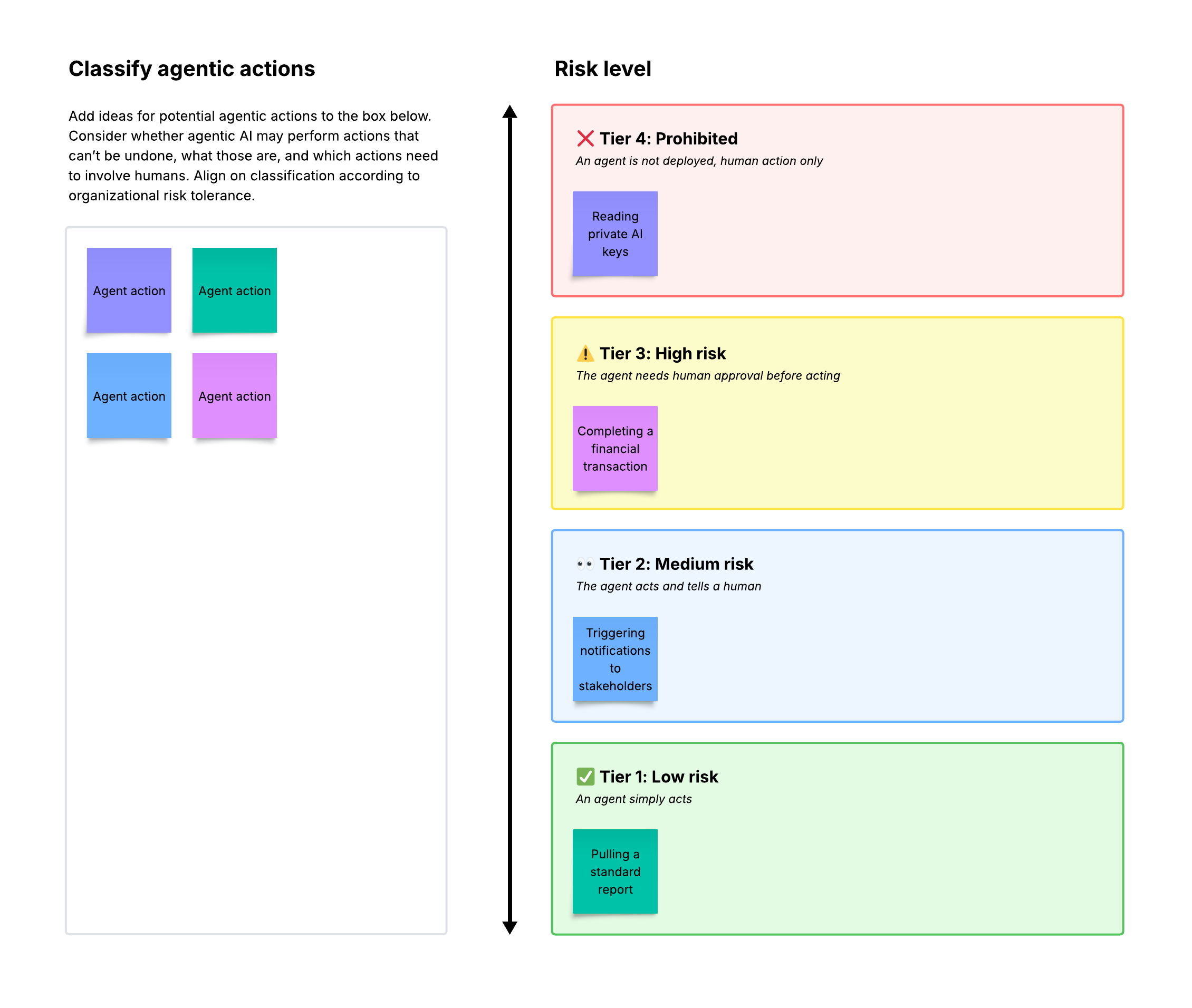
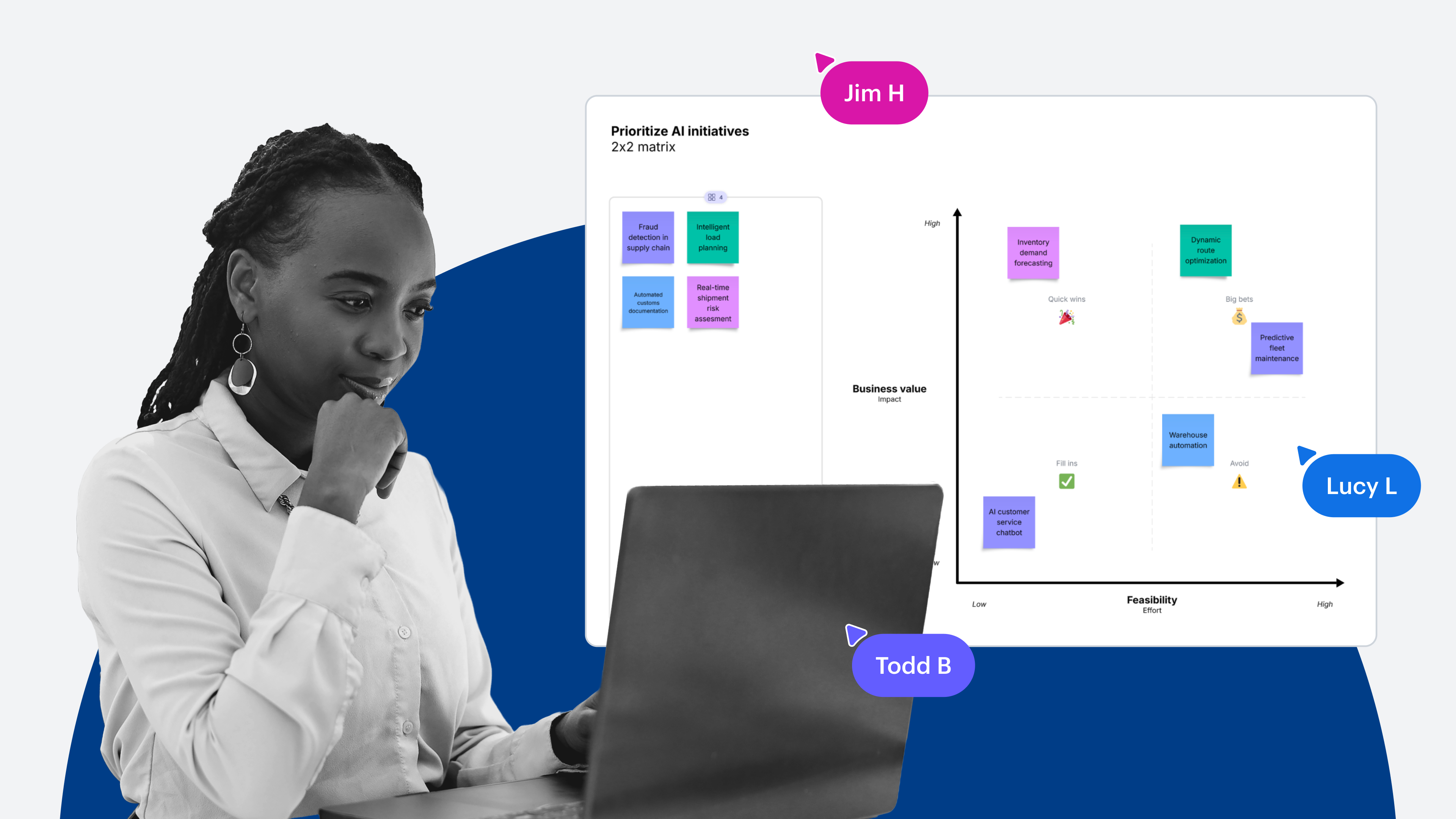
Classifying risk and impact should be a collaborative process. Use a shared visual canvas to determine agent purpose and scope. With a visual collaboration solution like Lucid, you can brainstorm use cases for agentic AI, leave comments, and loop in different stakeholders. You can even use Lucid’s Visual Activities to gather input from all stakeholders and reach consensus on where agents should be deployed and what’s considered to be low risk or high risk.
Step #2: Identify clear owners
The next step in AI governance is to document accountability and clearly define ownership ahead of agentic deployment. Determine where human-in-the-loop workflows are needed, including monitoring and approvals, and who will be assigned to them.
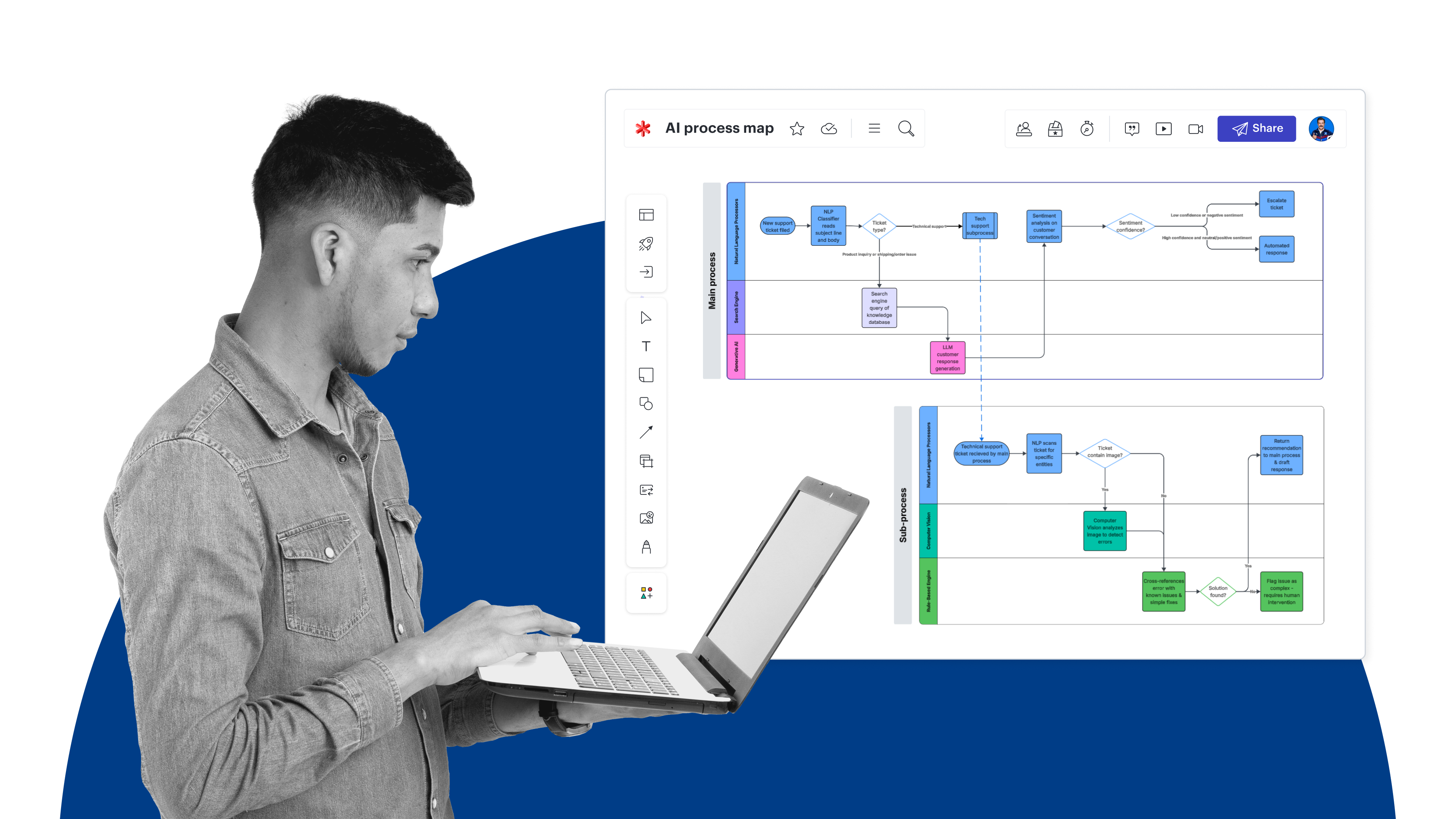
To identify and define ownership, create process diagrams to visualize a workflow. With Lucid, you can quickly diagram workflows with the Process Agent, an interactive AI tool that helps you build process diagrams and define triggers, owners, and specific steps.
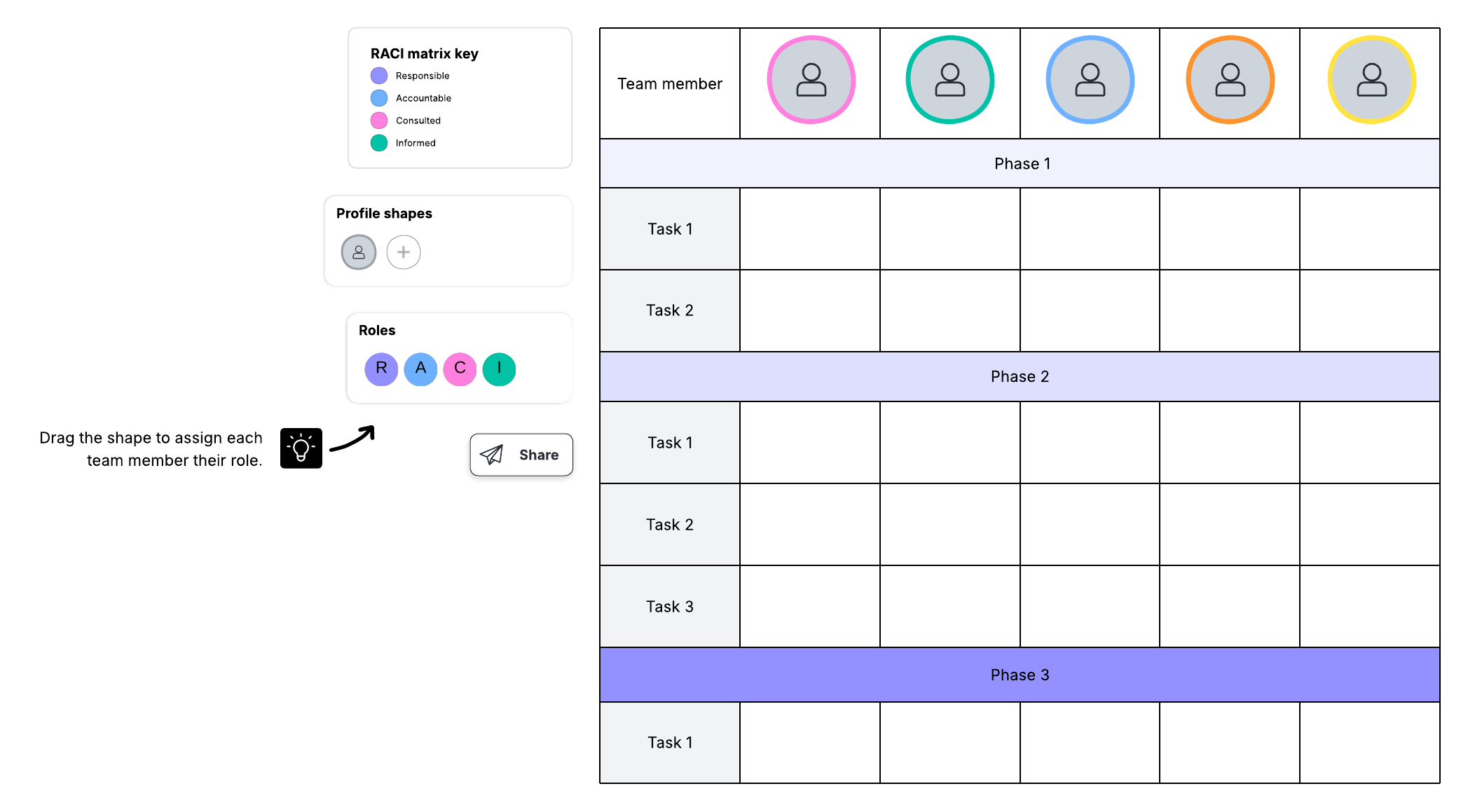
Then, you can use a RACI chart template to clarify who will be responsible, accountable, consulted, and informed for each task or step. RACI charts are an extremely helpful reference if an AI agent makes a wrong decision within a workflow.
Tip: Remember, agentic AI is different from generative AI, and agents are not code. Agents are non-deterministic by design (meaning that as they run, they will produce different outputs or behaviors, even if they’re started with the same input or initial conditions). You need to govern an agent’s behavior and boundaries, not just their source.
Rosenbaugh explains, “An AI agent follows your written processes exactly, at machine speed, and never stops to ask whether the process is wrong. How do you keep something like that from confidently doing the wrong thing across a critical workflow?”
In answering this question, you should implement key ownership controls such as mandatory verification checkpoints and boundary audits. Require the agent to stop before executing certain actions and provide step-by-step reasoning logs to enable human oversight before those actions can proceed. You can also test the agent in a sandbox environment before live deployment to verify it adheres to operational constraints.
Step #3: Define boundaries and scope
This step of your governance plan should answer these questions:
What data does the agent have access to, and what can it do with that data?
What decisions can agents make (or are limited to)?
Defining data boundaries includes input data, static system data, and approved process documentation. In Lucid, you can use conditional formatting on data flow diagrams to highlight sensitive data and visualize data lineage. Lucid’s enterprise architecture integrations (such as with LeanIX and Ardoq) allow you to securely connect system documentation with process documentation, since agents need to access systems to perform tasks.
For an additional layer of security, you should create standardized data structures and adhere to them to ensure the agent operates within verified guardrails. With Lucid’s Process Accelerator, you can enhance standardization in how your organization stores documentation with official repositories and approval workflows. The repositories MCP server, available in the Process Accelerator, helps ensure that agents follow only approved, official processes.
Step #4: Establish a data change and incident response plan
Agents operate in an evolving environment; data is constantly changing, and workflows also continue to adapt. As scope and context shift over time, what will you do?
Establishing a data management plan (and an incident response plan) is an essential final step before agentic deployment. If there is an incident, such as an agent acting out of bounds, you need fallback procedures to refer to, and a kill switch may be necessary to prevent further action. You can use visual diagrams to compare what the agent was supposed to do against what actually happened.
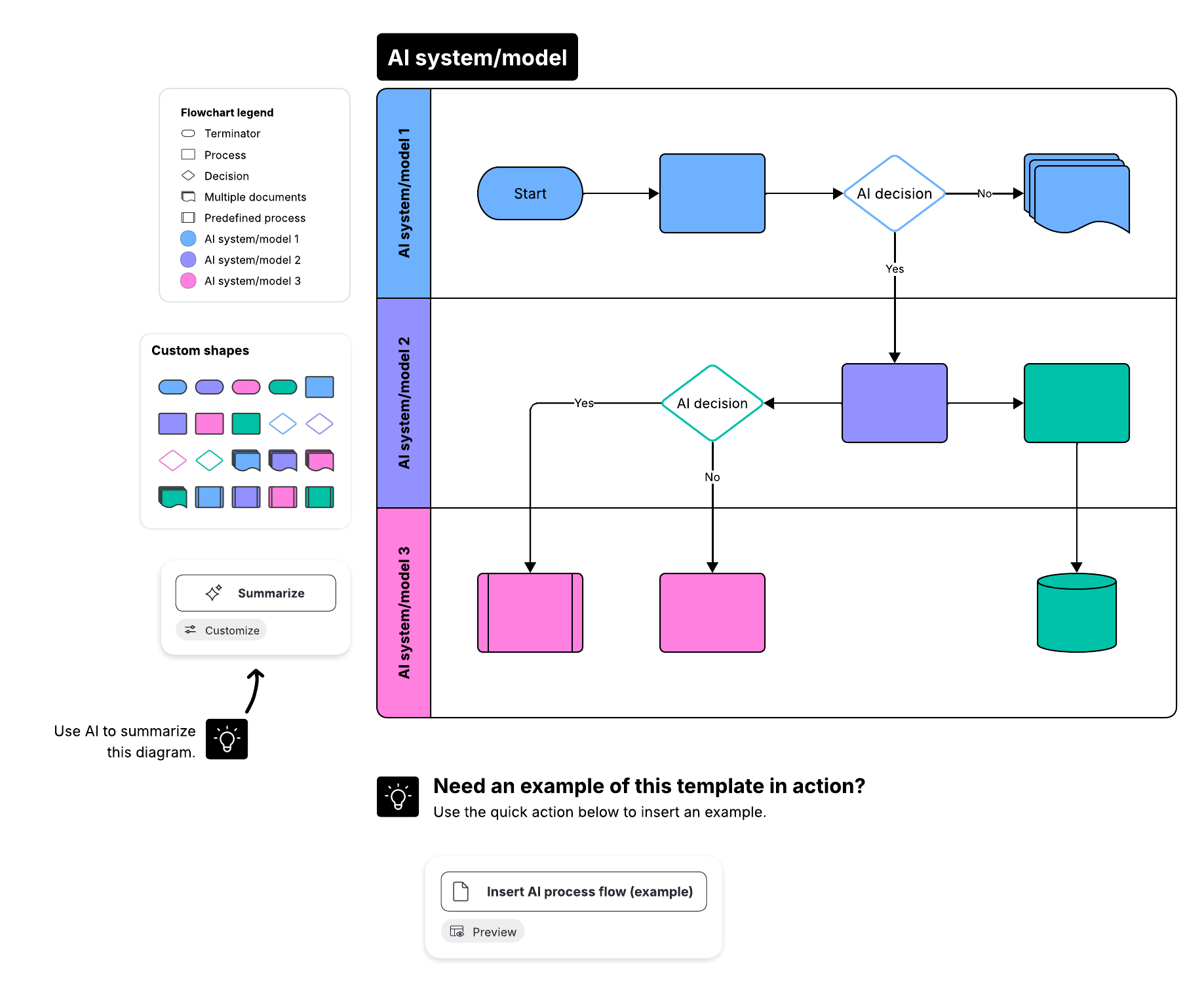
Deployed agents also require ongoing evaluation and drift monitoring. For successful governance, you need to establish real-time monitoring, comprehensive audit logs, and explicit protocols. Creating a plan for this ahead of time helps maintain alignment as systems evolve.
It also helps to have this information in a centralized place that’s accessible to all the people you’ve identified as responsible for deployment or should otherwise be informed. All documentation that defines agentic workflows, including purpose, authority, scope, and permissions, can live in Lucid as a single source of truth. Centralizing these resources makes it easier for people to understand the controls in place, monitor for drift, and identify what happened if something went wrong.
Craft your strategy to implement AI initiatives
Many companies are considering using agentic AI within their workflows. But do you have the governance pillars in place to make sure you’re actually ready?
To move from strategy to execution, organizations need a visual platform that brings clarity to complex AI deployments. Lucid is the layer teams use to build an understanding across the organization so that people and agents are all working from the same context. By visually mapping out workflows and aligning on controls and boundaries before agents go live, you can ensure your governance strategy supports automation while safeguarding your enterprise against critical risks.
Learn more about how you can build a scalable, trusted framework to implement AI across your business.

How to create an enterprise AI strategy
Learn the core components of a successful AI strategy that delivers real ROI.
Read more