Key takeaways
-
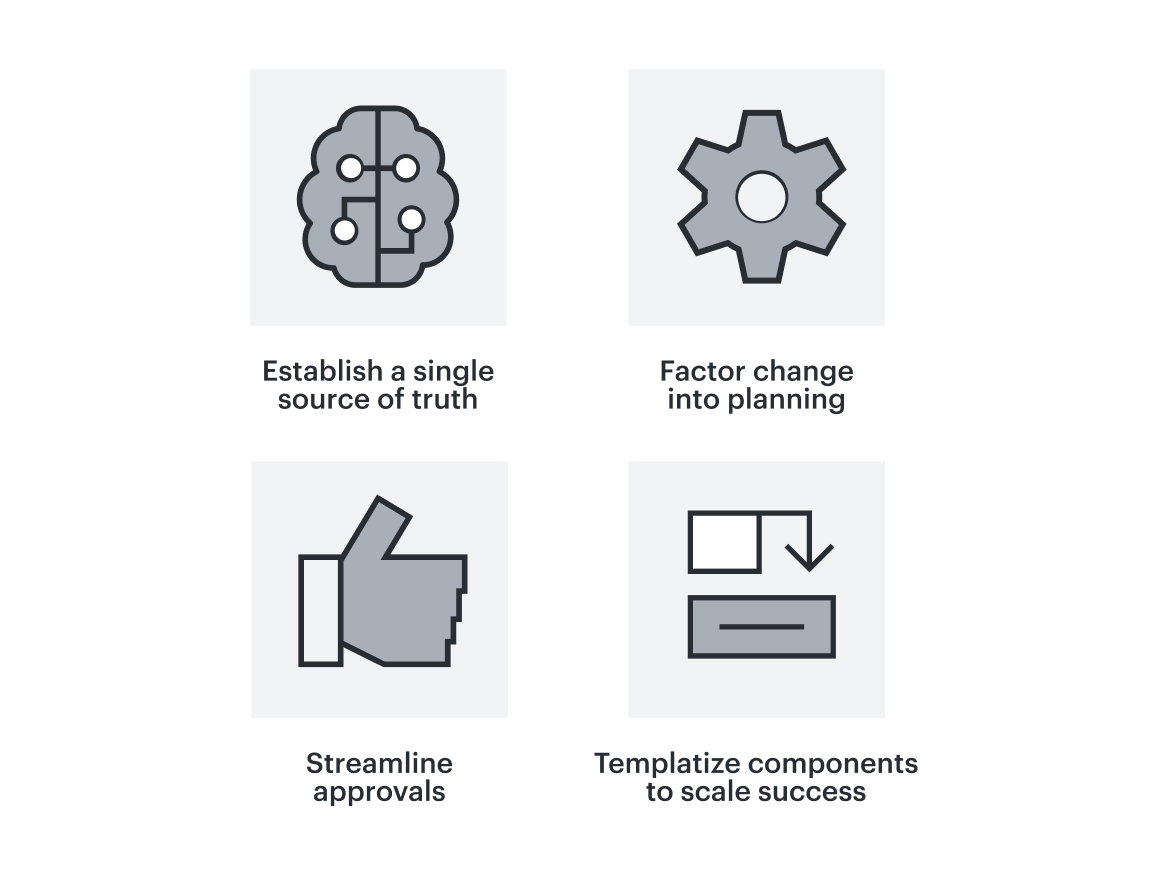
To prepare for AI modernization, government agencies should establish a single source of truth in Lucid and centralize workflow mapping to build the visual infrastructure AI modernization solutions require.
-
Factor change into planning by using interactive scenario modeling and dependency mapping to evaluate downstream impact before executing AI modernization pivots.
-
Streamline approvals with Lucid’s Process Accelerator to automate triggers, eliminate bottlenecks, and ensure consistency when implementing AI in the public sector.
-
Templatize components to scale success across government teams using standardized visual assets and pre-vetted AI and automation in public sector workflows.
Government agencies face immense pressure to modernize with artificial intelligence, but adopting AI isn’t as simple as flipping a switch. In fact, the 2026 list of State CIO Top 10 Priorities ranks safe AI adoption as the number one priority. Between navigating compliance hurdles and legacy system constraints, many leaders find themselves stuck in a cycle of analysis paralysis, unsure of where to safely begin.
To become AI native, agencies must adopt systems of action and use live documentation to protect institutional continuity and de-risk AI deployments. But for AI modernization, an agency’s greatest asset (deep institutional knowledge) can become its greatest hindrance. If your processes exist only as tribal knowledge, your AI can’t automate what it can’t see or understand.
In this article, we’ll break down four strategies the public sector can adopt to achieve successful mission-driven AI modernization.
1. Establish a single source of truth
Clear documentation is the foundation for implementing AI in the public sector. Mapping processes in a visual collaboration solution provides team members with the structural data they need in an easily digestible format, while building the necessary infrastructure AI agents require to navigate your agency’s logic.
Effective documentation doesn’t mean pages and pages of text and legal jargon. When processes and systems live in a central location, teams are instantly empowered to work with clarity. By brainstorming and mapping workflows in the same environment where your team performs daily work, you drastically reduce context switching. This practice produces high-fidelity, auditable artifacts organically, making it easy for new hires or returning team members to get up to speed.
For an agency navigating complex frameworks such as FedRAMP, FISMA, or NIST, a centralized approach transforms compliance documentation from an administrative tax paid at the end of a cycle into a living, real-time reflection of the system architecture. With a solution like Lucid’s Process Accelerator, leaders can establish secure repositories to house approved assets such as process, system, and architecture diagrams, establishing an unshakeable single source of truth across the entire organization. The Process Accelerator also empowers leaders to efficiently manage process governance, ensure consistency, and streamline compliance with built-in approval flows.
2. Factor change into planning
Change is inevitable. While no process or system remains static, the key to resilient operations, especially when moving towards AI modernization, is anticipating and modeling those shifts before they disrupt your agency. When you design a visual strategy within an interactive system of action, you can easily map out the impact of potential scenarios—eliminating the guesswork of what a pivot will cost you.
For example, if you need to simulate how reallocating taxpayer dollars or grant funding will affect your bottom line, you can model the entire adjustment visually. Imagine sitting in an executive briefing and having the documentation to show, “If we shift team members to this sudden, unfunded mandate, we can see exactly which secondary programs will defer their milestones.” That gives you and the entire team confidence to make decisions and plan the best next course of action.
To test changes and different scenarios without altering live documentation, scenario planning becomes imperative. In Lucid, you can sync with your existing system of record and analyze strategies in draft mode without altering live documentation. Additionally, leveraging dependency mapping helps teams visualize downstream changes, proactively identify bottlenecks, and effectively mitigate risk.
Use dependency mapping in Lucid to visualize how implementing AI and automation in the public sector will affect your workflows.
Visual planning strengthens organizational alignment by clearly linking granular tasks to high-level, strategic objectives. With the rise of AI modernization, fast-paced, iterative development is more important than ever. Building a visual blueprint and practicing flexible planning de-risks the implementation of AI in the public sector, ensuring you know the exact cost of change before you execute.
3. Streamline approvals
Once you figure out how to pivot, those changes need to be approved. Your single source of truth is tested when the unexpected occurs, such as a public health update or a shift in interagency mandates. In these high-stakes moments, the bottleneck isn’t an agency’s willingness to act on change; it’s the siloed approval pipeline.
Approvals exist for a reason. Within the public sector, strict governance and safety protocols are essential. But in an AI-augmented environment, traditional approval bottlenecks become even more dangerous. It’s vital to remember that AI solutions for modernization can either scale clarity or scale chaos. Without a streamlined way to act on change, AI agents will continue executing outdated instructions while your team members have already moved on. In a world where technology moves faster than policy, agencies have to enter a cycle of pivoting, approving, and taking action.
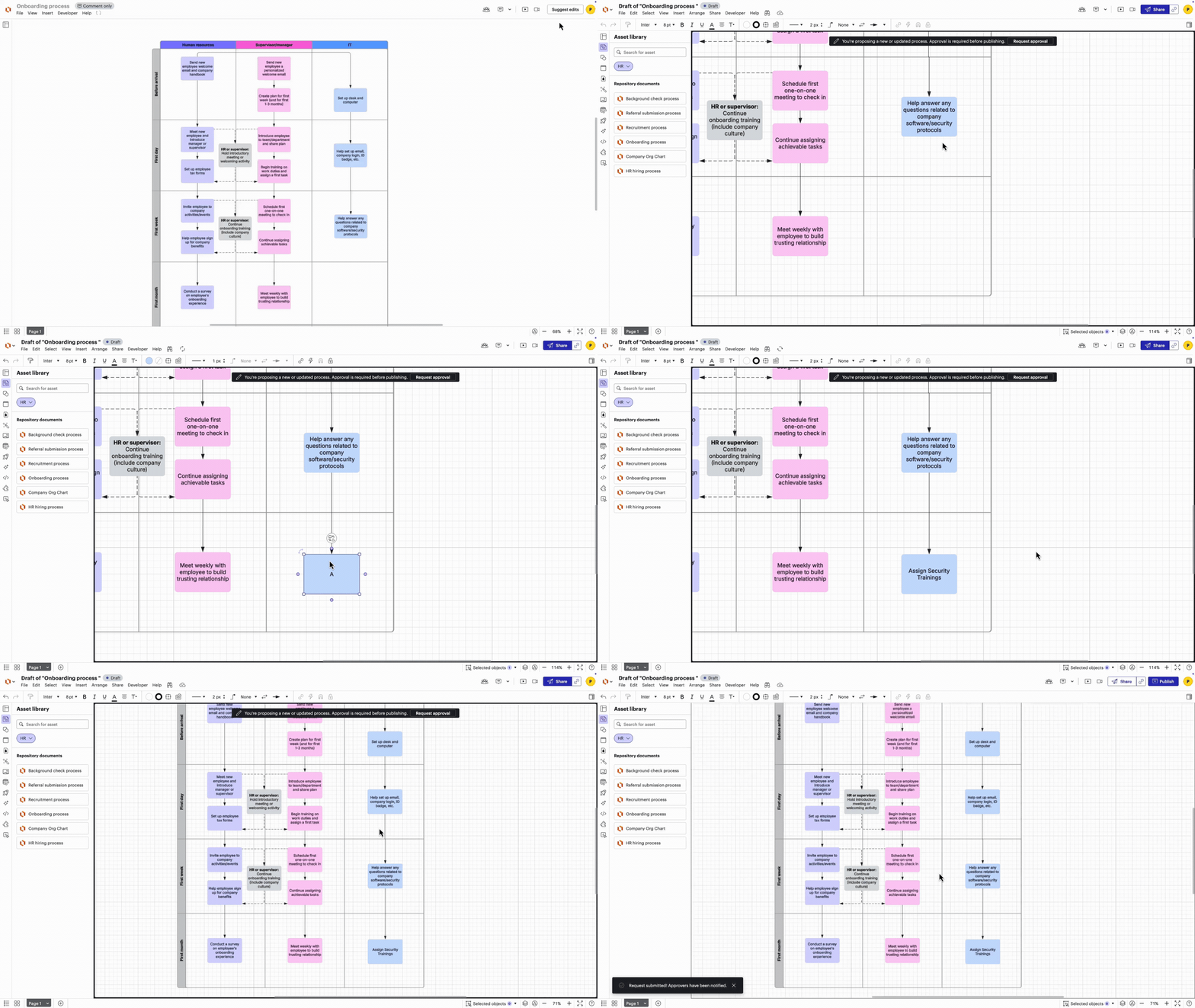
With the Process Accelerator, public sector agencies can streamline and automate the approval process to eliminate heavy manual overhead. By replacing slow pipelines with automated triggers and visual clarity, leaders can efficiently align stakeholders and secure institutional uniformity faster.
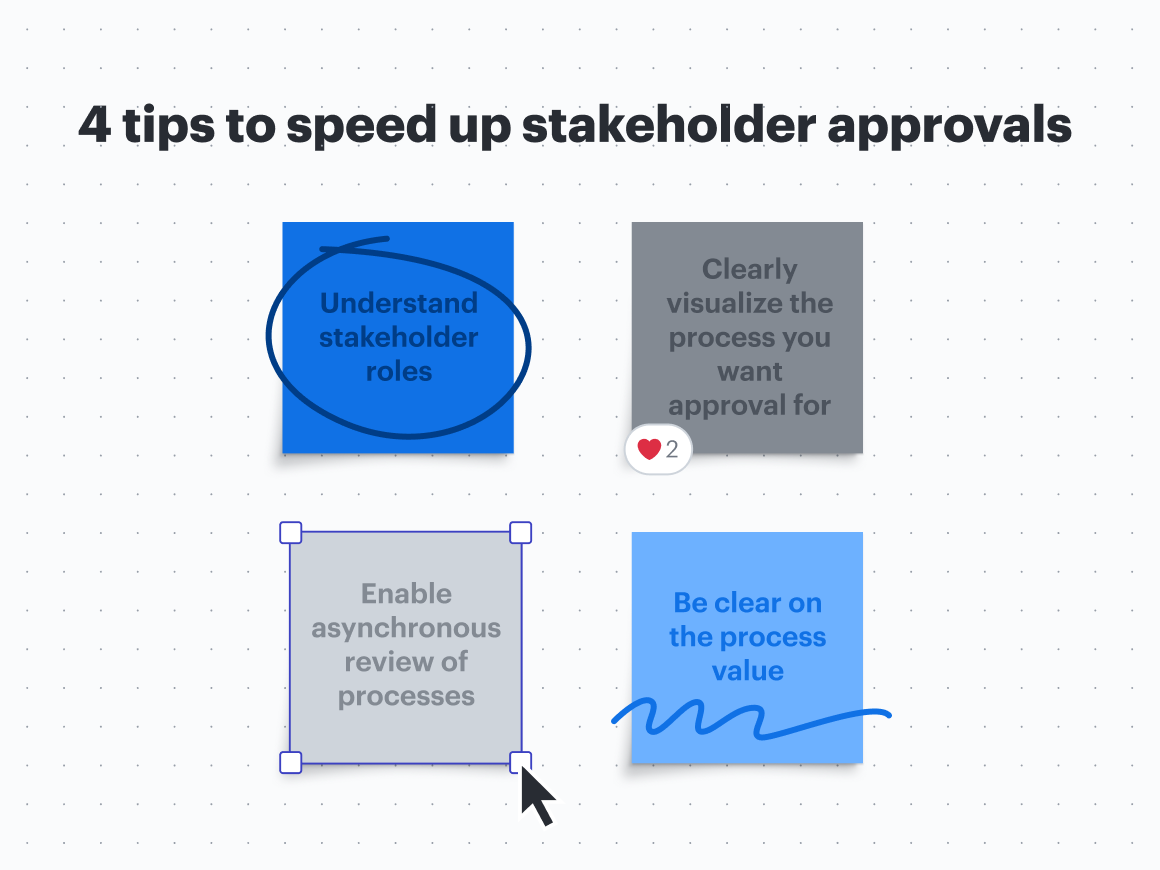
Tip: Do you have multiple stakeholders that need to sign off? For approvals to run smoothly, be sure to:
-
Understand stakeholder roles
-
Clearly visualize the process you want approval for
-
Enable asynchronous review of processes
-
Be clear on the process value
4. Templatize components to scale success
As agencies grow, they have to ensure they aren’t reinventing the wheel with every new initiative. When your team builds proven, successful workflows, you can templatize them for reuse. Sharing these blueprints across teams and departments ensures that nobody has to start from scratch.
To achieve a state where your organization is truly AI-ready, leaders should move away from custom-building every solution and build a bank of standardized assets that can be used indefinitely. By standardizing your visual language, you ensure that when one team discovers a more efficient way of working, the rest of the organization instantly inherits that success.
Documenting your processes, systems, and other institutional knowledge in a shared space makes it easier to adopt successful frameworks across teams. For example, you can create custom templates in Lucid for repeated events like sprint planning, so teams can spend less time setting up the board and more time doing the actual work while still leveraging best practices.
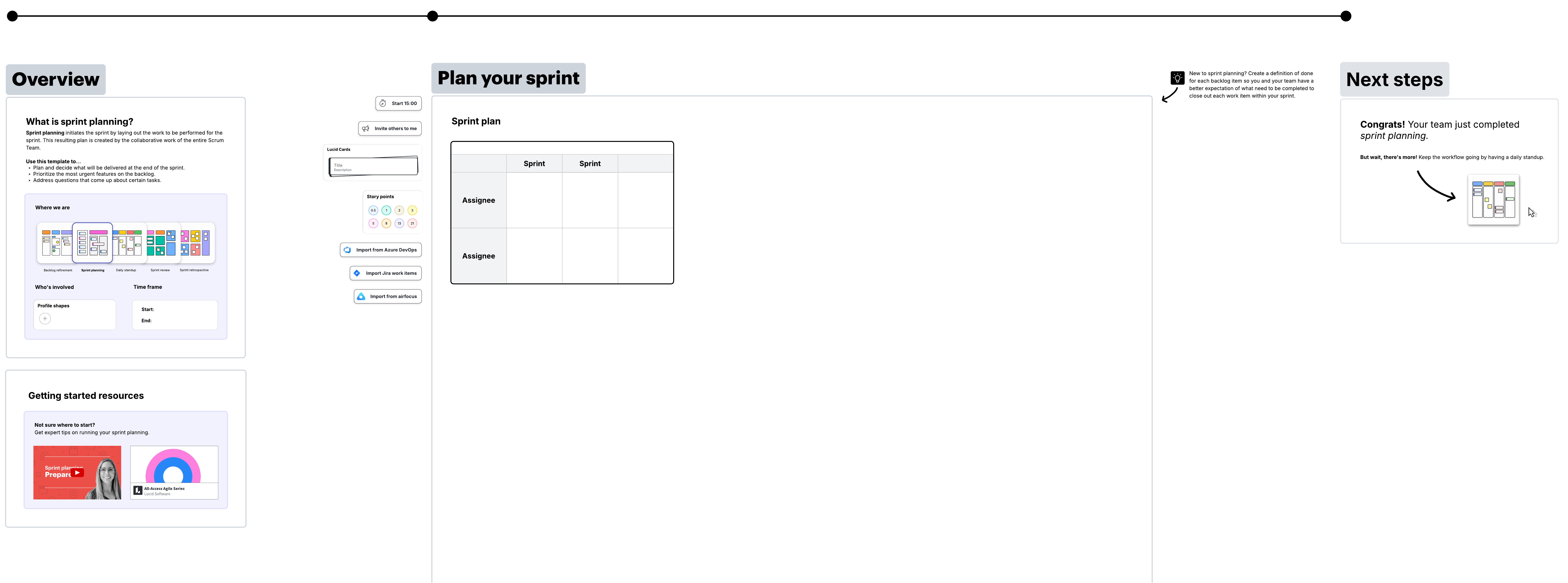
Tip: Within the sprint planning template, or any of our Lucid templates, you can use Lucid AI to brainstorm and organize ideas, summarize the contents of your meeting, integrate with other apps that supercharge teamwork, and more.
Note: Lucid AI is not available in our FedRAMP environment, Lucid GovSuite.
The Process Accelerator also enables you to build a centralized library of commonly used assets. This library allows team members to leverage pre-vetted, high-performance components while building out complex architecture. For example, if you have a successful security audit process, you can save it as a template and easily add it as a subprocess to a larger workflow.
When these core assets are updated, the changes are deployed wherever the assets are used, saving time and maintaining compliance across the organization.
Many organizations have seen greater individual efficiency with AI, but they haven’t been able to scale those benefits to safely deploy AI modernization initiatives. With a work acceleration solution like Lucid, you hardcode high-performance components directly into the agency's DNA and ensure compliance with streamlined process governance.
These four strategies are the foundation for public sector agencies to become AI-native. When both humans and systems are aligned, processes are rebuilt for the future, keeping the mission as the priority.
Read real-world examples of how Lucid has helped public sector agencies achieve modernization.
Take me there