Key takeaways
-
Driven by a digital-native workforce and the evolution of AI, project management is shifting toward enterprise-wide agility. An agile PMO applies business agility across all corporate functions, valuing outcomes and adaptability rather than rigid processes.
-
The benefits of an agile PMO include delivering continuous value, maximizing collaboration, and pivoting quickly.
-
To practice agile project management, leaders must maintain lightweight governance and focus on real-time business outcomes rather than output metrics.
A project management office (PMO) is central to helping all the different departments of an organization move quickly in the same direction. Since a PMO needs to constantly adapt to meet the business where it’s at, many PMOs are feeling pressure to adjust more quickly than ever before.
For example, according to PMI’s 2025 Pulse of the Profession, only 20% of project managers report having strong practical AI skills, yet 74% of organizations plan to leverage agentic AI within the next two years. That gap is exactly the pressure PMOs are currently feeling.
We talked to Janie Leddy-Jones, Director of Program Management at Lucid, about how to bridge that gap and keep up with the pace of change. “From my own seat as a PMO director, the pace of change has never felt more acute,” she says. “AI is reshaping how teams plan and execute work in real time. Economic uncertainty is forcing organizations to make faster pivots with fewer resources. And the workforce itself has fundamentally shifted, bringing higher expectations for autonomy and speed. PMOs that don’t evolve alongside these forces risk becoming bottlenecks rather than accelerants.”
As businesses continue to look for ways to become more effective and efficient, an agile PMO approach can enhance value by increasing transparency and alignment across functions for company-wide initiatives. Here’s a breakdown of what an agile PMO is, the benefits, and tips from Leddy-Jones about putting agility into practice for project management.
What is an agile PMO?
An agile PMO is an approach to project management that applies business agility across all teams and functions, not just technical teams. Rather than rigid traditional project management approaches, such as waterfall, an agile approach focuses on incremental delivery and better adaptability while enhancing alignment across teams.
You might use a traditional PMO for projects that have firm and known requirements, such as a strict deadline or budget, or for projects that require an established, repeatable process. You’d use an agile PMO for projects that are more flexible or experimental.
At its core, agile PMO focuses on objectives and desired outcomes, whereas traditional PMO focuses on deliverables. “In an agile PMO, you remove the assumption that ‘delivered equals done,’” Leddy-Jones explains. “Done isn’t achieved until you actually reach the desired outcomes.”
While many Agile teams are already familiar with the MVP, an agile PMO mainly focuses on the Minimum Testable Product (MTP), observing how customers react to and use the product first before continuing to build. An MTP is specifically about getting something in front of users to learn from and test core assumptions, not just ship a “minimum” version of the product. This approach shifts the frame from delivery to discovery, with primary goals of validating demand and gathering feedback.
The principle of MTP can be applied across business functions. For example, an HR team redesigning an onboarding experience might pilot the new process with one cohort before rolling it out company-wide. A finance team introducing a new budgeting workflow might test the workflow with one business unit first. In each case, the goal is the same: Get something real in front of the people who will use it, learn quickly, and adjust before investing further.
PMO and agile: Traditionally at odds, now joining together
Traditionally, project management offices and Agile teams operated with completely different mindsets about how work should be done (and what constitutes success). PMOs typically focused on predictability and control, while Agile was created in direct response to the rigidity of the waterfall approach, emphasizing speed, adaptability, and autonomy.
Recently, traditional PMO has undergone a massive cultural and operational shift, bridging the gap between project management and Agile. With an agile PMO, companies can be more focused on clearing roadblocks and maximizing the delivery of value. A recent example of this change is how the Project Management Institute (PMI) acquired Agile Alliance. Together, these companies created the Manifesto for Enterprise Agility, signaling a shift toward broader, enterprise-wide agility that expands beyond team-level Agile.
According to Leddy-Jones, this shift can be attributed to a combination of a few factors from the last five to 10 years:
-
A fundamental shift in the workforce, as people are now more digital-native and no longer tolerate waterfall processes. Employees have different expectations and mindsets; they want to move more quickly. On the customer side, people are expecting value and solutions sooner.
-
The AI evolution, which is causing rapid changes and market shifts. In general, companies need to be more flexible and adaptable.
-
Enhanced employee autonomy, as workers are more often given the freedom to determine how, when, and where they will complete tasks. Many employees now resist rigid project management.
The benefits of agile PMO
When companies choose to apply agility to all business functions, the benefits of an agile PMO include:
-
Achieving earlier signals and insights into what’s working, and whether continued investment is worth it
-
Enhancing the ability to meet customer needs and deliver value
-
Improving collaboration between teams as they adapt to change without derailing projects
-
Pivoting sooner to what’s more likely to succeed by delivering smaller increments more frequently
“With an agile approach to PMO, if something isn’t landing with customers, you find out in months, not years. The pivot costs you a quarter, not your roadmap.”
—Janie Leddy-Jones, Director of Program Management, Lucid
PMO and Agile: 5 tips for leading a more agile PMO
How can you take on a more agile approach to project management? Here are some tips Leddy-Jones has based on over five years of experience in leading a PMO.
Determine when to use traditional PMO versus agile PMO
There are times when a traditional approach to project management is still appropriate and the best choice. Understanding when to apply agility across business functions is the first step to being more agile when you need to be.
Traditional project management works best when requirements are well-defined upfront and unlikely to change significantly. Agile project management is better suited for situations where requirements are expected to evolve based on feedback and teams need faster delivery or a quicker response to change.
If you’re debating whether to take a traditional or agile PMO approach, here is some guidance:
-
Traditional PMO is a better fit when the steps are fixed, the deadlines are regulatory, and there’s no room for iteration mid-cycle. Payroll processing is a perfect example, as annual compliance audits and contract renewals all follow the same pattern. Success in this case means executing reliably, not discovering something new along the way.
-
Agile PMO is better when you have a hypothesis about what might work, but you won’t really know until you run a cohort through it and gain some learnings. Use agile PMO if the requirements will evolve as you get feedback. Examples include redesigning company-wide onboarding or launching a sales enablement program.
-
A hybrid approach is best for large-scale system implementation, such as rolling out a new human resource information system (HRIS) or new enterprise resource planning (ERP) software. The core configuration and data migration follow a sequential approach because those steps have dependencies, and you can’t iterate on them mid-flight. However, the change management, training, and adoption alongside these rollouts can be much more agile as you learn what’s working with employees and adjust in real time.
Implement an agile PMO structure
An agile PMO structure is more flexible than traditional PMO and supports rather than dictates, prioritizing collaboration and adaptability over rigid governance. The structure reflects a servant leadership model, where the PMO exists to serve the teams. This approach means pushing decision-making closer to where the work is actually happening, rather than centralizing it, empowering teams to make decisions as they learn.
An agile PMO’s main focus is on facilitating communication and removing impediments or blockers for teams. This project management style requires maintaining what Leddy-Jones calls “just enough governance”—lightweight, consistent standards that create alignment without creating bureaucracy. Examples of lightweight standards include:
-
A shared “project health check” format that allows teams flexibility in how they track progress toward outcomes, key risks, decisions needed, and team health. A shared format creates consistency across the PMO without dictating how each team works from day-to-day, so teams aren’t drowning in reporting overhead while leaders get the signals they need.
-
A standard “definition of ready” checklist that any team can use before kicking off a new initiative. With this standardized checklist, key stakeholders are identified, success metrics are defined, and dependencies are mapped, saving weeks of misalignment downstream.
Agile PMO roles and responsibilities also vary from traditional PMO in that team members act as coaches and enablers, not just process police officers. In practice, this might look like a PMO team member embedded in a sprint review or big room planning session to help the team connect their work to company-wide OKRs, rather than waiting for a status report at the end of the quarter. This approach is a meaningful shift from the traditional PMO model.
Use a visual collaboration solution
At its core, an agile PMO requires significant collaboration and transparency. A visual collaboration solution like Lucid enables that collaboration and transparency, bringing everyone together into one space and making it easier to track progress for both teams and stakeholders. With digital boards, people can more readily engage during project planning, and you can easily share documents to gather stakeholder input.
In Lucid, agile PMOs can use features like dependency mapping to visualize potential dependencies and breakout boards to facilitate group discussions. You can also track workload and measure progress with shapes like progress bars and ownership charts, powered by live data.
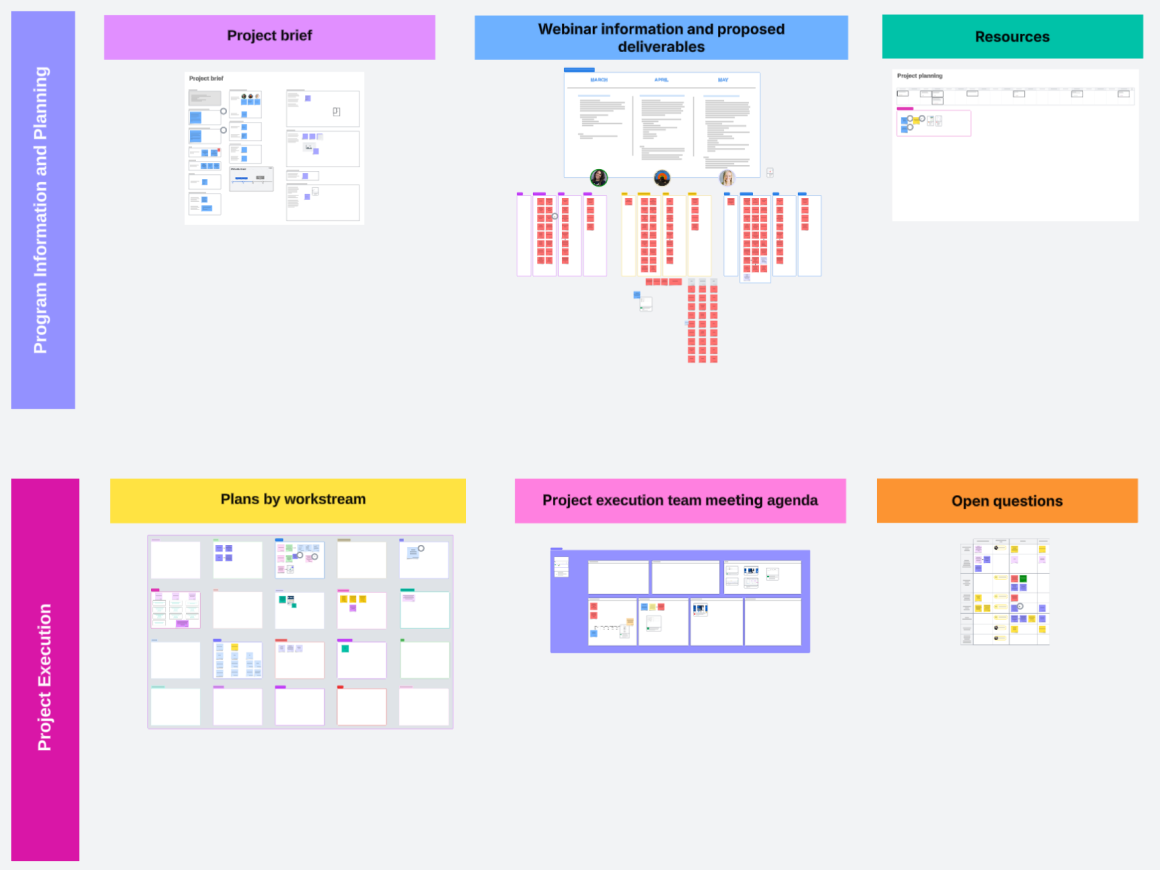
An example of using dependency mapping to visualize the relationship between tasks.
It’s important to choose a solution that integrates with your existing system of record, especially if you work with technical teams. For example, Lucid’s integrations with Jira, ADO, and airfocus feature a bi-directional sync, so a change in a Lucid board is automatically reflected in Jira. Having a way to centralize and visualize work is invaluable for agile PMOs.
Leverage templates and standardized documentation to increase agility
A PMO is involved in many cross-functional and team meetings. Using templates to facilitate those meetings creates a lightweight standardization and consistency that can be scaled across the business to increase overall agility. With templates connected to live data, it’s easy to include up-to-date information that enhances decision-making.
The following templates are valuable for agile PMOs and reduce friction for any kind of team:
-
Project kickoff templates, which document goals, success metrics, key stakeholders, and risks at the start of any initiative. Project kickoffs are universally used, and help teams move faster by getting aligned upfront.
-
Decision log templates, which help teams track what was decided, by whom, and why. Using a decision log reduces re-litigation of past decisions and maintains momentum.
-
Retrospective templates, which guide the regular practice of reflecting on what’s working and what isn’t. A lightweight template makes it easy to run a retrospective in 30 minutes.
-
A stakeholder communication plan, which keeps teams and leadership aligned without requiring heavy status reporting. This plan is typically one page that’s updated regularly.
-
OKR planning templates, which help teams anchor work to outcomes rather than task lists.
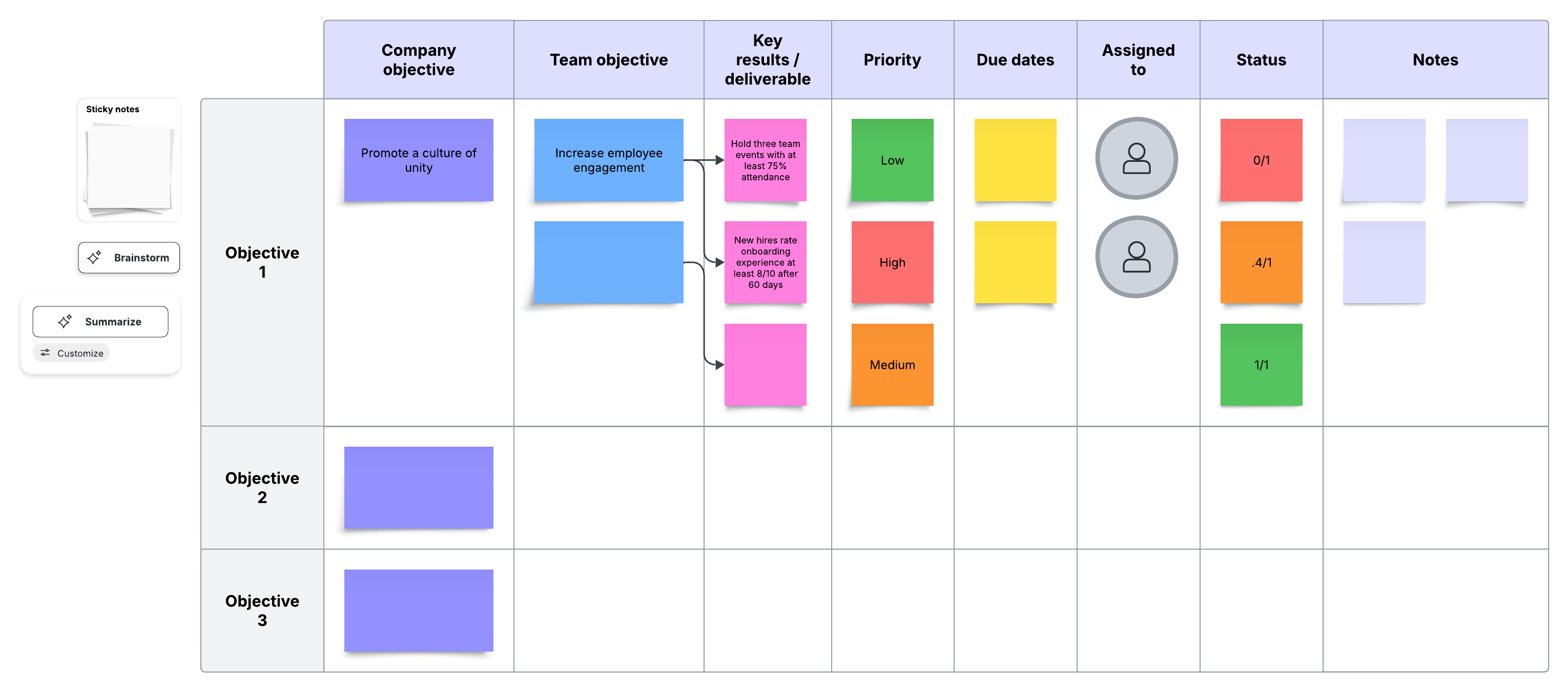
While these templates support agility for everyone, an agile PMO may also commonly be involved in Agile events for teams that already practice Agile. You can use templates for these events as well, such as sprint planning, daily standups, and PI planning.
Incorporate agile PMO metrics and reporting
The core shift in agile PMO reporting is to move away from output metrics (i.e., “Did we deliver on this?”) to outcome metrics (i.e., “Did delivering this actually move the needle?”).
In practice, agile PMO reporting means tracking metrics such as:
-
Business outcomes: These are metrics that tell you whether the investment was worth it, such as ARR impact, customer adoption and usage rates, and conversion metrics.
-
Delivery health: Use metrics such as cycle time (how long it takes from an idea to being in customers’ hands), how often teams meet sprint commitments, and how quickly impediments are resolved.
-
Team and process health: Are retrospectives leading to real process improvements? Are teams gaining velocity over time, or are they plateauing?
-
OKR progress: Rather than tracking task completion, agile PMOs stay anchored to whether the team is moving toward the outcomes they committed to at the start of the quarter.
In an agile PMO, the reporting cadence is different, as well. Rather than a monthly status deck, agile PMO reporting is more continuous and lightweight. Agile PMOs often use a living dashboard that reflects the current state, enabling leaders to make faster decisions. The goal is to have fewer surprises and to achieve more course correction in real time.
Continue to meet business needs as an agile PMO
“The most important thing for a PMO to be successful is to meet the business where it’s at, providing practices that people will actually adopt, not just ones that look good on paper,” Leddy-Jones says. “If you’re not flexible, teams will find their own path, and the PMO loses its seat at the table.”
Meeting the business where it’s at requires a PMO to operate less like a standards body and more like a partner. This starts with understanding the project management maturity of each business function. Some teams are ready for full sprint ceremonies and OKR tracking, while others are just figuring out how to run a project kickoff. Rather than enforcing a one-size-fits-all model, an effective agile PMO adopts a tiered approach: crawl, walk, or run. Find the early wins, build trust with function leaders, and gradually work toward consistency.
The PMO that earns adoption earns influence. The one that mandates process without earning trust often gets bypassed. And, remember, staying in touch with what works for employees is not a one-time action, but an ongoing process.
Ready to explore being an agile PMO? Learn more about using a visual collaboration solution like Lucid for flexible, adaptive planning that enhances alignment and agility across teams.
Explore capabilities that support an agile PMO
Read about the ways Lucid helps enhance agility across the business and prepares teams for change.
Learn more