Key takeaways
-
AI tools significantly impact innovation by accelerating decision-making and streamlining manual tasks, enabling people to focus on collaboration and ideation.
-
Using AI for innovation requires strong governance, secure data, and prioritizing human-AI collaboration over purely relying on AI outputs.
-
Teams can use AI to synthesize customer research, conduct rapid prototyping, and optimize their marketing strategies. AI can also be used to align product roadmaps with customer needs as companies bring their innovative products to market.
AI is completely redefining how people develop innovative solutions, creating more business opportunities and unlocking new ideas. How can people use AI for innovation successfully?
If your strategy for AI-driven innovation stops at asking a chatbot for ideas, you’re leaving the best insights on the table. To truly unlock potential, using AI for innovation requires guardrails, clear direction, enablement, and a back-and-forth dialogue between AI and humans.
We talked to Christopher Bailey, Director of Consulting Services at Lucid, about the ways people can use AI to boost innovation, from initial fact-gathering to analyzing a product launch. Here’s a breakdown of how and when to use AI for innovation.
What is AI’s impact on innovation?
AI has transformed innovation through advancements in automation, generative models, and autonomous agents. With a variety of AI tools, people can more quickly bring outside opinions or information into conversations, test their ideas, and accelerate diverse thinking.
A foundational impact on innovation is that AI has improved speed and enabled faster decision-making by streamlining what traditionally required a lot of manual effort: gathering ideas, sorting content, and surfacing themes. By simplifying many aspects of the innovation process, AI allows people to focus more on the ideas themselves, encouraging creativity and experimentation. AI also brings benchmarking more directly into conversations by enabling outside input and additional research more quickly, helping people unlock new business opportunities and maintain a competitive advantage.
Considerations and challenges of using AI for innovation
With all the benefits of using AI for innovation, it can be easy to jump right in. However, it’s important not to become overly reliant on AI tools and remember that human creativity and analysis remain as essential to innovation as ever.
Companies should establish best practices to ensure people understand when AI should be used and the potential limitations or risks. Here are some tips for using AI for innovation wisely:
-
Build the guardrails first: Innovation stalls when teams are afraid of breaking the rules. By setting clear ethical frameworks, data governance policies, and usage standards upfront, you give employees the safety to experiment without risking company data or reputation.
-
Secure data: AI’s effectiveness depends on the quality of the data it’s given and the AI algorithms. Organizations should enhance their data strategies by focusing on data quality and unified access as practices are put in place to ensure employees understand the limitations of AI.
-
Emphasize human-AI collaboration: AI can’t completely replace human creativity and oversight. Generative AI in particular parrots what it’s been fed, so instead of getting novel ideas, you often get what currently exists, and you want to define the market, not simply keep up with it. Effective innovation requires collaboration between humans and AI, leveraging both AI outputs and human insight and strategy.
Ideation in particular should not be anchored to AI output. “Since AI predicts the statistically most likely output based on historical data, relying on it too early in the ideation process creates a restrictive anchor point that smothers novel human thoughts,” explains Bailey. “AI should be used to compile raw facts. Then, humans can draw conclusions and creativity from there.”
How to use AI for innovation
To provide guidance on using AI for innovation, we’ll follow Lucid’s innovation framework, designed by experts with years of experience helping organizations build innovation pipelines. The framework outlines the stages of innovation in three phases: conception, validation, and growth, taking businesses from ideation to delivering a solution to market.
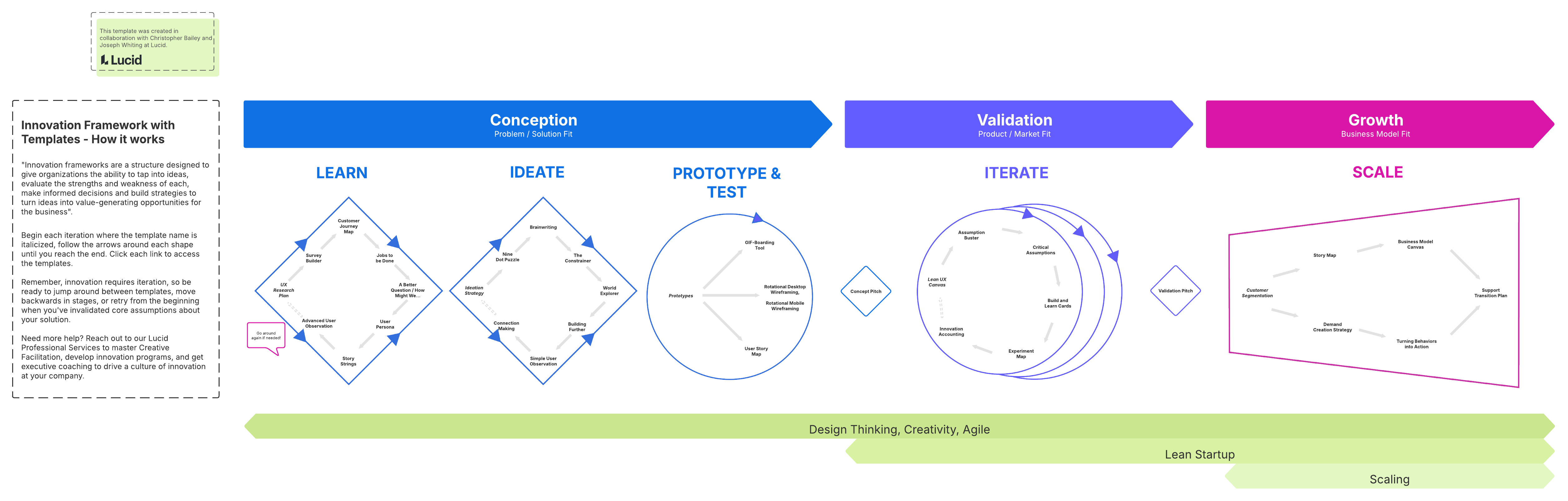
Here’s how you can use AI for every stage of innovation.
Conception: Learning and gathering research with AI
The first step to innovation is understanding the problems your customers face. As you conduct user research and collect data around your customers, you can use generative AI to streamline your research, such as synthesizing your observations from user interviews. You can also use agentic AI for landscape monitoring and trend detection, setting up an agent to handle deep research into the competitive landscape and summarize data. By automating this step and analyzing the results, you can leverage AI to inform your business plan and free up more time for innovative thinking.
AI can also be used for the ideation stage, but this is where it can get tricky. Remember, AI can’t fully replace creative thinking, but it can be used as another voice in the conversation. If you’re going to use AI during ideation, it should be after your team has completed brainwriting or another exercise, so you already have some ideas, and AI has multiple anchors to build off of.
For example, give a chatbot the ideas you have come up with and ask what you haven’t thought of, or ask it to challenge your assumptions. AI encourages divergent thinking and is useful for ideation when it’s treated as a teammate rather than asked to generate ideas on its own.
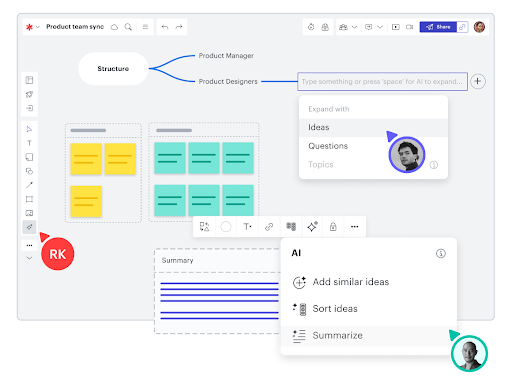
Once you have a list of ideas, you can use a tool such as Lucid AI to gather and sort them or generate summaries of entire boards in a matter of minutes. AI surfaces themes quickly to identify customer needs.
An important note: If you choose to use AI as a helpful tool during the conception phase of innovation, it should be used only to gather facts and ideas. Any decision-making based on those facts should be made by human beings. As Bailey explains, “AI is useful for getting started, but there should be back-and-forth collaboration between humans and AI here. And, as always, fact-check what AI is producing for you.”
Validation: Using AI to iterate on market fit
AI is highly useful when you’re ready to test your ideas and validate market fit. You can use AI to prioritize what to test, but rather than simply asking generative AI what it thinks you should test first, incorporate specific criteria into your prompt so it creates the right options.
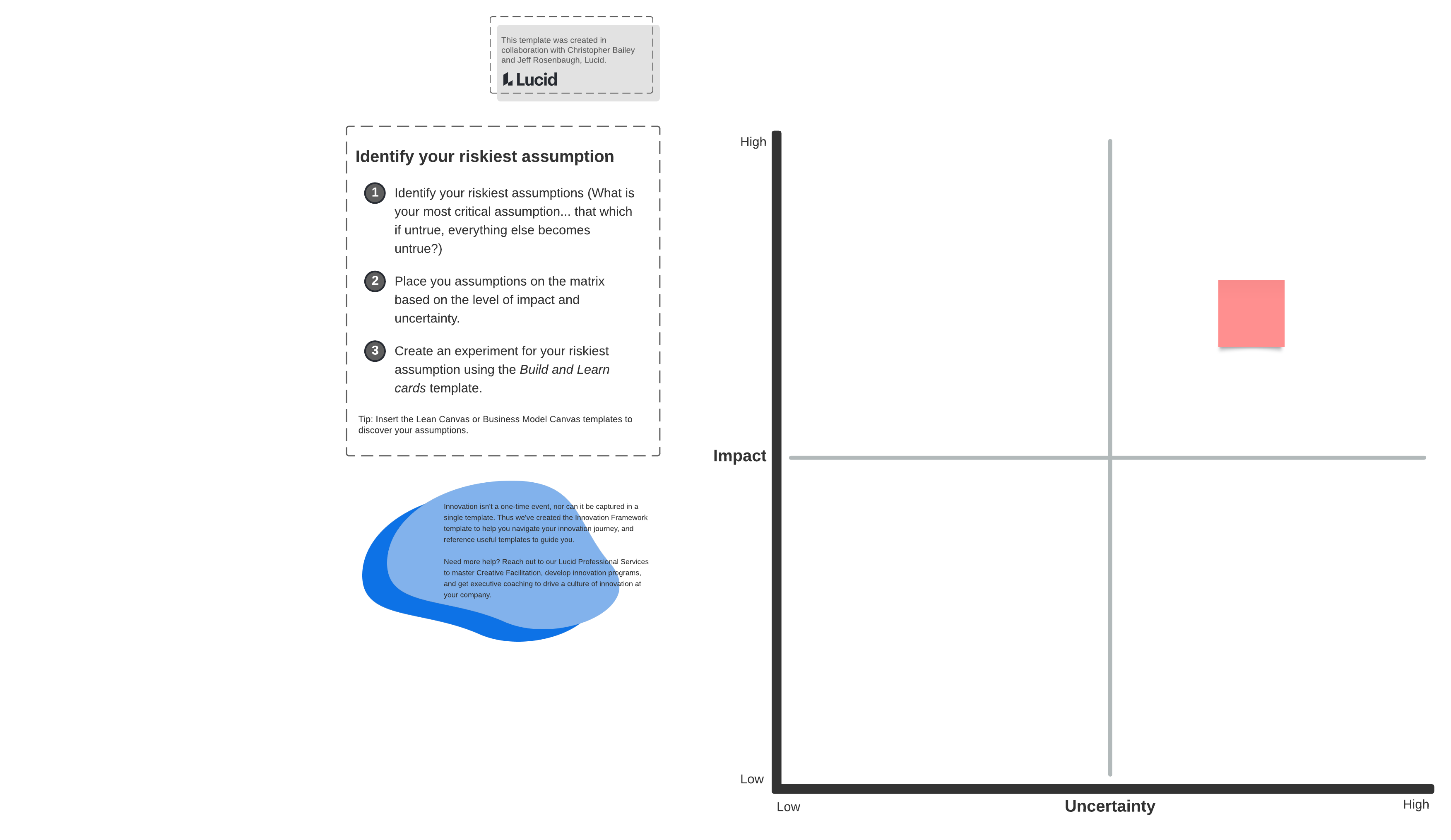
For example, it’s helpful to understand your team’s rate of learning. Prioritize ideas based on how fast your team can validate or invalidate critical assumptions (which are the core beliefs of feasibility, desirability, and viability that must be proven true in order for a new idea to succeed). Provide generative AI innovation metrics, such as learning rate and cycle time, as you determine which ideas are most useful to test.
You can also use AI for vibe coding and rapid prototyping. Start with generative AI to produce code, then use agentic AI to execute, test, and iterate on that code. Humans should be reviewing code and ensuring its security, but AI can dramatically accelerate the speed at which you prototype, test assumptions, and gather customer feedback.
By using AI at this stage, you’ll understand what’s clicking with customers and identify where to iterate quickly. If you’re doing in-market testing, you can immediately code a change and test on the fly with AI.
As you learn and iterate, ask generative AI to explore whether there are simpler ways to go about an idea that’s resonating with customers, or ask if there’s anything you’re missing. You can also use AI to test your critical assumptions—but remember, AI is prone to confirmation bias and most likely will be supportive of your ideas. Run a critical assumptions exercise with your team, or use build and learn cards, and check AI’s answers against human opinions.
Growth: Scaling success with AI
As you focus on bringing your new product or service to market, use AI to gain high-level strategies and insights and ensure that your roadmap actually aligns with customer needs. With AI tools for product management, you can catch strategic drift early, enhance decision-making at scale, and connect signal to strategy so you’re always working toward the right thing.
For example, an AI-driven platform like airfocus offers tools such as an AI Dashboard and an Insights agent to surface executive summaries and continuously analyze customer feedback to uncover patterns that humans may miss at scale.

You can also challenge generative AI to review raw customer feedback and assess whether your proposed product roadmap actually meets user needs. For example, ask AI to:
-
Explore whether there are different ways to stage your feature releases.
-
Look more closely at the dependencies between work items. Ask, “Would it actually be better if we launched this other feature first?”
-
Double-check your strategy and run a sense check by asking: “Do my current roadmap plans actually represent what customers are asking for?”
Remember to ask generative AI to explicitly tell you the truth; otherwise, it often will simply validate your input.
During the growth phase of innovation, you can also use generative AI to critique your marketing or demand generation strategies and provide suggestions to more specifically target audiences. Agentic AI can analyze real-time market data and consumer shifts, and help with demand forecasting, so you can continue to adjust to market signals over time.
Boost innovation from strategy to execution with Lucid AI
Ultimately, successful AI-driven innovation is about amplifying human ingenuity, not replacing it. By intentionally weaving AI into the conception, validation, and growth phases of innovation, businesses can accelerate their workflows while still valuing human strategy and creativity. The magic lies in deliberate back-and-forth collaboration between team members and technology.
With Lucid AI, companies are transforming the way they work and boosting innovation overall. Explore how Lucid’s intelligent features seamlessly streamline your innovation pipeline from strategy to execution.

A quick guide to Lucid’s AI features
With AI integrations, an MCP server, and built-in AI features, Lucid offers the capabilities teams need to enhance productivity and quickly execute on their ideas.
Read more